You start a photography business by choosing one paid category, building a portfolio in that single category, and selling to businesses that need images repeatedly rather than to individuals who need them once. The camera is not the decision. It has never been the decision, and treating it as one is the most reliable way to spend a year not earning.
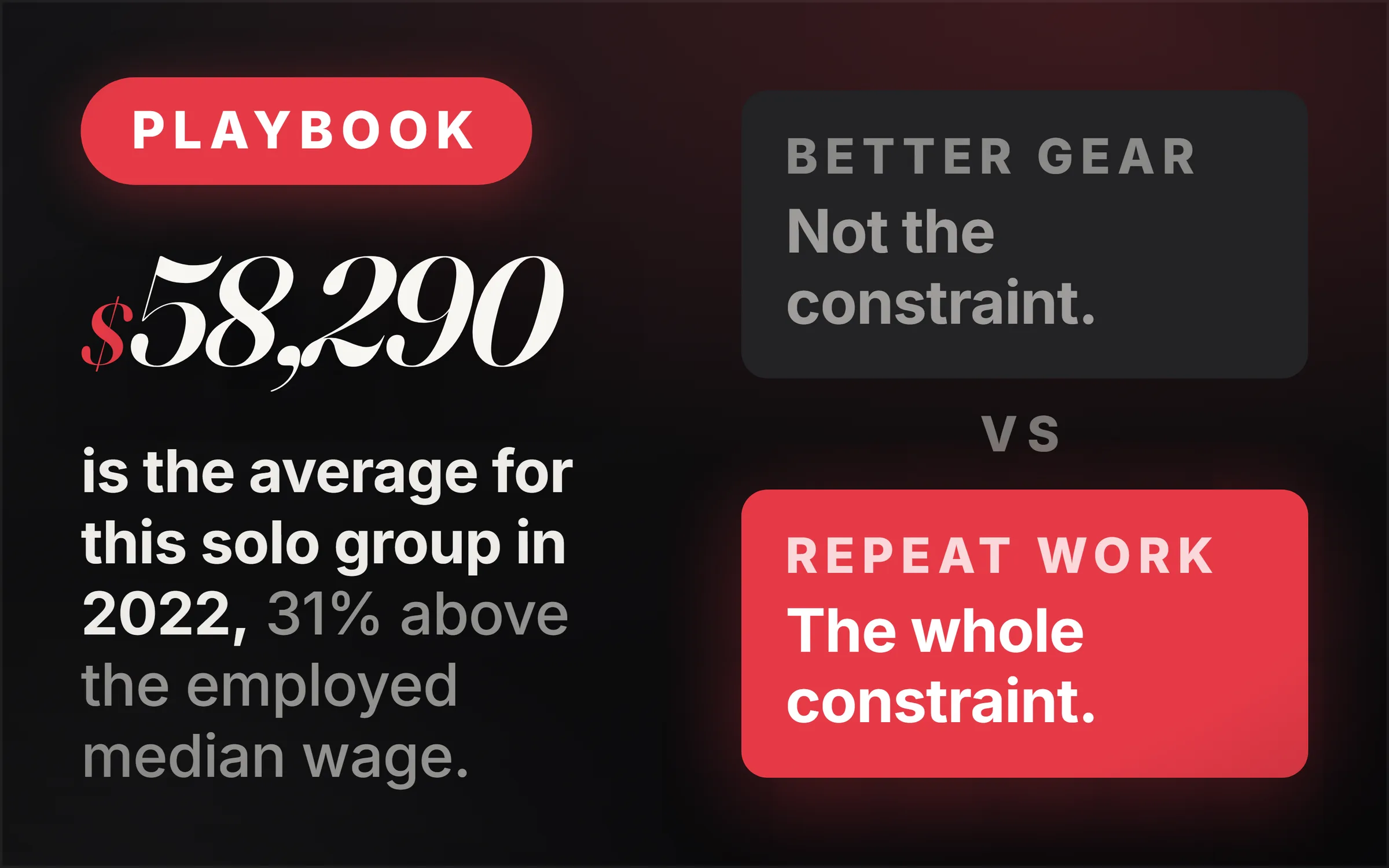
In 2022 the average solo firm in the Census group covering photography took in $58,290, across 1,186,677 establishments with no employees. The median wage for an employed photographer was $44,660 as of May 2025. The average solo business is 31 percent ahead of the wage on revenue, which puts this among the better-performing independent trades in the published data.
How much does a photography business make?
The average solo operator grossed $58,290 in 2022. That is Census Bureau Nonemployer Statistics for NAICS 5419, other professional, scientific and technical services, covering 1,186,677 establishments with no paid employees and $69.2 billion in receipts.
The caveat here is larger than in the other trades we have looked at. NAICS 5419 is a wide group: it contains photography alongside marketing consulting, translation, veterinary services and other professional work. It is the published population photography sits inside, not a photography-specific figure, and it almost certainly runs above what a photography-only average would be.
What can be said precisely is the wage comparison. BLS put the median for photographers at $44,660 a year, or $21.47 an hour, as of May 2025, with a high school diploma as typical entry-level education. Independent work in this broader professional group runs 31 percent ahead of that on revenue. Treat the direction as reliable and the exact figure as an upper bound.
The more useful signal is the firm count. At over 1.18 million solo establishments, this is the most crowded group in our data by a wide margin, which tells you the average hides an enormous spread between people earning nothing and people earning well.
Should you shoot weddings or commercial work?
Commercial, if the goal is income rather than a particular kind of day. The difference is repeat purchase, and it dominates everything else about these two businesses.
A wedding client buys once. Every booking requires a new customer, won through a competitive process, for a date that can only be sold once, in a season that occupies a few months of the year. The revenue per job is high and the cost of acquiring each job never falls, so the business restarts every year.
A commercial client buys on a cycle. A restaurant needs new menu photography each season. An estate agent needs every property shot. A brand needs product images for every launch. The first sale is harder and the price per job is lower, and then it repeats without further selling, which is the entire difference between a business and a sequence of gigs.
Weddings are a legitimate business and some of the best photographers in the world shoot them. But they are chosen for the work rather than for the economics, and anyone choosing them for the economics has usually not counted the acquisition cost of a customer who will never buy again. The general case for repeat buyers over one-off buyers is in how to get your second client.
What equipment do you actually need?
Enough to deliver the category you have chosen, and no more. For most commercial work that is one competent body, one or two lenses appropriate to the subject, a light, and a way to back up files reliably.
The reason to say this bluntly is that equipment is the single largest source of wasted time and money in this trade. Gear is enjoyable to research, it produces a visible sense of progress, and it postpones the uncomfortable work of finding a paying client. People spend months and thousands optimising a variable that stopped differentiating photographers years ago, because affordable cameras crossed the threshold of being good enough for commercial delivery a long time ago.
The item that genuinely matters and gets skipped is backup. You are being paid to hold something that cannot be recreated, and losing a client's files is the one failure in this business with no recovery. Two copies, in two places, before you leave the job, is the standard, and it costs almost nothing.
The correct order is to sell the work, then buy what that work requires. Renting for the first jobs in a new category is normal, cheap, and lets the client pay for the equipment before you own it.
How do you get your first photography clients?
By producing work in the exact category you want to be paid for, then approaching businesses that visibly need it. A portfolio of what you enjoy shooting does not sell what a business wants to buy.
The mechanism is specificity. A restaurant owner looking at landscape work and portraits cannot tell whether you can shoot food, and will not take the risk. The same owner looking at ten strong images of dishes from two other local restaurants has no question left to ask. Build the portfolio for the buyer, not for yourself, even if that means shooting a category speculatively to have something to show.
Then approach narrowly and locally. Businesses whose current images are visibly poor are the warmest possible prospects, because the gap is already obvious to them and they have usually been meaning to fix it. Showing them a small piece of what better looks like, before any discussion of price, converts far better than a rate card. That is the general shape set out in how to get your first client without asking for one.
The crowding in this trade makes one thing non-negotiable: you cannot be a photographer generally. At 1.18 million solo firms in the group, the generalist is invisible. The person who shoots interiors for local estate agents is not.
What should you charge?
By the job or the day, with usage stated explicitly, and never by the hour. Hourly pricing in photography is a trap because the shoot is a fraction of the work: editing, culling, retouching, delivery and file management routinely exceed the time on site.
The item most new photographers omit entirely is usage. What the client may do with the images, for how long, and in what contexts, is part of what is being sold, and in commercial work it is a large part of the value. A set of product images used on a website is a different sale from the same images used in paid advertising for two years, and pricing them identically leaves money on the table every time.
The second common error is pricing per image, which incentivises exactly the wrong behaviour on both sides and turns delivery into a negotiation. Price the engagement, state what is included, and state the number of final edited images.
Costs are lower here than in the trades, but they are not zero: insurance for equipment and liability, backup storage, editing software, and travel. If you have no basis for a first number, derive it from your own costs and capacity rather than from what other photographers appear to charge, using the method in how to price a service with no track record.
Is photography too crowded to start now?
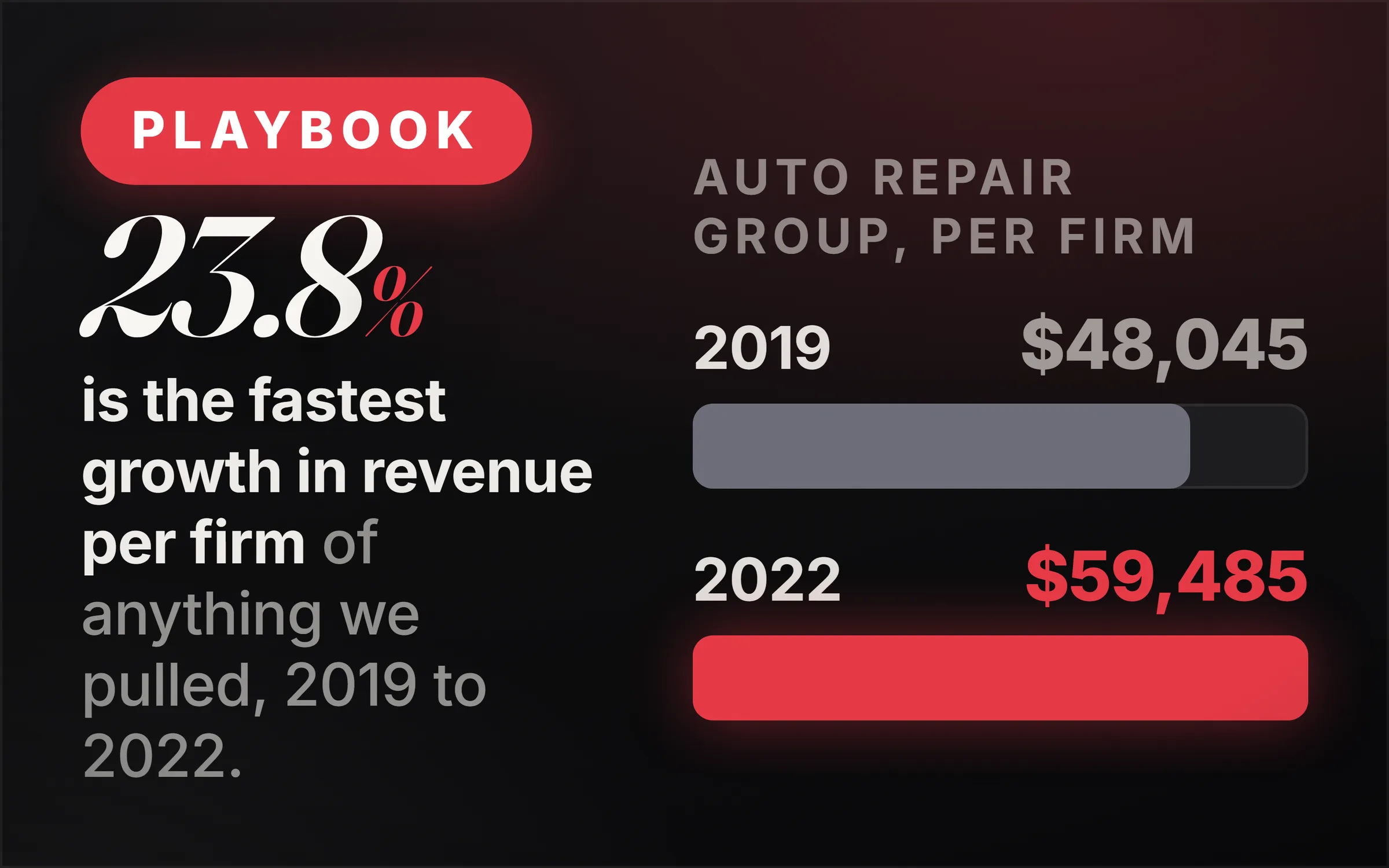
It is the most crowded group in our data and it is still growing in revenue per operator, which are both true and neither is the whole answer.
The crowding is real: 1,186,677 solo firms in this group in 2022. Cameras are cheap, phones are competent, and a very large number of people would like to be paid for this. That is why the bottom of this market is brutal and why unpaid or barely-paid work is so widely available.
What the crowding is concentrated in is the categories people want to shoot. Portraits, weddings and creative work attract enormous competition because they are desirable. Commercial categories that are useful rather than glamorous, which is product on white, interiors, food, industrial and documentation work, attract far less, and the buyers there are businesses with budgets and recurring needs rather than individuals spending discretionary money.
So the honest answer is that photography as an identity is oversupplied and specific commercial photography services are not. The people who struggle are competing for the work everyone wants. The people who earn are usually doing something less interesting to photograph and more valuable to buy.
The honest hard part
The hard part is that this is a business where the thing you love and the thing that pays are frequently different, and the data does not care which one you chose.
Most people enter photography because of the images they want to make, and the market rewards the images businesses need made. Those overlap sometimes and often do not, and the operators who earn well have usually made peace with a split: paid work that is competent and repeatable, and personal work that is why they picked up a camera. The ones who insist the two must be the same thing tend to be the ones in the lower half of that $58,290 average.
The second hard part is that reliability outranks talent in the buyer's mind, permanently. A business commissioning photography is buying a deadline met, files delivered in the right format, and an absence of problems. A more talented photographer who is slow to deliver loses to a competent one who is not, every time, and this surprises people who came in through the craft.
And the third is that the average conceals a distribution with a very long tail at the bottom. Over a million solo registrations in this group means an enormous number of people who bought a camera, registered a business, shot a few paid jobs and stopped. Being above that average is not a high bar, and being well above it requires the specific choices in this article rather than better photographs.
For how this trade compares with the others in the published data, see boring businesses: which ones actually make money.