
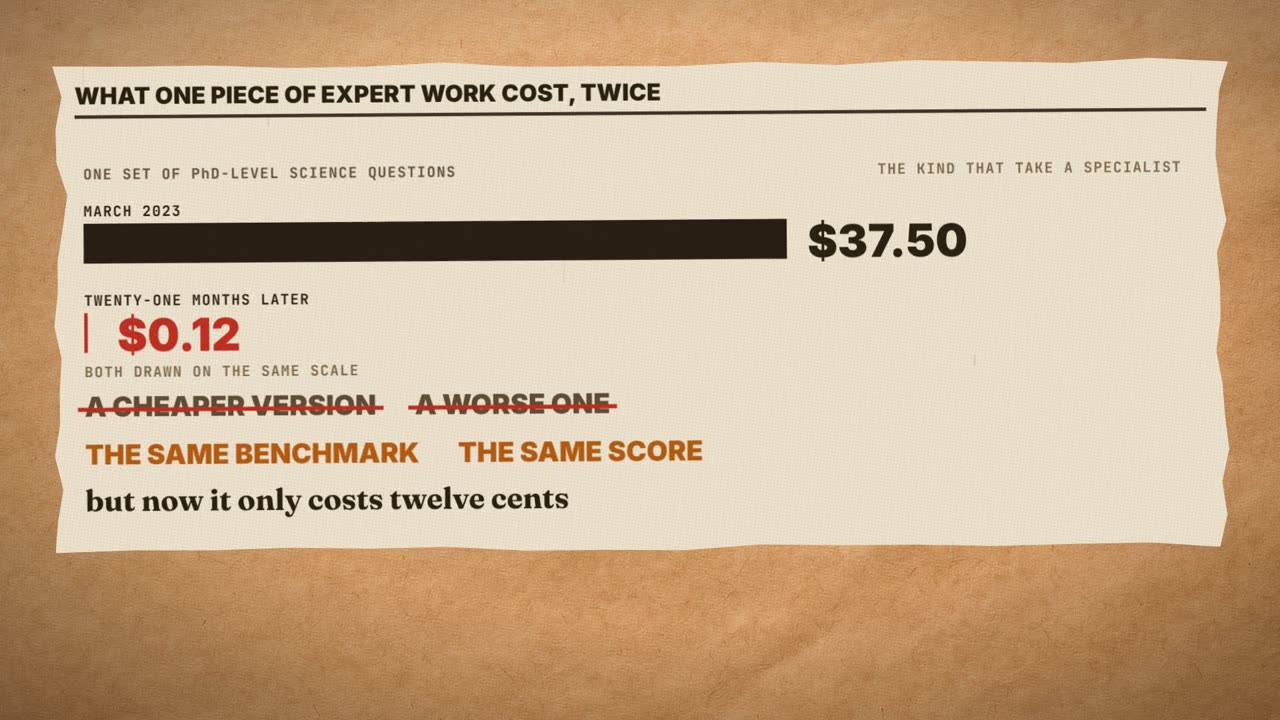
In March 2023, getting a machine to answer a set of PhD-level science questions cost thirty-seven dollars and fifty cents. Twenty-one months later the same work cost twelve cents: not a cheaper version, the same benchmark at the same score. In the same years, five companies, Amazon, Microsoft, Alphabet, Meta and Oracle, spent four hundred and sixty-four billion dollars in a single year on the equipment that runs it.
Both are true, and our 27-minute documentary for The Signal reads them both out of their own sources. Every figure is marked on screen for what it is: FILED, read out of a 10-K; REPORTED, journalism with an outlet and date; PROJECTION, a forecast said out loud as one; DISPUTED, both sides shown and neither settled. It predicts no date, gives no figure for what a human costs, and makes no claim that AI is cheaper in general. This piece follows it chapter by chapter.
The film in 10 chapters
Pick a chapter and the film starts there. 26:33 in all.
How much cheaper has AI actually become?
Watch from 0:56The fall is real
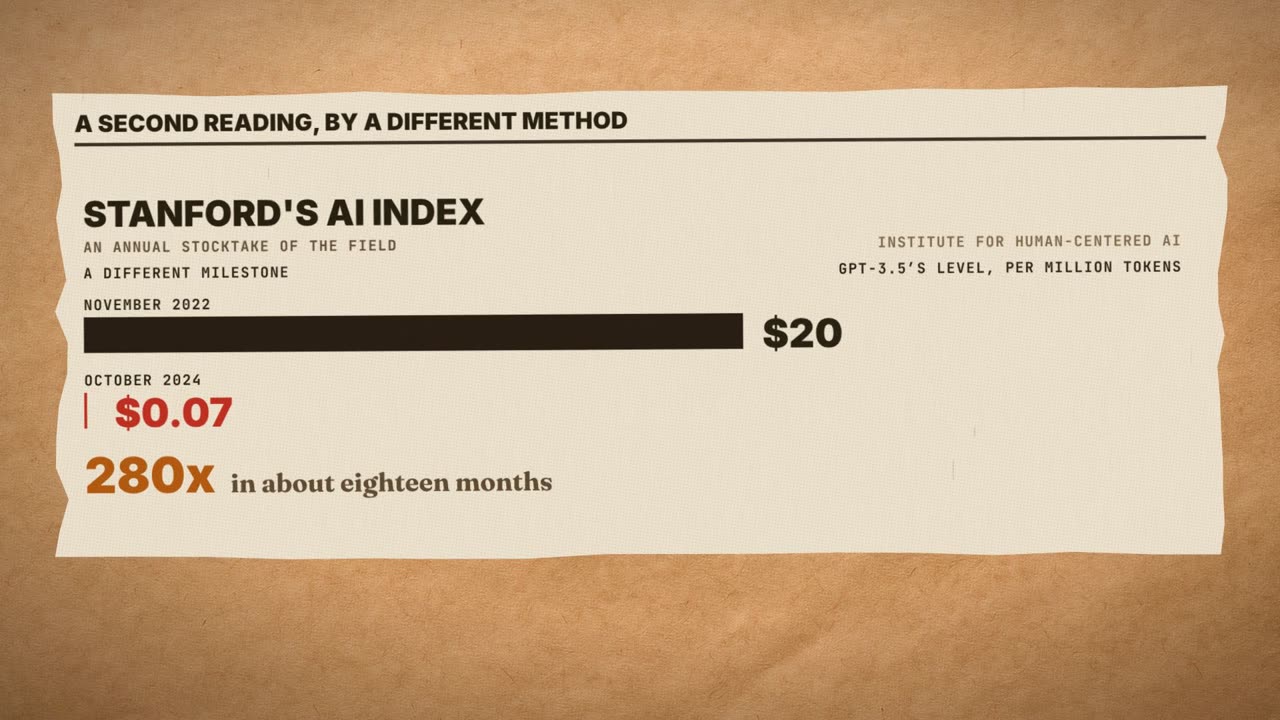
Hundreds of times cheaper, measured twice independently. Epoch AI found the price of reaching a fixed level of performance fell between 9 and 900 times a year depending on the benchmark, and about 40 times a year at GPT-4's level on PhD-level science questions. Stanford's AI Index found GPT-3.5-level performance fell from $20 per million tokens in November 2022 to 7 cents by October 2024, a 280-fold drop.
A token is roughly a word-fragment, the unit these systems are billed in, the way electricity is billed in kilowatt-hours. Underneath the fall, Stanford puts hardware costs dropping about 30 percent a year and energy efficiency improving about 40 percent a year. Epoch attaches its own caution: the fastest falls came in the most recent year it measured, so it is less clear those rates will persist. But it happened. And the companies whose computers everybody else's AI runs on spent more on equipment every year the price was falling.
How much are Amazon, Microsoft, Google, Meta and Oracle spending on AI?
$464.5 billion in their most recent filed year, read from their annual 10-K filings, the audited documents a company can be sued over. Amazon went from $52.7 billion of capital expenditure in 2023 to $83 billion in 2024 and $131.8 billion in 2025; Microsoft from $44.5 billion to $64.6 billion to $115.9 billion; Alphabet from $32.3 billion to $52.5 billion to $91.4 billion; Meta from $27 billion to $37.3 billion to $69.7 billion.
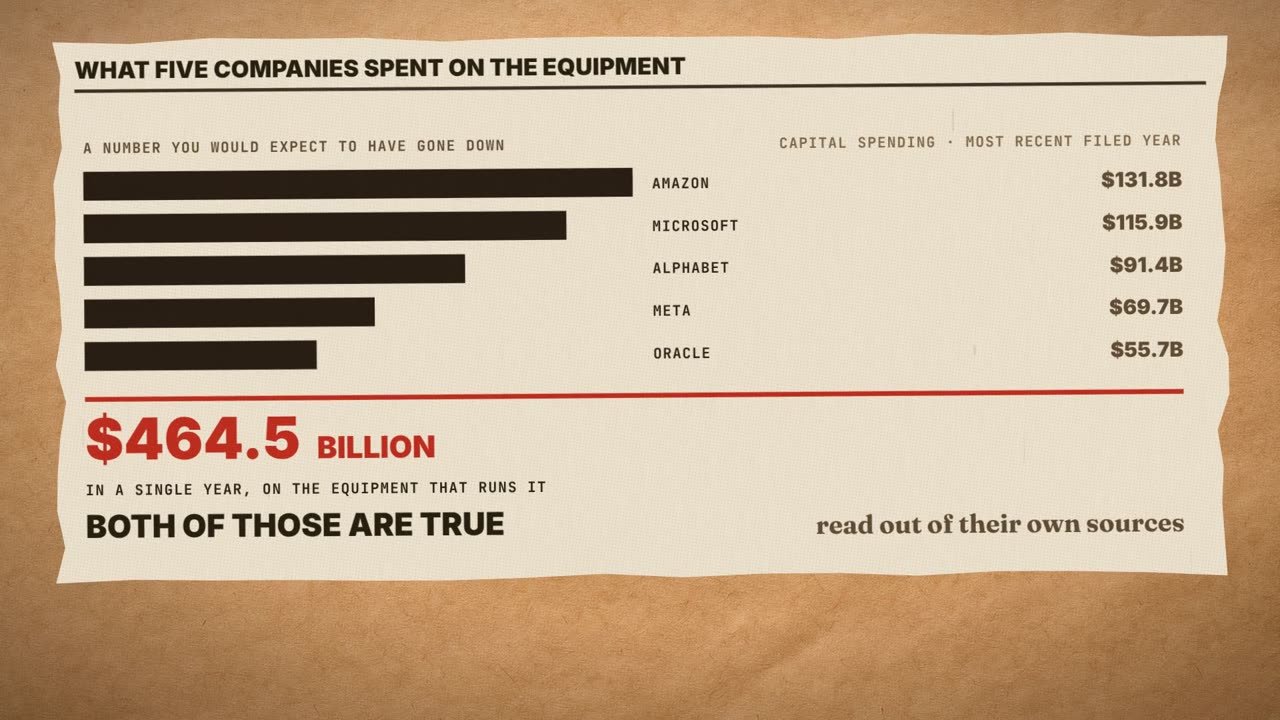
Oracle, selling databases since the 1970s, went from $6.9 billion two years earlier to $55.7 billion in its most recent filed year, an eightfold rise. The price per unit fell off a cliff and the total bill went up, which is not a contradiction; it is the oldest pattern in economics, seen with coal, electricity and bandwidth. But $464 billion did not evaporate. It was paid to somebody.
Who received the money AI companies spent?
Mostly Nvidia. Its filing for the year to January 2026 shows revenue of $215.9 billion, up 65 percent from $130.5 billion, net income of $120.1 billion and a gross margin of 71.1 percent. Its compute and networking segment went from $47.3 billion to $82.9 billion to $130.1 billion in three years. Of every dollar that came in, more than fifty-five cents stayed.
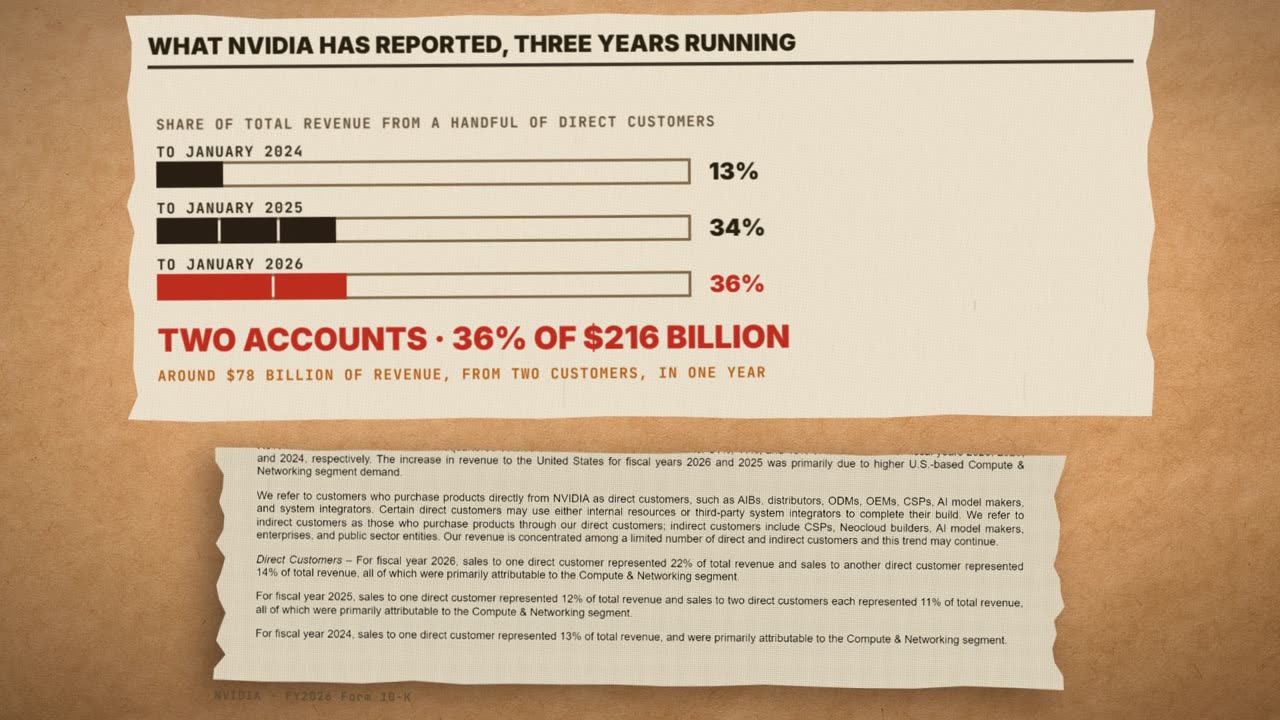
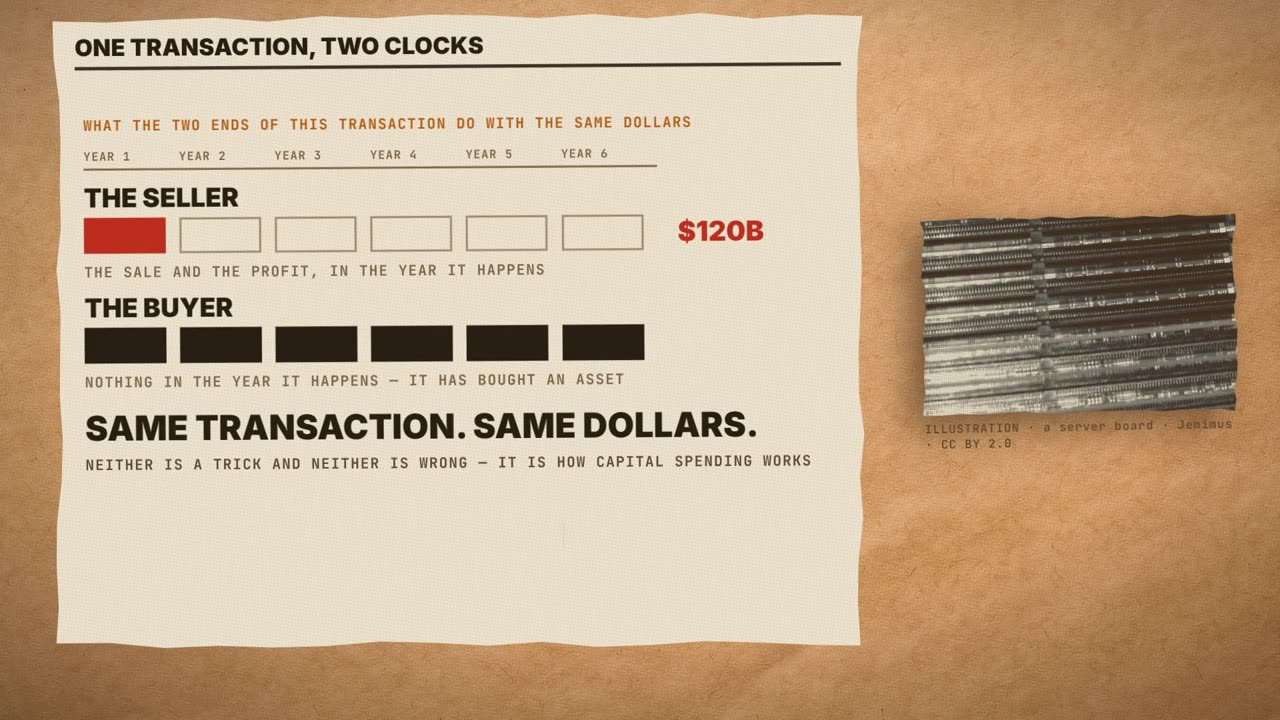
Nvidia must disclose heavy dependence on a few customers. In the year to January 2024, one direct customer was 13 percent of revenue; the next year, one was 12 and two more 11 each; in the year to January 2026, one was 22 percent and another 14. Two accounts, 36 percent of $216 billion, around $78 billion. The filing does not name them, and its direct customers include manufacturers and system integrators rather than the cloud companies themselves, so nobody reading only the documents can name them. Then the asymmetry. Nvidia books the sale and its profit in the year it happens. The buyer books almost nothing that year, because it has bought an asset. Same transaction. Same dollars. One side books it now, the other books it over six years.
Same transaction. Same dollars. One side books it now, the other books it over six years.
Why doesn't AI spending show up in Big Tech's profits?
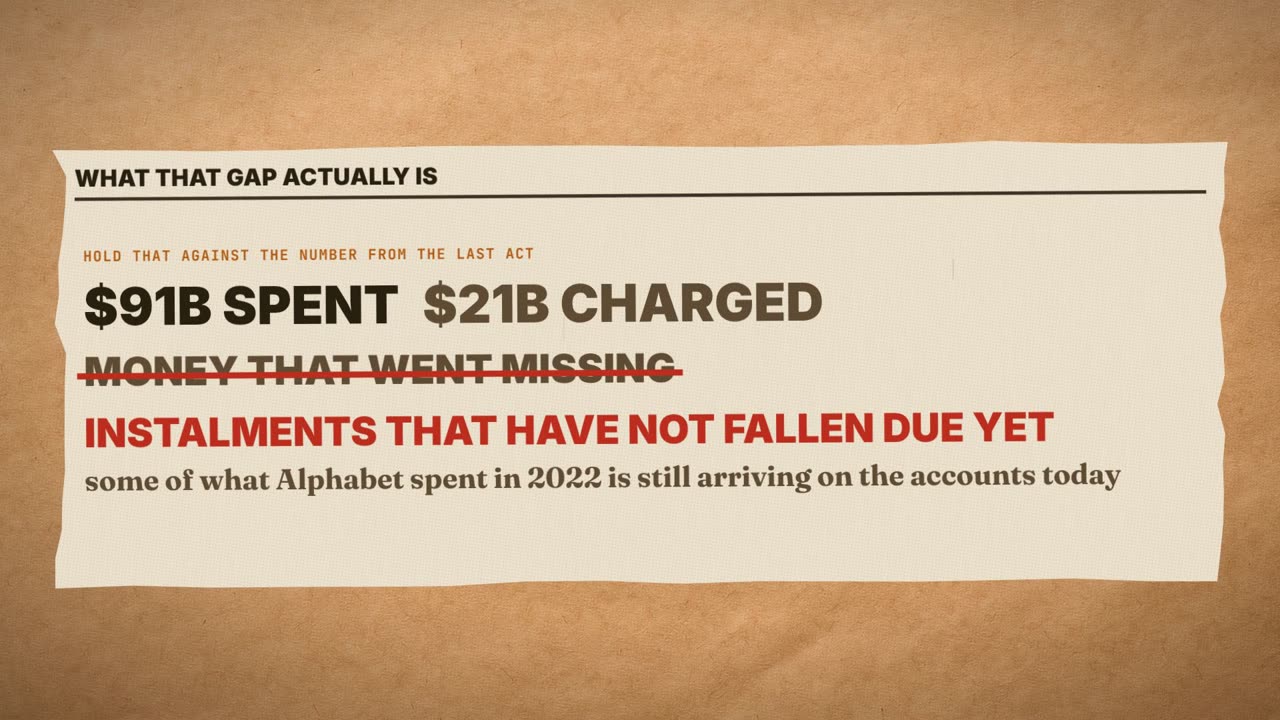
Because spending on equipment is not a cost in the year it happens. A business that buys a $30,000 van swaps cash for a van and spreads the cost over the years it expects to use it; that spreading is depreciation. In 2025 Alphabet spent $91.4 billion and charged $21.1 billion; Microsoft $115.9 billion and $34.3 billion; Amazon $131.8 billion and $41.9 billion; Meta $69.7 billion and $18 billion.
Four companies, $408 billion spent, $115 billion charged: roughly $293 billion spent in one year that has never yet appeared as a cost to anyone. There is no trick and nothing hidden. It is the ordinary, audited treatment of capital spending, applied at a scale nothing has been applied at before. It is not a loss, and it is not a saving.
When will that spending hit the accounts?
Watch from 13:00It is a schedule
On a timetable the companies write down in advance. Alphabet's 2025 annual report: "We depreciate servers and network equipment generally over a period of six years." So a server bought this year arrives on the profit line in six instalments, until 2031. The gap is not missing money. It is instalments not yet due, on balance sheets, in public, with the schedule printed beside them.
One correction the film makes to itself: the machines are on a timetable, the electricity running them is not. Power is an operating cost that hits the accounts in the month it is burned. How big that part is, nobody reading the filings can tell; there is no separate energy line in Alphabet's or Meta's annual reports, because it is not a figure they must break out. And once you can see the timetable, you notice six years is not a fact. Six years is a decision. So who made it?
Six years is a decision. So who made it?
Who decides how long an AI server lasts?
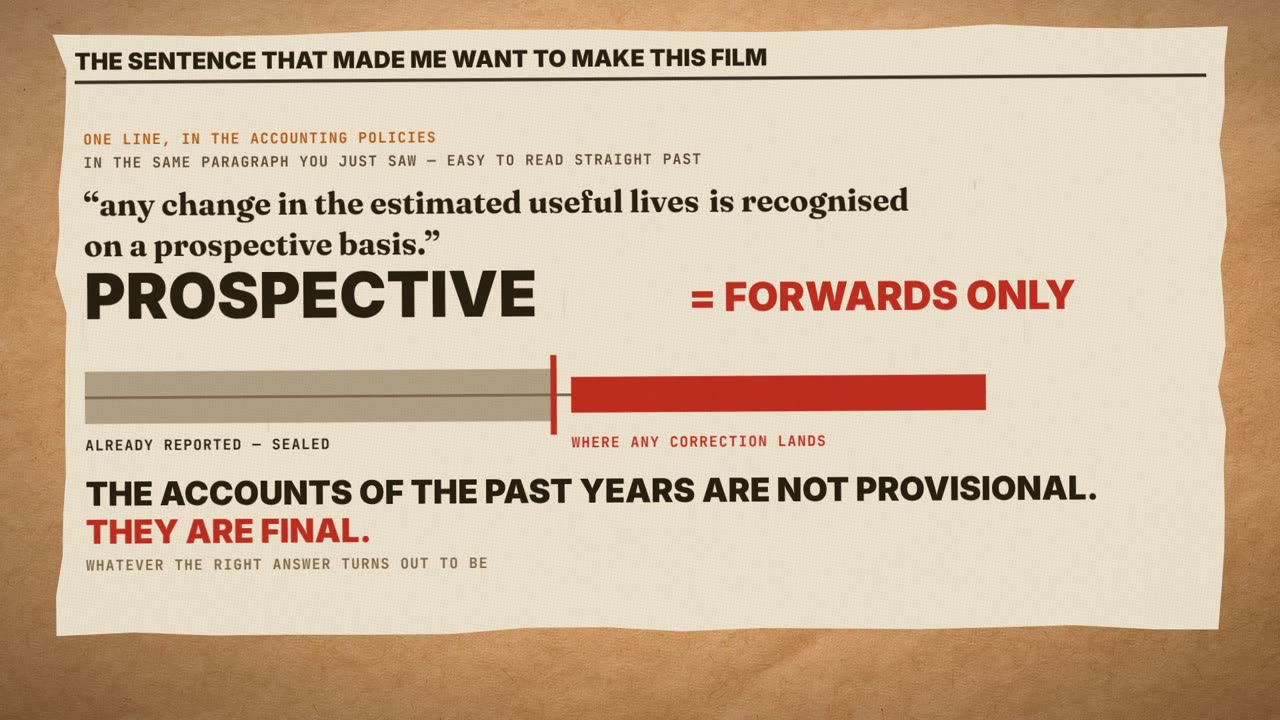
The company does, with auditors checking the reasoning. Alphabet says it relies on "historical asset performance, expected technology advancements, and our future infrastructure deployment plans." And: "Any change in the estimated useful lives is recognized on a prospective basis", meaning forwards only. Profits already reported stay reported; any correction lands in years to come.
Between 2020 and 2024 the assumed life of a server across these companies went from three years to four to six. A $600 machine over three years is $200 a year against profit; over six years, $100. Every change was disclosed. But extending an asset's life makes this year cheaper and a later year dearer, and the extensions came in exactly the years the spending was climbing fastest. What happens if six is wrong?
Why did Amazon and Meta change their server depreciation in opposite directions?
Because they reached opposite conclusions about the same equipment in the same month. Effective 1 January 2025, Amazon cut some servers from six years to five, "due to the increased pace of technology development, particularly in the area of artificial intelligence and machine learning", adding $1.4 billion of depreciation and cutting net income by $1.0 billion, ten cents a share. Meta extended most servers to 5.5 years.
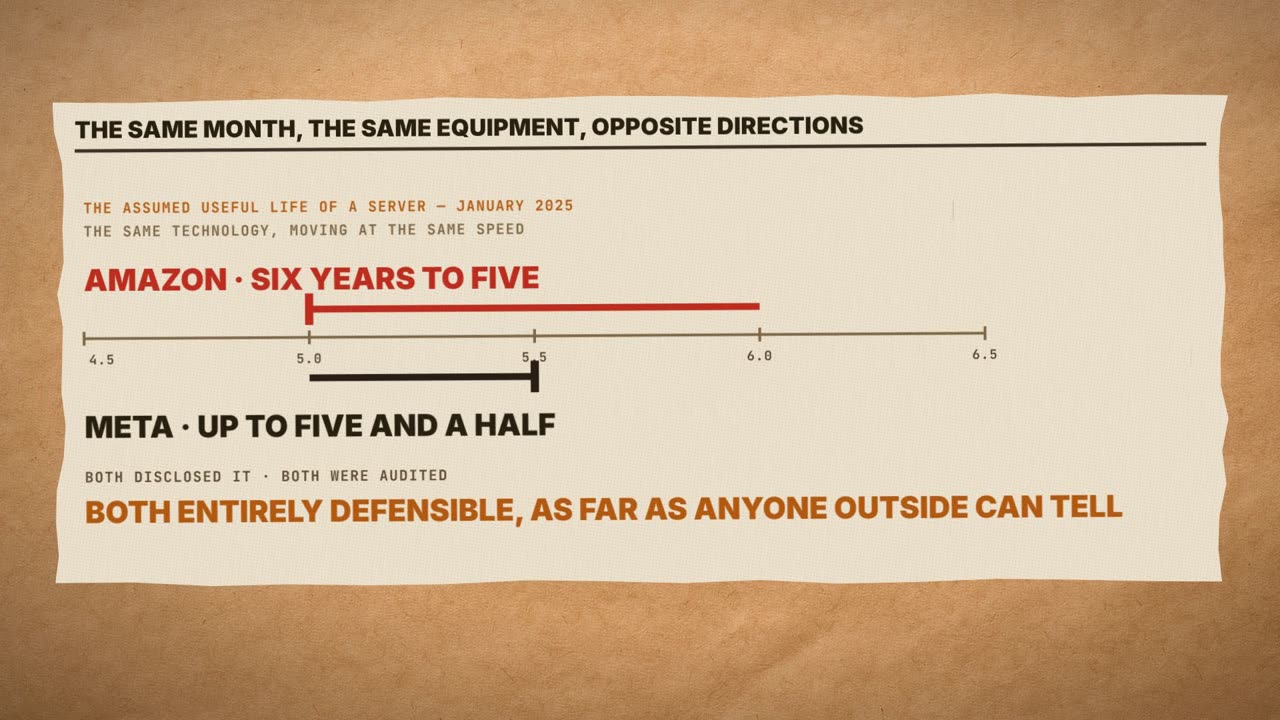
Meta's report lists among the things shaping its costs "decreases in the depreciation growth rate due to an extension in the useful lives of servers and network assets." Both disclosed it, both were audited, and both are, as far as anyone outside can tell, defensible. There is a public argument: one estimate has these companies understating depreciation by about $176 billion between 2026 and 2028, while the companies answer that every change was disclosed, reviewed and justified with performance data. The film marks it disputed and does not settle it. What is not in dispute is that the date the largest capital build in corporate history reaches the accounts is an estimate, and in January 2025 two of the companies making it moved it in opposite directions.
Are companies actually saving money from cheaper AI?
The film found few that could point to a line in their accounts that went down because the same work got cheaper. What comes back, overwhelmingly, is restructuring: headcount down, layers removed. Those are real savings, but they are the cost of fewer people, not the same work done more cheaply. Klarna said its assistant did the work of 700 people, then went back to hiring humans because the assistant was cheaper and also worse.
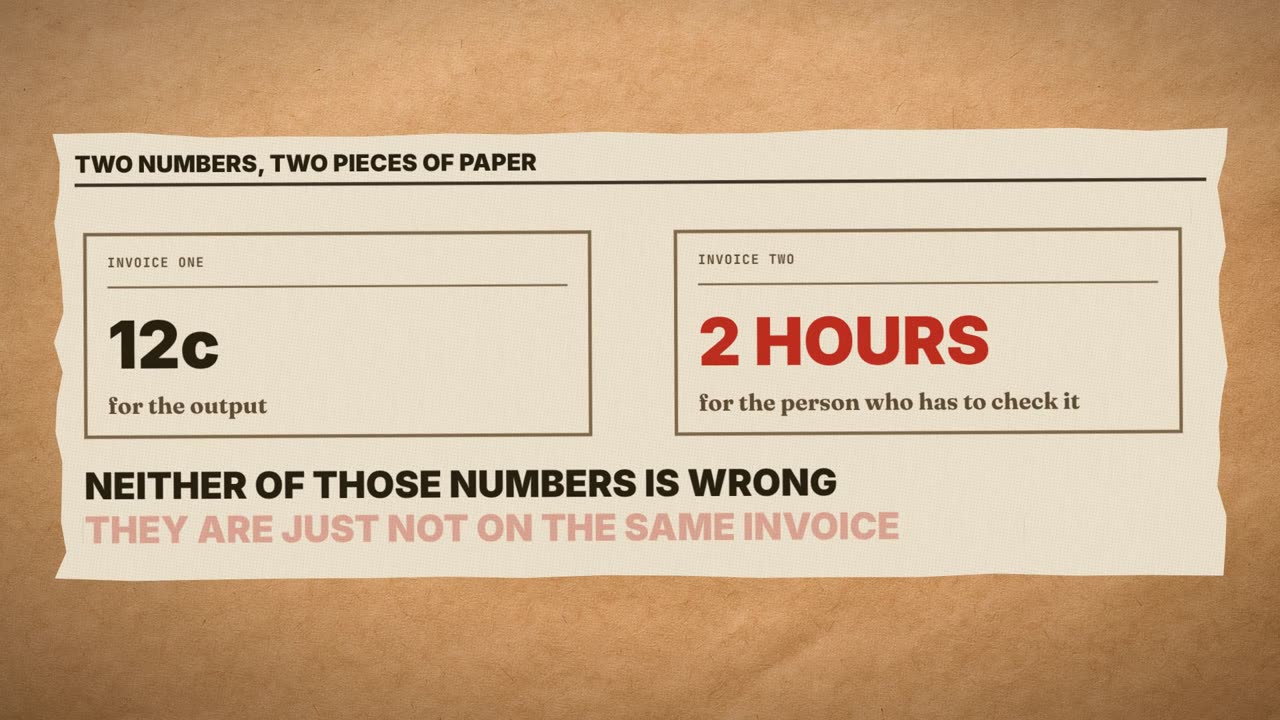
And there is a cost on nobody's price card. In a survey published in Harvard Business Review by BetterUp Labs and Stanford's Social Media Lab, 41 percent of full-time American workers said they had received something in the past month that looked finished and was not, and each instance cost them nearly two hours to read, check and fix. Twelve cents for the output. Two hours for the person who has to check it.
Twelve cents for the output. Two hours for the person who has to check it.
So where did the $464 billion go?
Watch from 24:10Where this lands
Into equipment, and onto a schedule. The price of machine intelligence collapsed, measured twice. The spending went up to $464.5 billion at five companies in one year. Roughly $293 billion of a single year at four of them sits on balance sheets waiting for its instalments. It was not hidden. It was scheduled, in documents the companies wrote about themselves.
It was not hidden. It was scheduled.
The schedule is an estimate that got longer for four years while spending climbed, then moved two ways at once in January 2025. The film will not invent a date for when the bill lands, and says anyone giving you a year is guessing. The cheapest thing in the history of the world was bought on credit: its cost was recorded as an asset, on a timetable that is a judgement about how long the future takes to arrive. The first instalment came early, Amazon's $1.4 billion. Watch the useful life: one line, near the back of the filing, that decides when $464 billion stops being an asset and starts being a cost.
The cheapest thing in the history of the world was bought on credit.
Key findings
Epoch AI found the price of reaching a fixed level of AI performance fell between 9 and 900 times per year depending on the benchmark; for GPT-4's level on PhD-level science questions, about 40 times a year, from $37.50 in March 2023 to 12 cents 21 months later.
Epoch AI, LLM inference prices have fallen rapidly but unequally across tasksStanford's AI Index found the price of GPT-3.5-level performance fell from $20 per million tokens in November 2022 to 7 cents by October 2024, a 280-fold drop.
Stanford HAI, AI Index Report 2025Amazon, Microsoft, Alphabet, Meta and Oracle spent $464.5 billion on capital expenditure in their most recent filed year; Amazon alone spent $131.8 billion in 2025, up from $52.7 billion in 2023.
Company 10-K filings, as read in the filmIn 2025, Alphabet, Microsoft, Amazon and Meta spent about $408 billion on equipment but charged about $115 billion of depreciation, leaving roughly $293 billion spent in one year that had not yet appeared as a cost.
Company 10-K filings, 2025, as read in the filmNvidia's revenue for the year to January 2026 was $215.9 billion, up 65%, with net income of $120.1 billion; two direct customers accounted for 22% and 14% of revenue.
Nvidia, Form 10-K, fiscal 2026Effective 1 January 2025, Amazon shortened the useful life of some servers from 6 to 5 years, citing the pace of AI development, adding $1.4 billion of depreciation and cutting net income by $1.0 billion. Meta extended most servers to 5.5 years the same month.
Amazon and Meta, Form 10-K filings, 2025In a survey reported in Harvard Business Review, 41% of US full-time workers said they had received AI-generated 'workslop' in the past month, costing an average of nearly 2 hours per instance to deal with.
BetterUp Labs and Stanford Social Media Lab, Harvard Business Review, Sep 2025Frequently asked questions about AI costs and Big Tech spending
How much cheaper has AI become?
Very much cheaper, depending on the task. Epoch AI found the price of reaching a fixed performance level fell between 9 and 900 times a year, and about 40 times a year at GPT-4's level on PhD-level science questions. Stanford's AI Index measured a 280-fold drop in the price of GPT-3.5-level performance between November 2022 and October 2024.
How much are Big Tech companies spending on AI infrastructure?
Amazon, Microsoft, Alphabet, Meta and Oracle spent $464.5 billion on capital expenditure in their most recent filed year, according to their 10-K filings. Amazon spent $131.8 billion in 2025, Microsoft $115.9 billion, Alphabet $91.4 billion, Meta $69.7 billion and Oracle $55.7 billion.
Why doesn't AI spending show up as a cost in company profits?
Because capital spending is depreciated: a company records the cost of equipment gradually over its expected useful life rather than in the year it buys it. In 2025, four of these companies spent about $408 billion and charged about $115 billion, so roughly $293 billion was scheduled to arrive as cost in later years.
How long do tech companies depreciate AI servers?
Mostly five to six years, and it is the companies' own estimate. Alphabet depreciates servers and network equipment generally over six years. Across these companies the assumed life rose from three to four to six years between 2020 and 2024. In January 2025 Amazon cut some servers to five years, citing AI, while Meta extended most to 5.5 years.
Who sells the equipment AI companies are buying?
Mostly Nvidia. Its revenue for the year to January 2026 was $215.9 billion, up 65%, with net income of $120.1 billion. Two direct customers accounted for 22% and 14% of revenue; Nvidia does not name them, and its direct customers include manufacturers and system integrators.
Sources
- Epoch AI, LLM inference prices have fallen rapidly but unequally across tasksepoch.ai
- Stanford HAI, The 2025 AI Index Reporthai.stanford.edu
- Amazon.com, Inc., Form 10-K filings, SEC EDGARsec.gov
- Microsoft Corporation, Form 10-K filings, SEC EDGARsec.gov
- Alphabet Inc., Form 10-K filings, SEC EDGARsec.gov
- Meta Platforms, Inc., Form 10-K filings, SEC EDGARsec.gov
- Oracle Corporation, Form 10-K filings, SEC EDGARsec.gov
- NVIDIA Corporation, Form 10-K filings, SEC EDGARsec.gov
- Niederhoffer, Kellerman, Lee, Liebscher, Rapuano & Hancock, AI-Generated Workslop Is Destroying Productivity, Harvard Business Review, Sep 2025hbr.org
Every filed figure in the film and in this article is read from the companies' own Form 10-K annual reports, listed above via SEC EDGAR; reported figures are named with their outlet. The estimate of $176 billion of understated depreciation, and the companies' answer to it, are shown as disputed and not settled.
Watch next




















Token, inference and the other terms behind this film are explained in plain English, with a printable sheet, in our free AI Terms guide.