
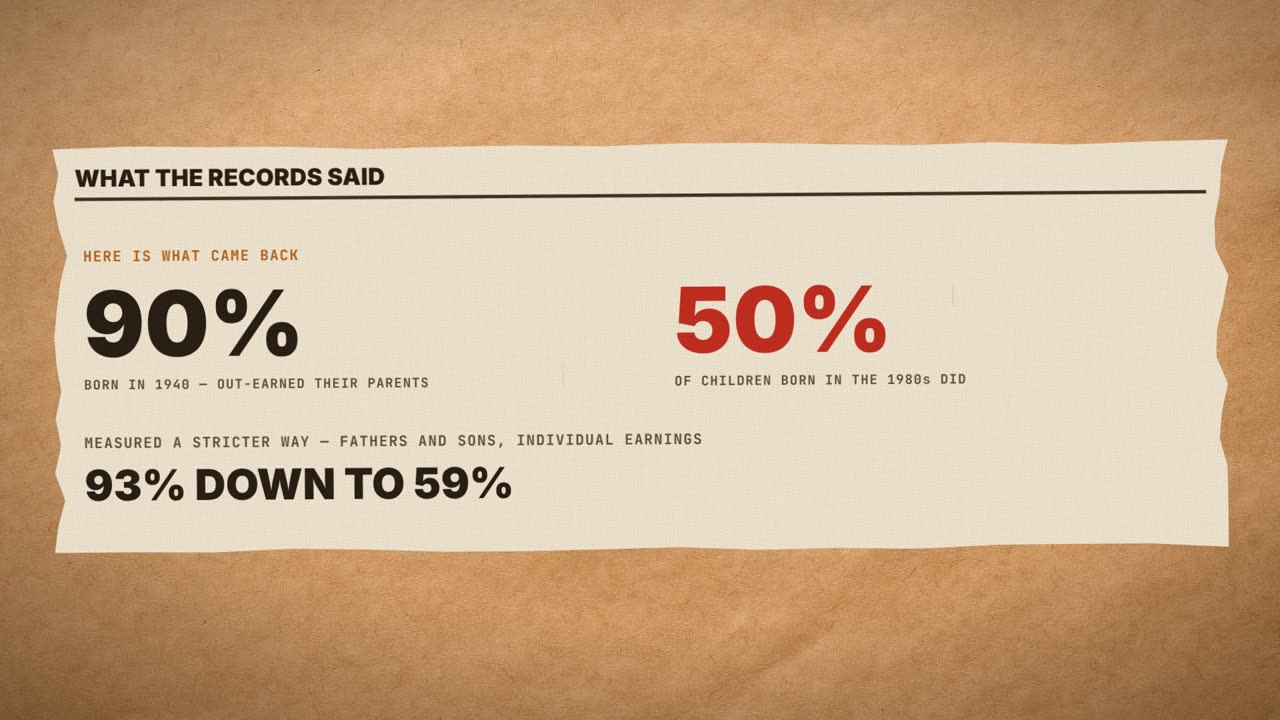
Nine out of ten Americans born in 1940 ended up earning more money than their parents did. For Americans born in the 1980s, it is about five out of ten: a coin toss. That is not a survey or a feeling. It is a measurement taken from tax records and published in Science in April 2017. And the obvious explanation, that the country stopped growing, is the wrong one. The economy kept growing. What changed was how the growing got divided, and that sentence is in the paper's own abstract.
A division is not weather. It does not just happen to a country. Somebody has to write it down. Our 44-minute documentary for The Signal goes looking for what was written down in the years the division moved: ordinary, published rules, each with a date. It does not claim anyone planned this, or that these rules are the cause; where it joins the paper's finding to the rules, it says on camera that the join is its own. This piece follows it chapter by chapter.
A division is not weather. It does not just happen to a country. Somebody has to write it down.
The film in 17 chapters
Pick a chapter and the film starts there. 44:05 in all.
- 010:00Nine in ten, then five in ten
- 022:21The measurement
- 035:40What the paper does not say
- 046:171947: the first rule
- 058:221978: the clause that replaced the pension
- 0611:18What the swap actually did
- 0714:371982: the safe harbour
- 0817:40What happened after 1982
- 0919:44So who owns the shares?
- 1021:551993: the cap that exploded
- 1124:32Why sunlight did not work
- 1227:28The number, including the part that goes the wrong way
- 1329:47The best case for the other side
- 1432:55The rules start moving back
- 1534:58The nineteenth of December, 2023
- 1637:57The half that does not fit
- 1740:58Two clocks
How many Americans earn more than their parents?
Watch from 2:21The measurement
About half of those born in the 1980s, against about 90 percent of those born in 1940. The measure is absolute mobility: at around thirty, are you earning more than your parents were at thirty, adjusted for prices? In 2017 a team led by Raj Chetty linked census data with de-identified tax records to measure it. Fathers to sons on individual earnings, the fall is from 93 to 59 percent.
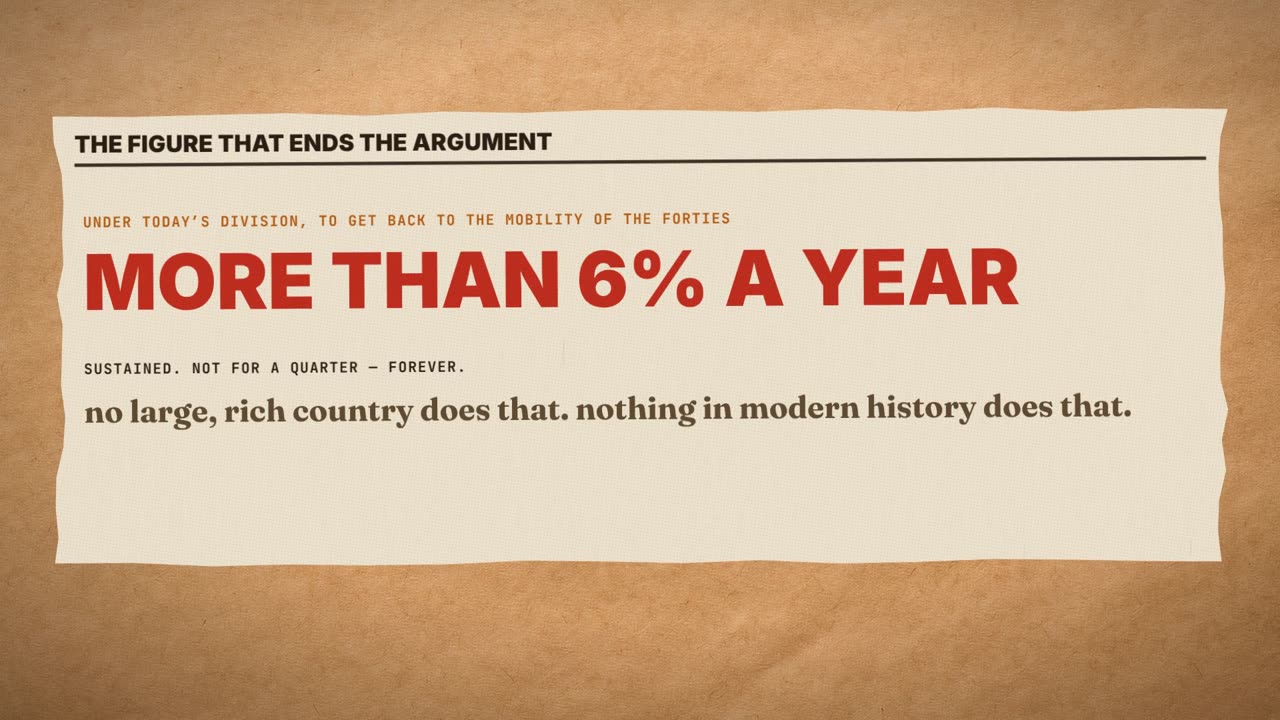
The 1940 figure never came out below 84 or above 98 percent across every plausible assumption. Then the team tested the obvious explanation. Give the modern generation the growth rate their grandparents had, leaving the division as it is now, and mobility rises from 50 percent only to 62. Keep today's real, sluggish growth but divide it the way the 1940 generation's was divided, and it rises to 80: more than 70 percent of the collapse reversed, without adding a dollar. Under today's division, regaining the 1940s rate would need growth above 6 percent a year, forever. So it is not the size of the thing. It is the division.
So it is not the size of the thing. It is the division.
Does the research say who changed the division?
Watch from 5:40What the paper does not say
No. The paper measures an outcome, runs two tests, and stops; it never names a law, rule or regulator, and was never trying to. The film goes looking at what was written down while the division moved, in public documents with their dates. But the join between "the division changed" and "these rules changed it" is the film's, not the paper's, and it says, each time, how far the evidence reaches.
How much has union membership fallen in the US?
Watch from 6:171947: the first rule
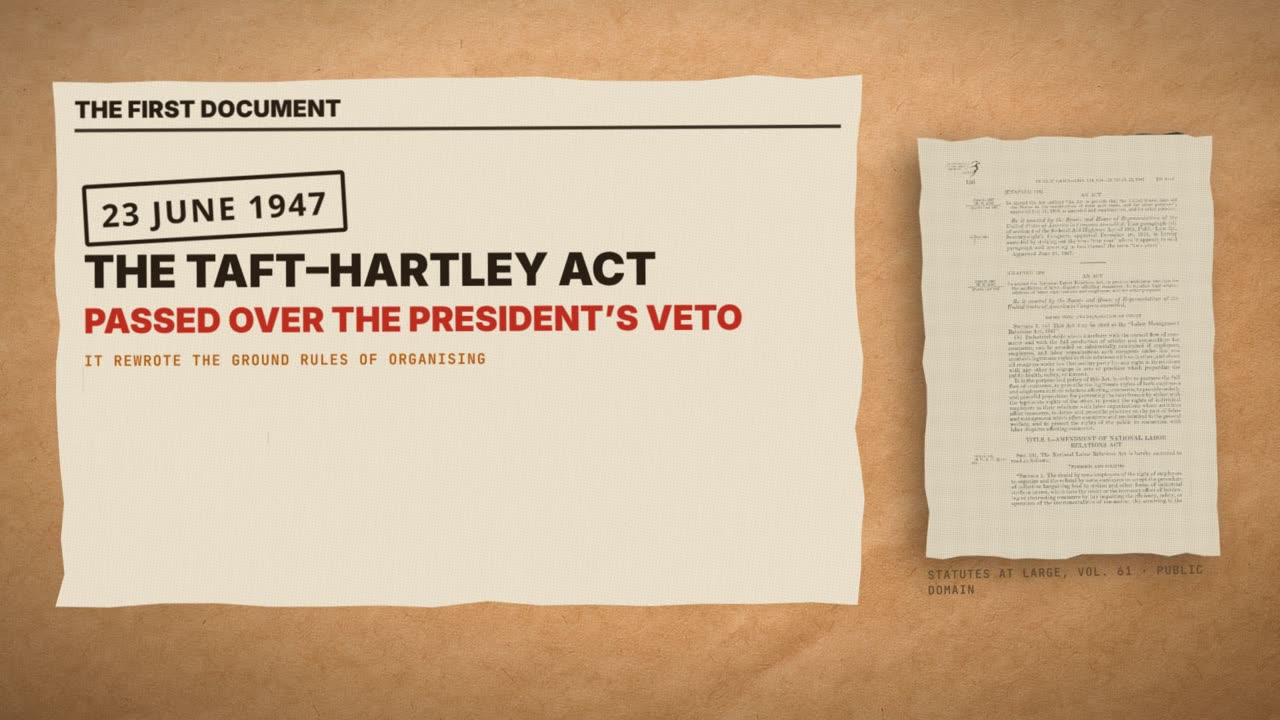
From a peak of 33.5 percent of workers in 1954 to 9.9 percent in 2024, and 5.9 percent in the private sector, the lowest ever recorded. Collective bargaining pushes up pay in the middle of a workforce and compresses the gap between top and bottom: it is a machine for changing a division. On 23 June 1947, Congress passed the Taft-Hartley Act over the president's veto, rewriting the ground rules of organising.
The film's caveat is that this is the rule it can tie least tightly to the outcome. Membership fell for many reasons: manufacturing moved, the workforce changed shape, whole new industries were never organised. What survives is narrower: the largest institution built to compress pay went from covering a third of workers to one in ten, and the first legal turn against it has a date at the front of the fifty years in question.
How did the 401(k) replace the pension?
Watch from 8:221978: the clause that replaced the pension
Through a short clause written for something narrow. A defined-benefit pension promises you a set amount every month, and if the sums go wrong, that is the company's problem. A defined-contribution plan defines only what goes in, and the risk is yours. In 1978 Congress added section 401(k) to a revenue act to let employees defer part of a bonus; it took effect on 1 January 1980, and 1981 tax guidance confirmed ordinary salary could go in.
A benefits consultant in Pennsylvania, Ted Benna, read the two together and built the first salary-funded savings plan for ordinary employees. He is called the father of the 401(k), and has spent much of the last decade saying he regrets it: he has called it a monster, said he helped open a door for Wall Street, and said it was never meant to be how most Americans save for retirement. The film is careful that his regret is not evidence about the distribution of income. It is evidence that the man best placed to know says the 1978 clause was never meant to carry what was loaded onto it.
What did the shift from pensions to 401(k)s do?
Watch from 11:18What the swap actually did
The swap turned one outcome into a distribution. By 1995 more Americans were in defined-contribution plans than traditional pensions; in 2024 filings there were about 90,350 401(k) plans against 6,676 defined-benefit pensions. The Bureau of Labor Statistics found in March 2025 that 72 percent of private-sector workers can join a workplace plan: 70 percent a defined-contribution plan, 14 percent a pension.

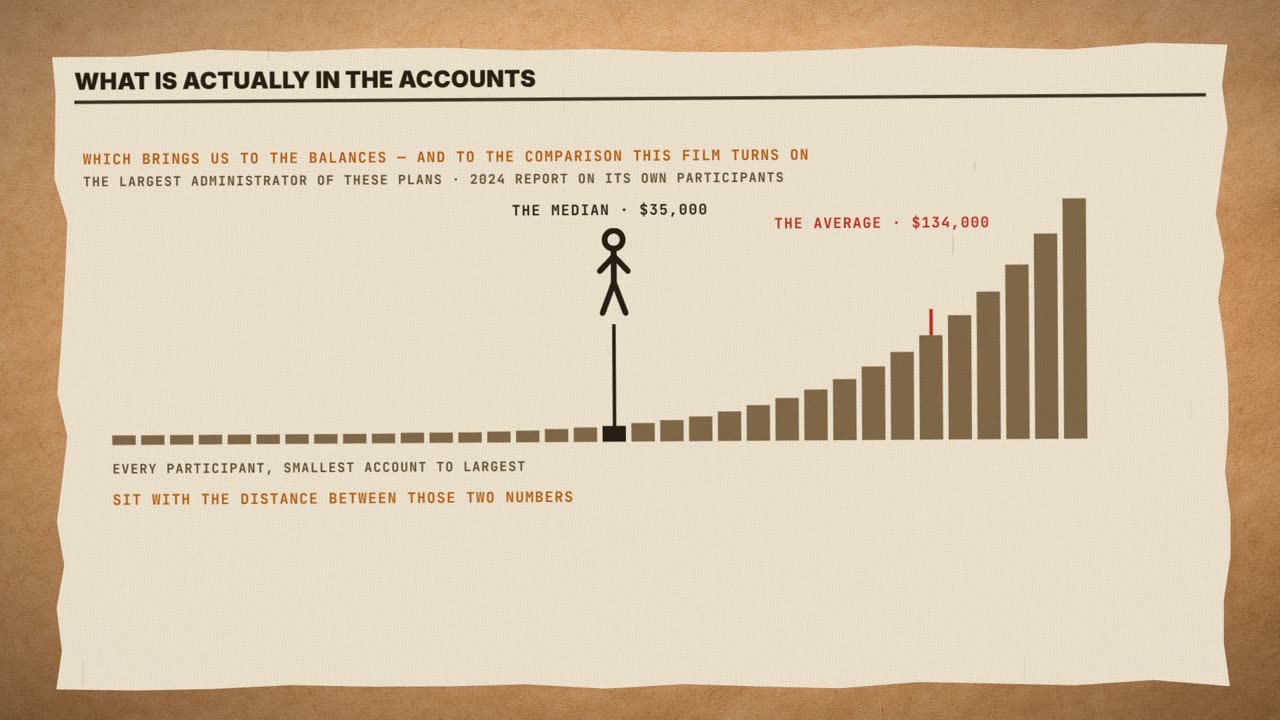
Access depends on your employer: 90 percent at firms with 500 or more workers, 59 percent at firms with fewer than 100, and only about three-quarters of those offered a plan take it up. The largest plan administrator's 2024 report put the average balance at about $134,000 and the median at $35,000. The average is nearly four times the middle, which only happens when a few huge accounts drag it up. The average describes a person who does not exist. Among those aged 65 and over, the average was $272,000 and the median $88,000. That is not a malfunction. Individual accounts produce individual results.
The average describes a person who does not exist.
When did stock buybacks become legal?
Watch from 14:371982: the safe harbour
On 17 November 1982 the Securities and Exchange Commission, under chairman John Shad, adopted Rule 10b-18. Before that, a company buying its own shares on the open market risked being treated as manipulating its price. The rule created a safe harbour: do it this way and the SEC will not treat it as manipulation. The Commission's own staff later called the change an about-face.
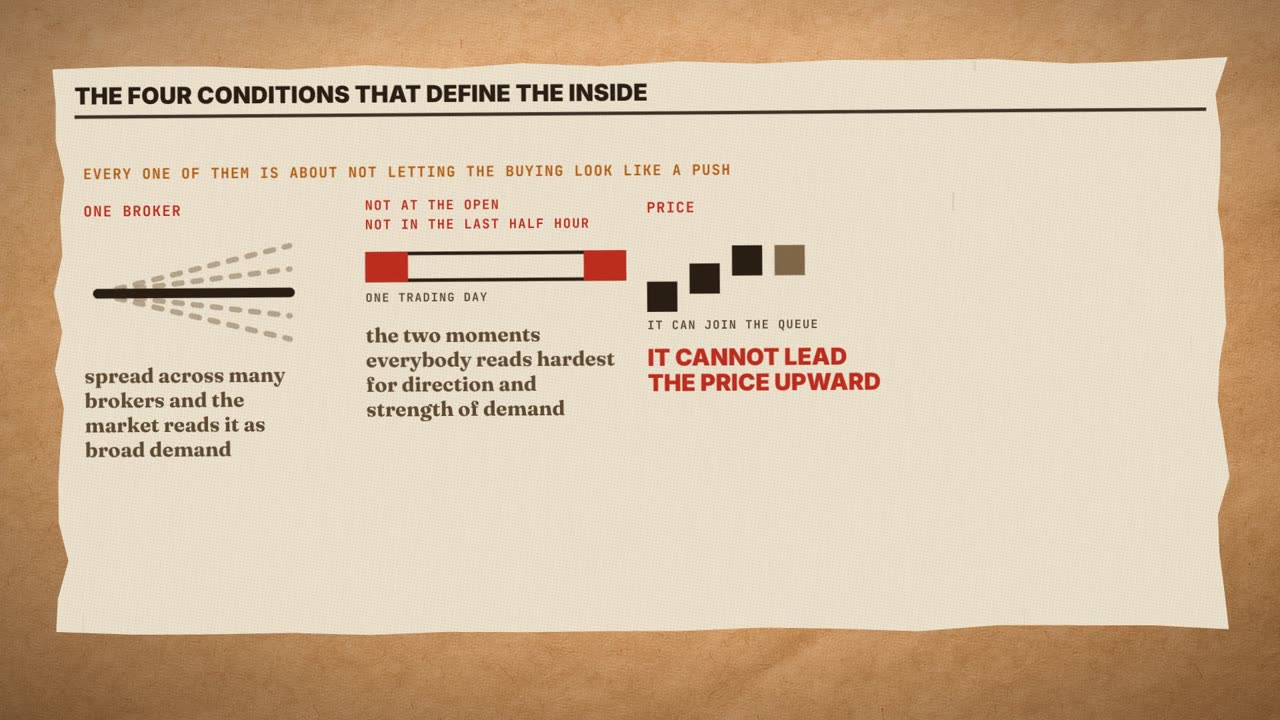
There are four conditions: one broker a day; no buying at the open or in the last half hour; no bidding above the highest independent bid or last trade; and no more than 25 percent of average daily volume over the previous four weeks. The SEC was not blessing the practice. It drew a box around a version that could not dominate a day's trading and promised not to prosecute inside it. Nobody announced that money should move toward shareholders. A regulator published four conditions and a promise. The behaviour followed the conditions.
How big did stock buybacks get?
Watch from 17:40What happened after 1982
Enormous. In June 2022, buybacks by the 500 largest listed US companies passed $1 trillion over twelve months for the first time. Over the decade to 2023 they spent more than $4 trillion on buybacks and about $3 trillion on dividends, together about 106 percent of their profits. In 2024 American companies spent a record $942.5 billion buying back their own shares.
The film is careful about what that proves. Corporate cash is not one pie with a wages slice and a shareholder slice; some repurchases were funded by profits that would never have gone to pay, some by borrowing. What it can show is simpler: a use of corporate cash that was legally hazardous before November 1982 became one of the largest uses of corporate cash in the American economy, and the thing that changed in between was four conditions and a promise.
Who owns American stocks?
Watch from 19:44So who owns the shares?
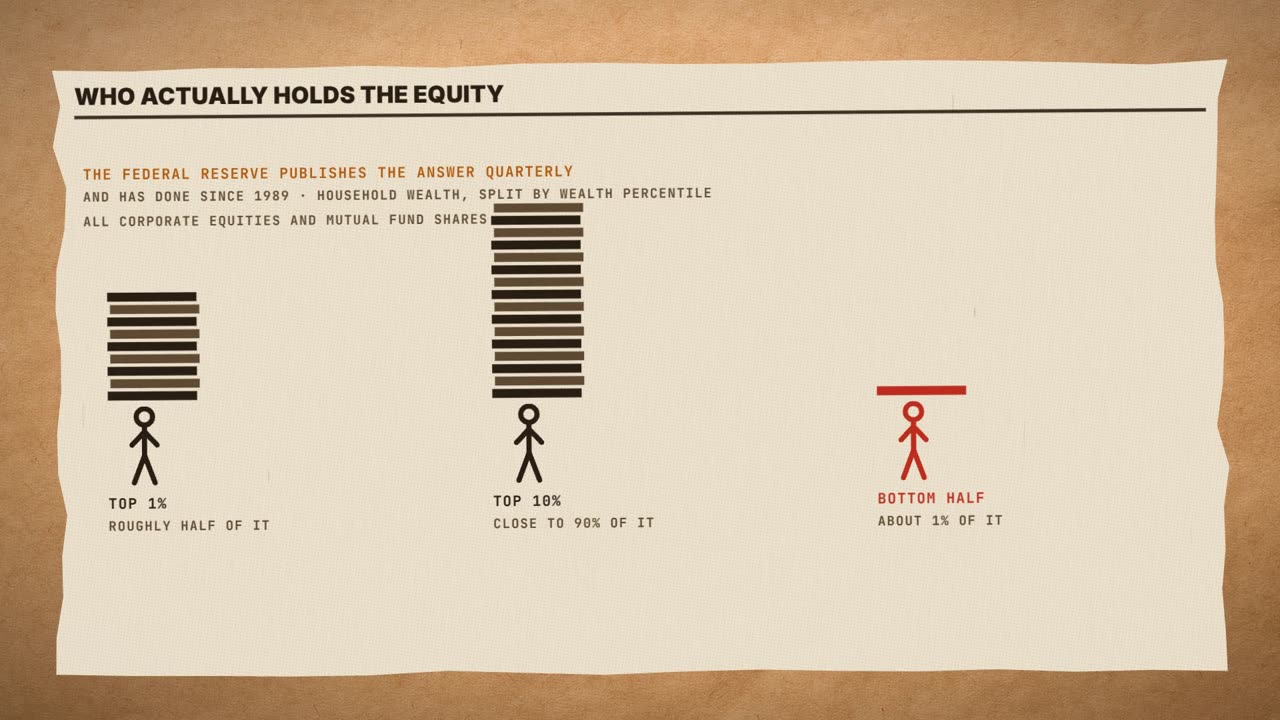
Mostly the wealthiest households. The Federal Reserve's distributional accounts show the top 1 percent hold roughly half of all corporate equities and mutual fund shares, the top 10 percent close to 90 percent, and the bottom half about 1 percent. So money returned to shareholders is not money returned to everybody.
The complication runs back through the 401(k): millions of ordinary Americans now own shares through retirement accounts, so a sliver of every buyback lands with them. Two rules written fifteen years apart, by different institutions, for unrelated reasons, interlock: one moved ordinary people's retirements into the market, the other moved corporate cash toward it. The pipe is real; its width for you depends almost entirely on how much you already had. That is the definition of a division.
Did the 1993 cap on executive pay backfire?
Watch from 21:551993: the cap that exploded
Yes. In 1993 Congress added section 162(m) to the tax code, capping the deductible pay for each top executive at $1 million to make huge pay packets more expensive. It exempted pay tied to performance goals, set by outside directors and approved by shareholders. Stock options cleared all three tests.
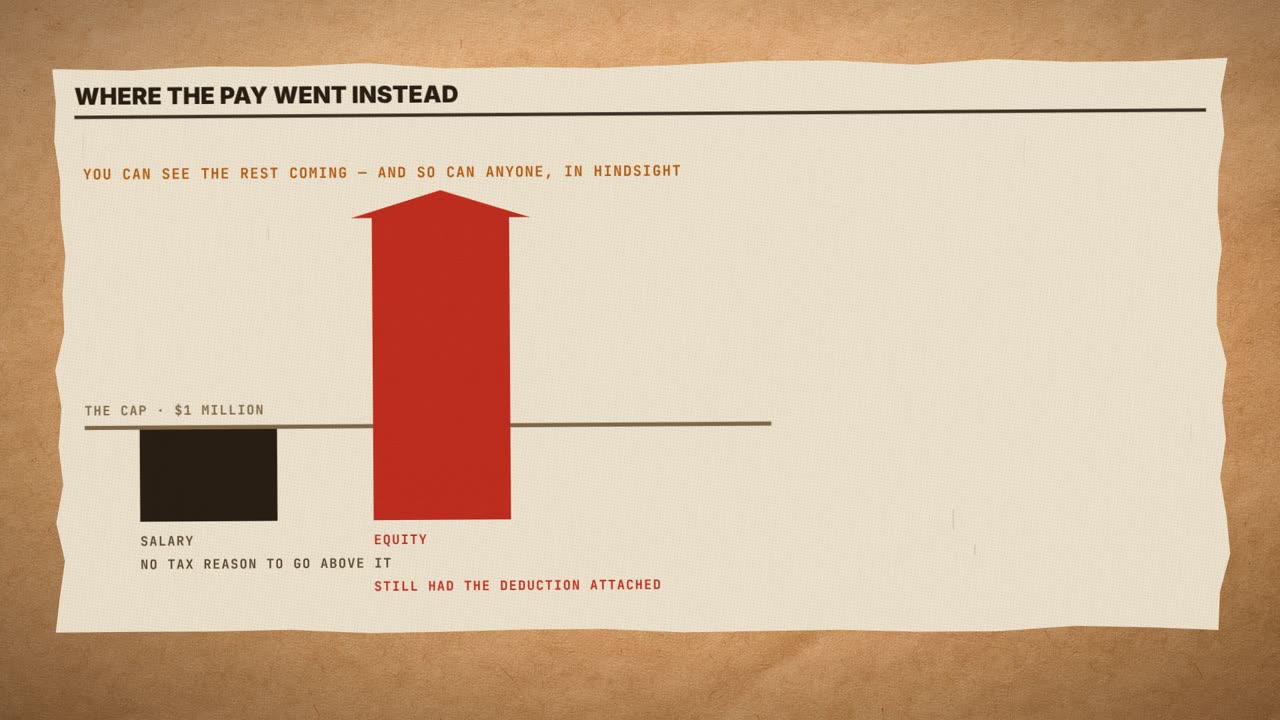
Salaries clustered at the cap and everything above it moved into equity, which had no ceiling. One of the standard papers on the change has "the law of unintended consequences" in its title and finds pay shifted into options and total compensation rose. A law written to bring executive pay down is the law under which executive pay went vertical. Nobody had to want it. An incentive is just a rule, seen from the point of view of the person it applies to.
A law written to bring executive pay down is the law under which executive pay went vertical.
Why didn't publishing executive pay restrain it?
Watch from 24:32Why sunlight did not work
Because comparison became a ratchet. In 1992 the SEC, under chairman Richard Breeden, required a standard Summary Compensation Table in every company's filings. Once pay sat in a comparable grid, boards benchmarked against peers, and around 90 percent of major US companies target executive pay at or above their peer median.
If nine in ten aim at or above the middle, the middle has to rise, every year; economists call it the Lake Wobegon effect. By 2006 the SEC required companies to disclose how they chose their peer groups, a rule about the unintended effect of a rule. Two agencies, two years, two tools, the same target and the same direction of failure. At some point that stops being bad luck and starts being a property of the thing.
What is the CEO to worker pay ratio?
Watch from 27:28The number, including the part that goes the wrong way
About 281 to 1 in 2024. The long-running series comparing large-company chief executives' pay with a typical worker's was about 21 to 1 in 1965, 31 to 1 in 1978 and about 380 to 1 at the 2000 peak. It came down from the peak and has not gone back, and the film shows that before anyone else can.
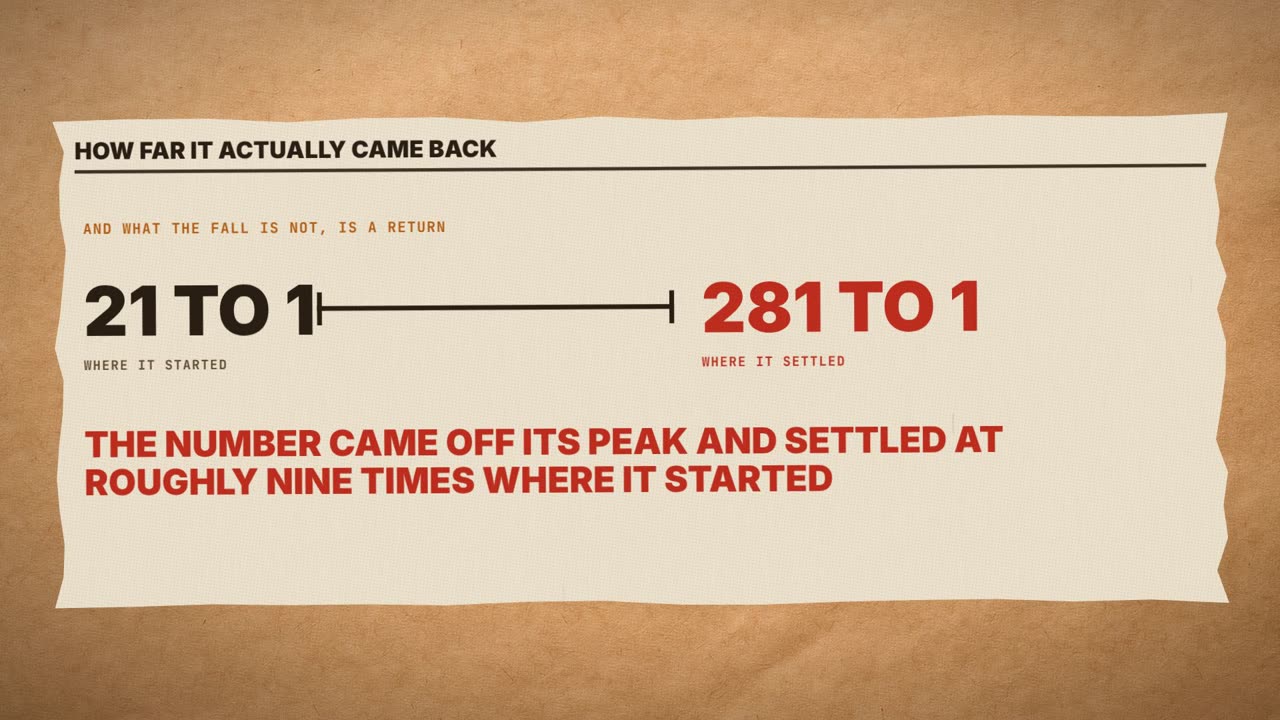
The fall is mostly the stock market: the 2000 peak was the top of the dot-com bubble, and with so much executive pay in equity the ratio moves with the market. It settled at roughly nine times where it started. The film also declines to build on the well-known productivity-and-pay chart, which it marks disputed because it depends partly on which inflation measure is applied to each line. Its spine is the counterfactual from the 2017 paper, the same tax records asked one question twice.
What is the best argument for buybacks, executive equity and 401(k)s?
Watch from 29:47The best case for the other side
The film makes it properly. A company with more cash than good ideas should give it back rather than spend it badly, and a buyback can pause in a bad year where a dividend cut is punished. Paying managers in shares aligns them with owners, and many value-creating companies did exactly that. Pensions were promises that companies broke in bankruptcy, and they chained people to one employer, where a 401(k) is portable.
And a rising market now reaches further down the ladder than when only the rich held shares. The film's verdict: every one of those arguments is true, and none of them is a claim that the division did not change. They are claims that the changes were reasonable, and mostly, individually, they were. The film's argument is narrower: they were rules, with authors and dates, that between them moved something nobody voted on.
Are the rules on buybacks and executive pay changing back?
Watch from 32:55The rules start moving back
Mostly, yes. On 5 August 2015 the SEC adopted a rule requiring every public company to publish its chief executive's pay, its median employee's pay and the ratio, first appearing in 2018 filings. In 2017 Congress repealed the 162(m) performance-pay exception. In 2022 it imposed a 1 percent excise tax on buybacks after 31 December 2022, the first push against the 1982 safe harbour in forty years. In May 2023 the SEC adopted a buyback disclosure rule on top. That one did not survive.
Why was the SEC's buyback disclosure rule struck down?
Watch from 34:58The nineteenth of December, 2023
Because a court found the SEC had not shown its working, not because the rule was wrong. The 2023 rule would have required companies to record repurchases daily, file them quarterly and say why they were buying. The US Chamber of Commerce, with two Texas business groups, challenged it in the Fifth Circuit, which held on 31 October 2023 that the SEC had failed to answer objections and analyse costs and benefits.
The court gave the SEC thirty days, refused more time, and when the SEC said it could not fix the defects in time, vacated the rule on 19 December 2023. The film is fair to the court: requiring agencies to justify costly rules protects real people. But the 1982 rule that opened the door has stood for forty-three years without going to court, while the rule that would only have described what came through it lasted seven months. The following year, buybacks hit their record.
Has anything about American mobility improved?
Watch from 37:57The half that does not fit
Yes, and the film includes it though it sits awkwardly. In 2024 the same research group studied Americans born between 1978 and 1992, measuring gaps between groups. Among white Americans, the gap by parental income widened by around 30 percent. For children from low-income families, the gap by race narrowed by around 30 percent, as Black Americans' earnings rose at every level of parental income.
One line got worse and one got better, and they are not the same line. A film that keeps a research group's numbers when they suit it and drops them when they don't is an argument wearing a documentary's clothes. And international versions of the measurement differ a great deal, by ten or fifteen points depending on the records used. The American line is not a law of nature; it is one country's arithmetic, which the film calls the strongest evidence that these were choices rather than a tide.
Why can't we yet know how today's young adults will do?
Because the outcome clock stops at people born in 1984. You cannot ask whether someone out-earned their parents until their earnings settle around thirty, and the tax records take years more. There is no number for people born in the 1990s or this century, from this team or anyone; anybody who gives you one is making it up.
The rules clock is still running. We can read every rule of the last twenty-five years, but we will not see what they did to the children born under them until the 2030s. What is on the record: nine in ten became five in ten; more growth would not fix it; a different division would reverse most of it; and in the years the division moved, these were written down: an act over a veto in 1947, a clause in 1978, a safe harbour in 1982, a disclosure table in 1992 and a tax cap in 1993, a pay-ratio rule in 2015, a repeal in 2017, a tax in 2022 and a court in 2023. Nobody wrote a rule that said fewer children should out-earn their parents. I have read them. You can go and read the one from 1982 this afternoon.
Nobody wrote a rule that said fewer children should out-earn their parents. I have read them.
Key findings
About 90% of Americans born in 1940 earned more than their parents at around age 30; for those born in the 1980s it was about 50%. Measured fathers to sons, the fall is from 93% to 59%.
Chetty, Grusky, Hell, Hendren, Manduca & Narang, The Fading American Dream, Science, April 2017Giving today's generation the 1940s growth rate raises mobility from 50% only to 62%; keeping today's growth but dividing it as in the 1940s raises it to 80%, reversing more than 70% of the decline.
Chetty et al., The Fading American Dream, Science, 2017Union membership peaked at 33.5% of US workers in 1954. In 2024 it was 9.9%, and 5.9% in the private sector, the lowest on record.
US Bureau of Labor Statistics, Union Members SummaryThe top 1% of American households hold roughly half of all corporate equities and mutual fund shares, the top 10% close to 90%, and the bottom half about 1%.
Federal Reserve, Distributional Financial AccountsThe ratio of chief executive pay to typical worker pay was about 21 to 1 in 1965, 31 to 1 in 1978, about 380 to 1 at the 2000 peak, and 281 to 1 in 2024.
Economic Policy Institute, CEO pay seriesSeventy-two percent of US private-sector workers have access to a workplace retirement plan; 70% to a defined-contribution plan and 14% to a defined-benefit pension.
US Bureau of Labor Statistics, Employee Benefits Survey, March 2025In a 2024 follow-up on Americans born between 1978 and 1992, the gap in outcomes by parental income among white Americans widened by around 30%, while the Black-white gap for children from low-income families narrowed by around 30%.
Opportunity Insights, Changing Opportunity, 2024Frequently asked questions about doing better than your parents
What percentage of Americans earn more than their parents?
About 50% of Americans born in the 1980s out-earned their parents at around age 30, down from about 90% of those born in 1940, according to Raj Chetty and colleagues in Science in April 2017. There is no comparable figure yet for people born in the 1990s, because their earnings have not settled.
Why are fewer people doing better than their parents?
Mostly because of how growth is divided, not how much there is. Chetty's team found that giving today's generation the 1940s growth rate only raises mobility from 50% to 62%, while dividing today's growth the 1940s way raises it to 80%. The film then examines rules written while that division changed, and says the link to those rules is its own, not the paper's.
What is SEC Rule 10b-18?
Adopted on 17 November 1982, Rule 10b-18 created a safe harbour for companies buying back their own shares: if they use one broker a day, avoid the open and the last half hour, do not lead the price and stay under 25% of average daily volume, the SEC will not treat the buying as manipulation. Buybacks became one of the largest uses of corporate cash.
How did the 401(k) start?
Section 401(k) was added by the Revenue Act of 1978 to let employees defer part of a bonus, taking effect in 1980. After 1981 tax guidance allowed salary deferrals, benefits consultant Ted Benna built the first 401(k) savings plan. He has since said he regrets what it became.
Did the 1993 cap on executive pay deductions work?
No. Section 162(m) capped the deductible pay per top executive at $1 million, but exempted performance-based pay, which stock options qualified as. Pay above the cap moved into equity, and research found total executive compensation rose. Congress repealed the exception in 2017.
What happened to the SEC's 2023 share buyback disclosure rule?
The rule would have required companies to record buybacks daily, file them quarterly and state why. The US Chamber of Commerce challenged it, and the Fifth Circuit found on 31 October 2023 that the SEC had not adequately analysed costs and benefits. When the SEC said it could not fix the defects in time, the rule was vacated on 19 December 2023.
Sources
- Chetty, Grusky, Hell, Hendren, Manduca & Narang, The Fading American Dream: Trends in Absolute Income Mobility Since 1940, Science, April 2017opportunityinsights.org
- Opportunity Insights, Changing Opportunity: Sociological Mechanisms Underlying Growing Class Gaps and Shrinking Race Gaps in Economic Mobility, 2024opportunityinsights.org
- US Bureau of Labor Statistics, Union Members Summarybls.gov
- US Bureau of Labor Statistics, Employee Benefits Surveybls.gov
- Federal Reserve, Distributional Financial Accountsfederalreserve.gov
- Economic Policy Institute, CEO pay jumped nearly 6% in 2024: CEOs made 281 times as much as the typical workerepi.org
- US Securities and Exchange Commission, SEC Adopts Amendments to Modernize Share Repurchase Disclosure, 3 May 2023sec.gov
Every figure in the film and in this article is a published paper, statute, regulator's rule, court decision or public statistical series, as listed above. The Chetty paper identifies the division of growth as the driver and attributes it to no rule; the connection between that finding and the rules described here is the film's own, and the film says so. The productivity-pay gap is contested and is deliberately not relied on.
Watch next
























Buyback, defined-benefit pension, capital and the other money terms behind this film are explained in plain English, with a printable sheet, in our free Finance Terms guide.