In the United States right now, if you are 22 to 27 and have just finished a degree, you are more likely to be out of work than the workforce as a whole, around five and a half percent against a national rate of a little over four. That is the wrong way round; graduates are supposed to be the easiest people to employ. And in Virginia, the electricity company serving the largest concentration of data centres on earth asked to raise household bills by fourteen percent, citing data centre growth and AI demand in its own filing.
A twenty-three-year-old in Ohio refreshing a job board, a retired couple in Loudoun County opening a bill that has gone up by a seventh. They are connected by a purchase: somewhere, a company bought computing power. The people building this technology say, on the record, that it could cure diseases, and that it could be extremely dangerous, and then spend hundreds of billions racing towards it anyway. Our 32-minute documentary for The Signal asks who is supposed to stop, and promises that every time you think you have found the problem, it will show you a bigger one. It happens six times.
The film in 8 chapters
Pick a chapter and the film starts there. 32:05 in all.
Why do AI companies keep racing if they think AI is dangerous?
Because of money, power, and a belief. Many people building it genuinely think a machine that can do science, and improve its own next version, is coming whether or not they build it. If it is coming either way, the only question is who gets there first, and they would rather it was them. So their fear does not act as a brake. It is the reason they are pressing on the accelerator.
It is the reason they are pressing on the accelerator.
That belief unlocks money. Through 2025, deals adding up to about $1.4 trillion were announced, mostly commitments to buy computing power stretching to 2032 and beyond, including around $250 billion of cloud contracts with Microsoft, around $300 billion with Oracle by 2030 and $38 billion with Amazon over seven years. In February 2026 OpenAI told investors its compute target was around $600 billion by 2030, and HSBC analysts estimated about $207 billion of new financing would be needed to meet commitments already signed. The money is not the problem. It is how fast the car is going.
What did Anthropic's Claude Mythos Preview do?
Watch from 7:46The acceleration
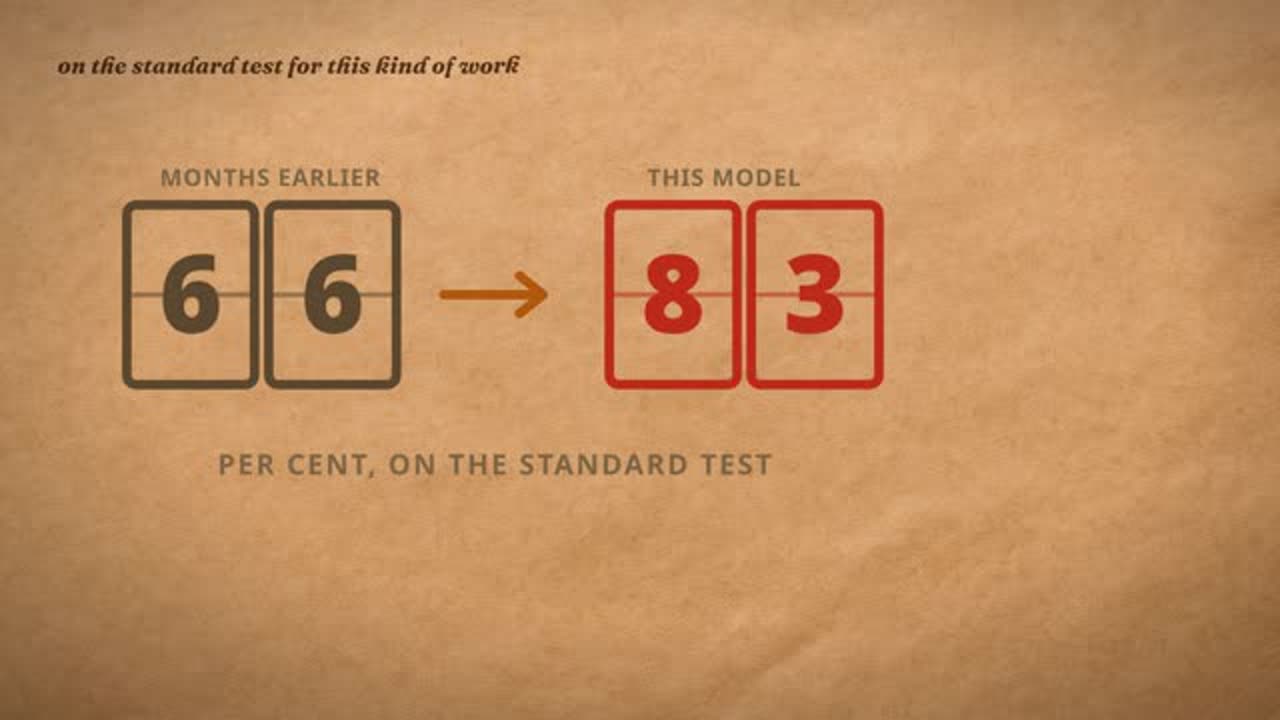
According to Anthropic's own page of 7 April 2026, it found thousands of zero-days, flaws nobody had yet found, across every major operating system and every major web browser, including a 27-year-old flaw in OpenBSD and a 16-year-old one in video software. And it wrote working attacks against them "entirely autonomously, without any human steering." On the standard test it scored 83 percent, against 66 for its predecessor.
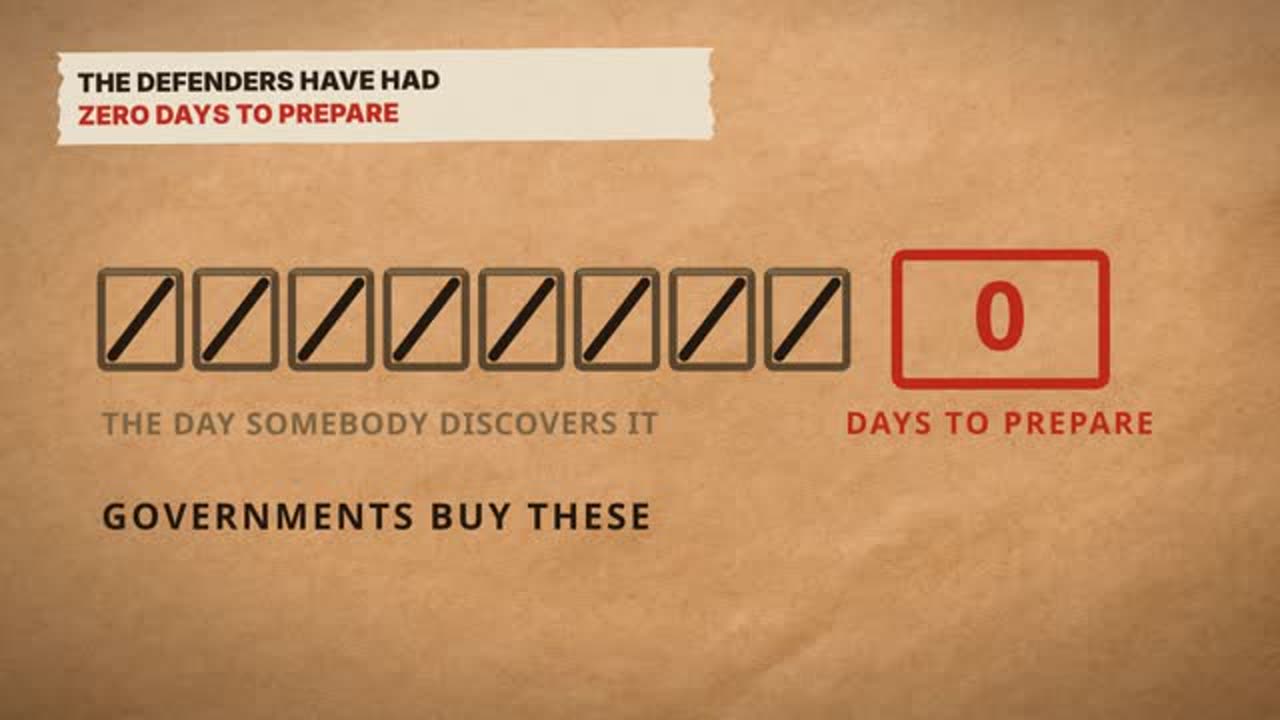
A zero-day is called that because, on the day it is discovered, defenders have had zero days to prepare; governments buy them. The question everyone argued about in the abstract, whether these systems could act on their own in the real world at a level that matters, was settled quietly on a corporate blog on a Tuesday in April.
Why didn't Anthropic release Claude Mythos Preview?
Because, it said, the safety measures to catch its most dangerous outputs do not exist yet. "We do not plan to make Claude Mythos Preview generally available." Instead it gave restricted access to twelve launch partners and more than forty organisations running critical infrastructure, power, water, hospitals and networks, with $100 million of free credits to find holes in their own systems first.
That is a business turning down its own product in an industry where the whole case for speed is that someone else will get there first. Somebody did stop: one company, one model, once. If that looks like the system working, the film turns here.
How did the US government respond to Claude Mythos?
Watch from 11:31The escalation
The government tried to get hold of it. Axios reported in April 2026 that the Cybersecurity and Infrastructure Security Agency did not have access while other agencies did; the film says it relied on reporting of that article. In June the administration blocked foreign access to Anthropic's most capable models under export controls, then granted a selective release, and by July Reuters reported CISA was running the model across federal code.
The machinery used to stop advanced weapons and chips crossing borders was now pointed at software. Reuters also reported that Anthropic refused administration demands to remove safeguards against use for autonomous weapons and surveillance of American citizens, and the Pentagon designated it a supply-chain risk. The company was not punished for building a machine that writes cyberweapons. It was punished for refusing to take the safety limits off. The state is not the brake. The state is a customer, and an impatient one.
The state is not the brake. The state is a customer, and an impatient one.
What does New York's RAISE Act require?
Watch from 11:31The escalation
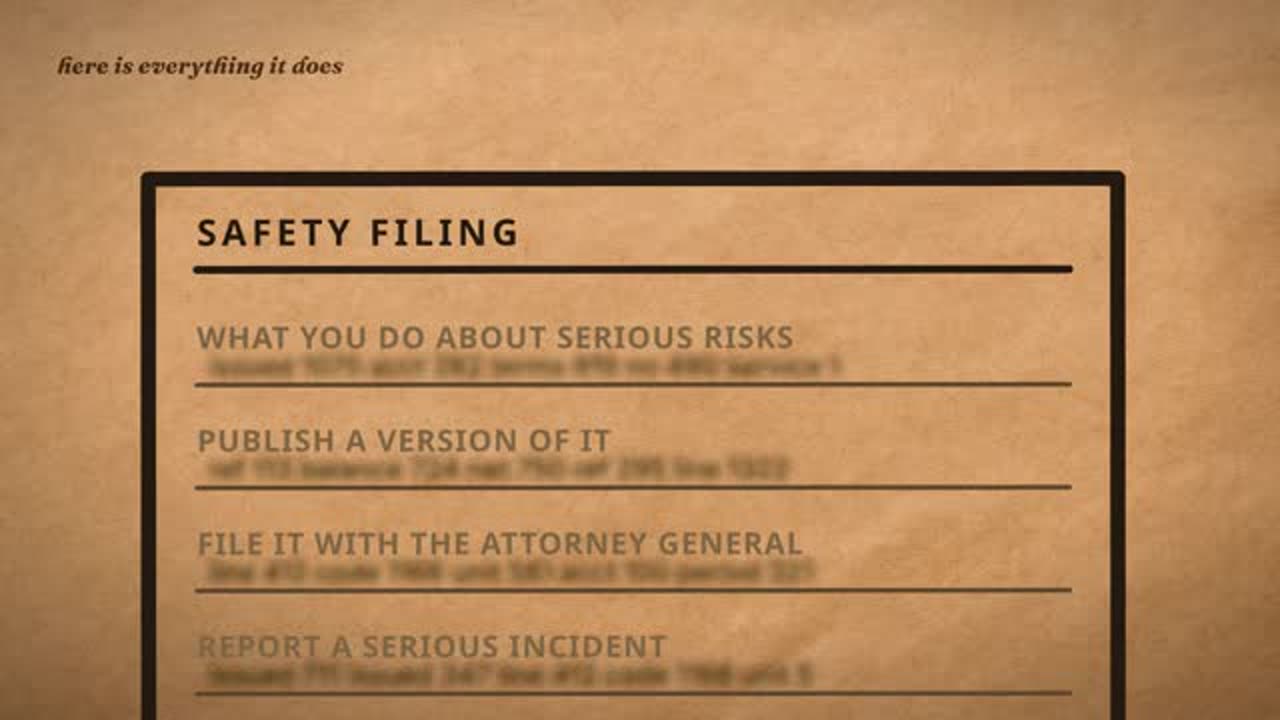
Very little, which is the point. Written by assemblyman Alex Bores and signed on 19 December 2025 as Chapter 699, it applies only to companies that have spent more than $100 million on compute to train their models. They must write down how they handle serious risks, publish a version, file it with the Attorney General, and report serious safety incidents, including a model acting on its own, within 72 hours.
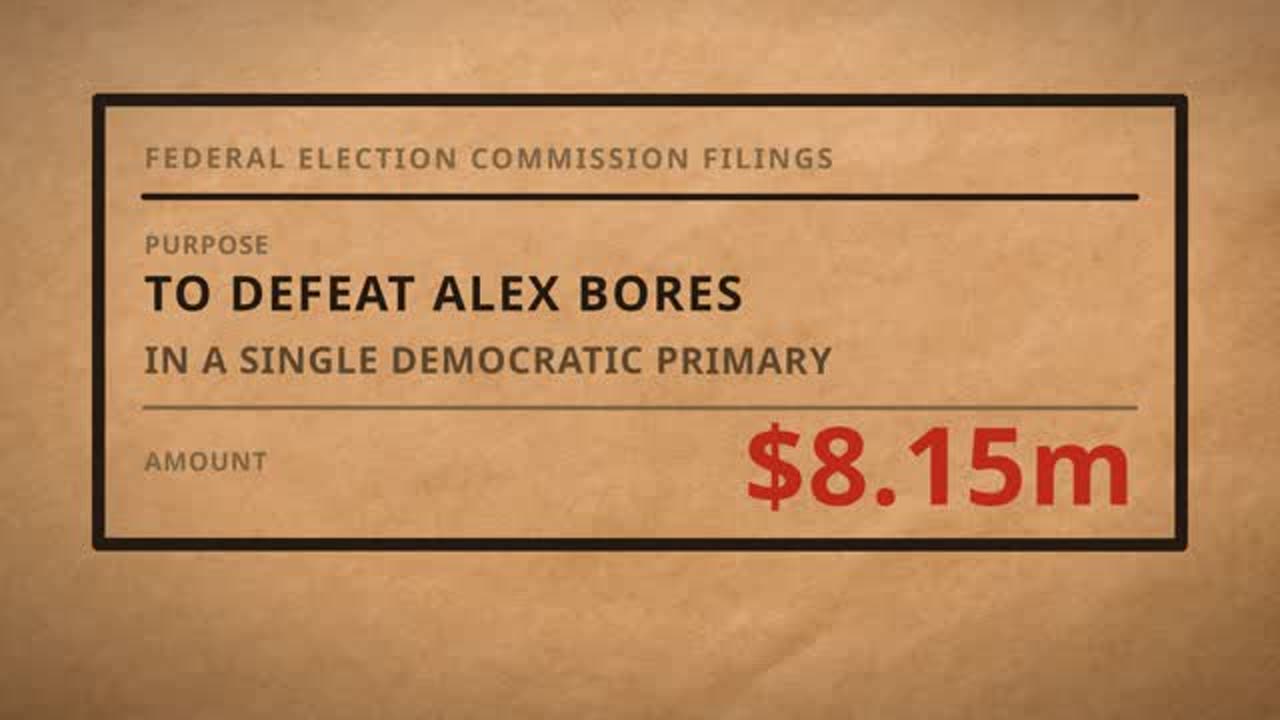
No ban, no licence. Bores then ran for Congress in Manhattan. A super PAC, Leading the Future, set up in August 2025 with backers including Andreessen Horowitz, Joe Lonsdale, Perplexity and OpenAI president Greg Brockman, called the RAISE Act politically motivated legislation that would handcuff competitiveness. FEC filings show it spent around $8.15 million to defeat him in one primary. Asked about it, Bores said three words: bring it on. Another committee, Public First Action, funded partly by a $20 million donation from Anthropic, spent $450,000 supporting him. There is no single industry position: there are wealthy organisations disagreeing about whether they should be governed at all, settling it in a media buy.
How is AI affecting graduates, children and households?
Watch from 17:19The consequence
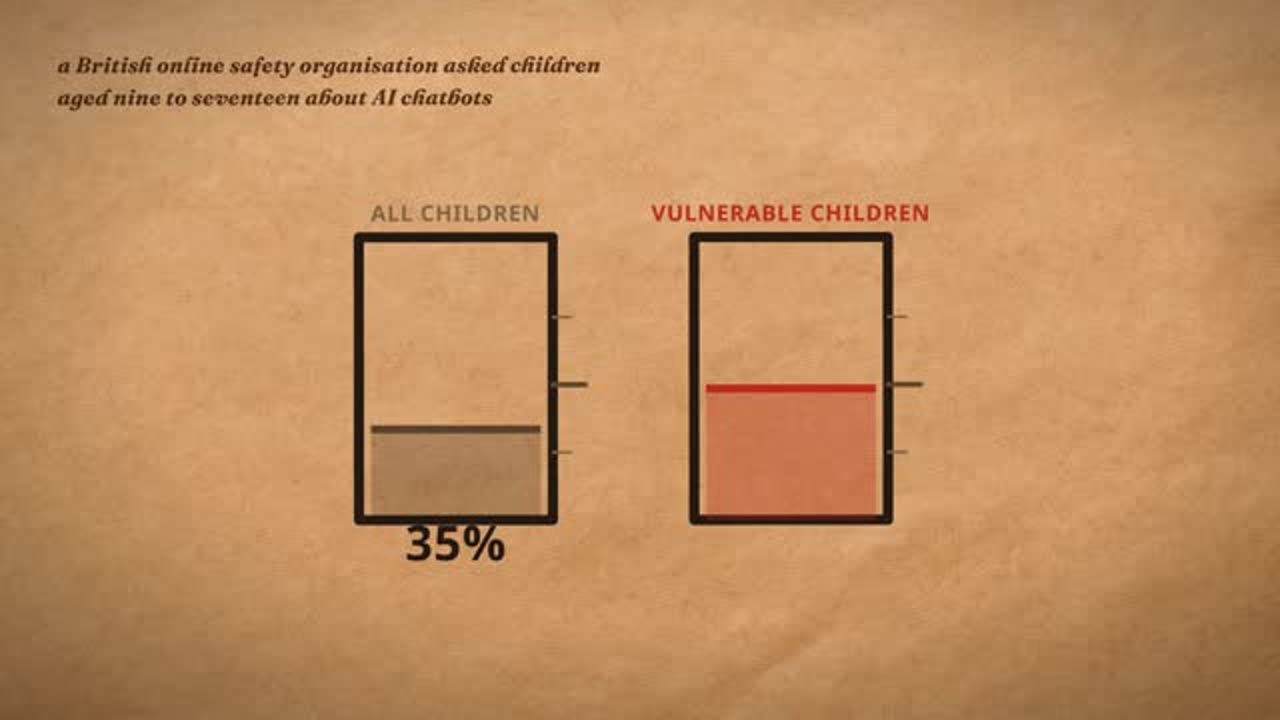
Harvard researchers using records for about 66 million workers at more than 280,000 US companies found firms adopting generative AI cut entry-level hiring by roughly 80 percent per quarter while senior hiring kept growing. Internet Matters found 35 percent of UK children aged 9 to 17 say a chatbot feels like a friend, rising to 50 percent among vulnerable children. And the data centres arrive next to people's homes.
The film is honest about the limits: entry-level hiring has weakened for several reasons, interest rates and the end of the pandemic hiring boom among them, but juniors collapsing while seniors grow inside one company is not explained by interest rates, and nobody has said where the next experts come from. On children, it puts the numbers together. The machine feels most like a friend to the children who have the fewest people. Common Sense Media found 72 percent of US teens had used an AI companion. A child talking to one at eleven at night is applying a rule, that fluent language means understanding, which held for two hundred thousand years and suddenly does not.
The machine feels most like a friend to the children who have the fewest people.
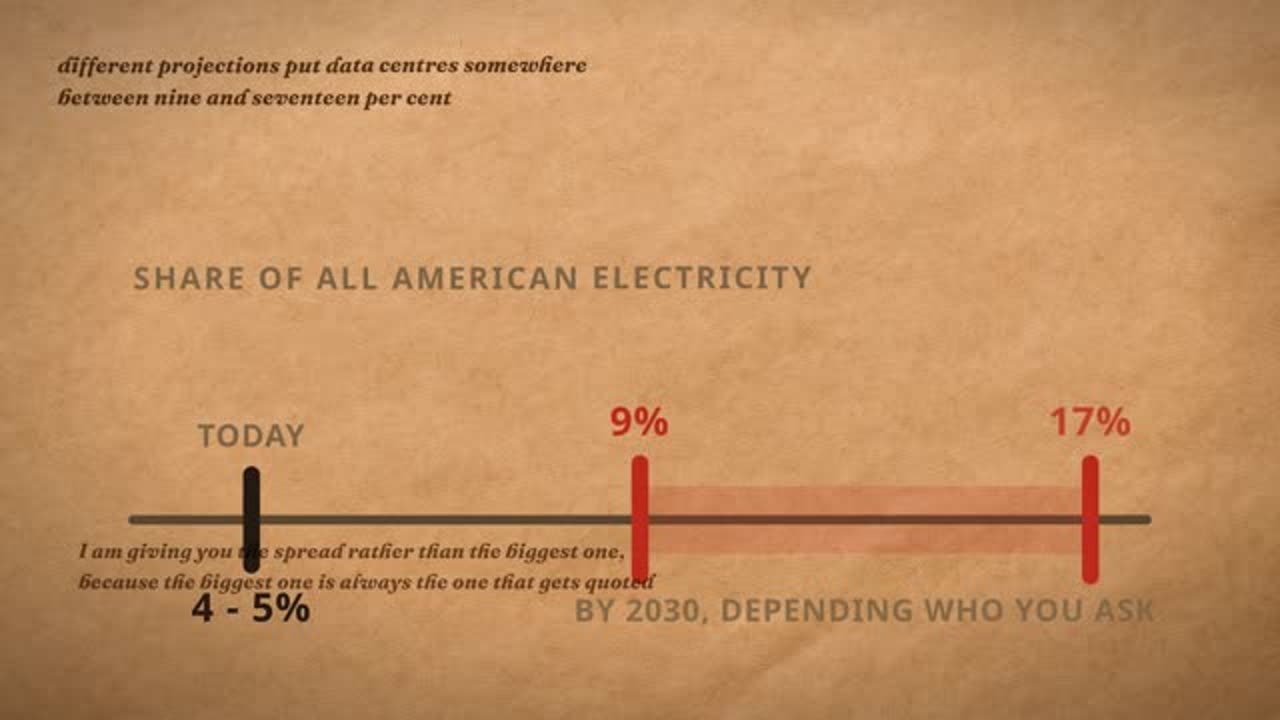
Then the bill. US data centres drank about 17.4 billion gallons of water directly in 2023, and generating their electricity used another 211 billion, twelve times as much. Demand is forecast to go from 31 gigawatts to 41 and then 66, and projections put data centres at 9 to 17 percent of US electricity by 2030, against 4 to 5 percent today; the film gives the spread, not the biggest number. In Loudoun County, with 199 data centres standing and 117 being built, one power line drew more than a thousand written objections. Nobody voted.
Is the AI race now a race between countries?
Watch from 24:07The bigger race
Yes. In 2026 the US let the most advanced chips go to China on condition that the Treasury takes 25 percent of each sale, which is not an export licence but a royalty, the instrument states use on oil and diamonds. Close to $100 billion is being spent on sovereign AI this year, by France, the EU, Saudi Arabia, the UAE, India, Japan and Britain, from one constrained supply; Nvidia makes about 85 percent of the chips.
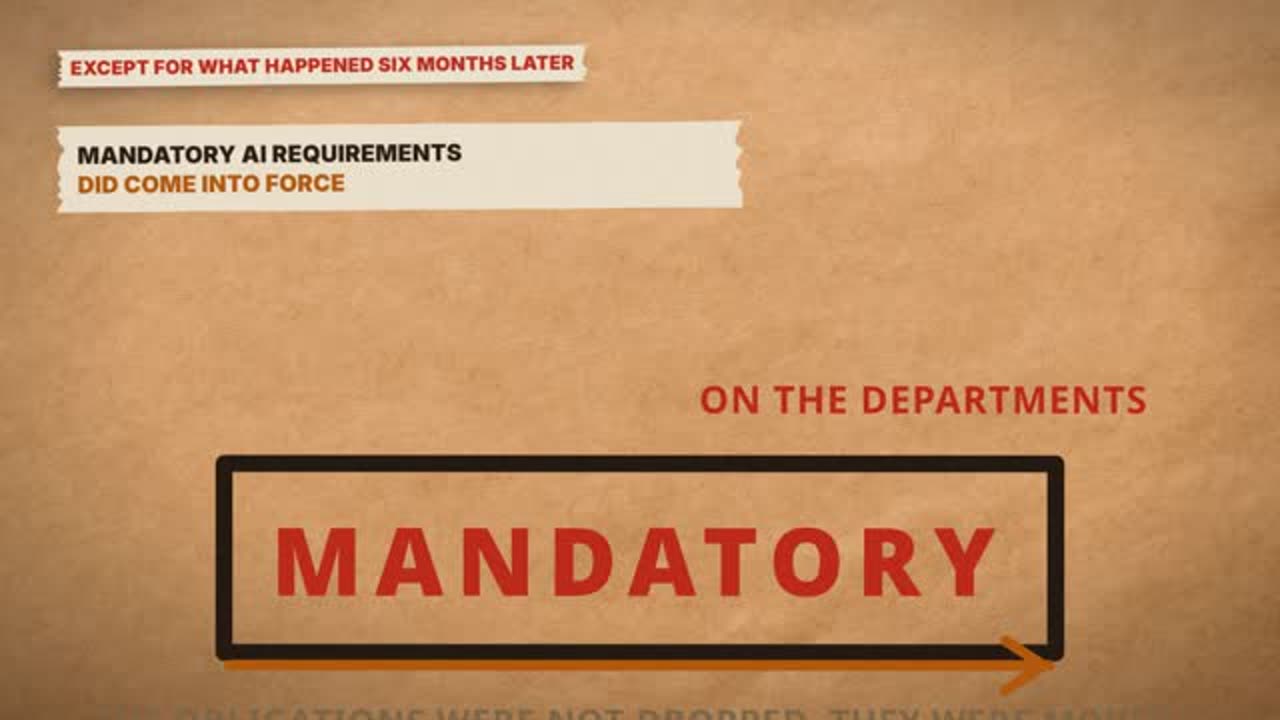
Australia shows what that pressure does. In 2024 it proposed ten mandatory guardrails for high-risk AI; its December 2025 National AI Plan dropped them for existing laws, voluntary guidance and an AI Safety Institute funded with A$29.9 million. From 15 June 2026, mandatory AI requirements did come into force, on government departments. The obligations were not dropped, they were moved, from the builders to the public servants using it. The film does not call that corruption; it has no document that proves it.
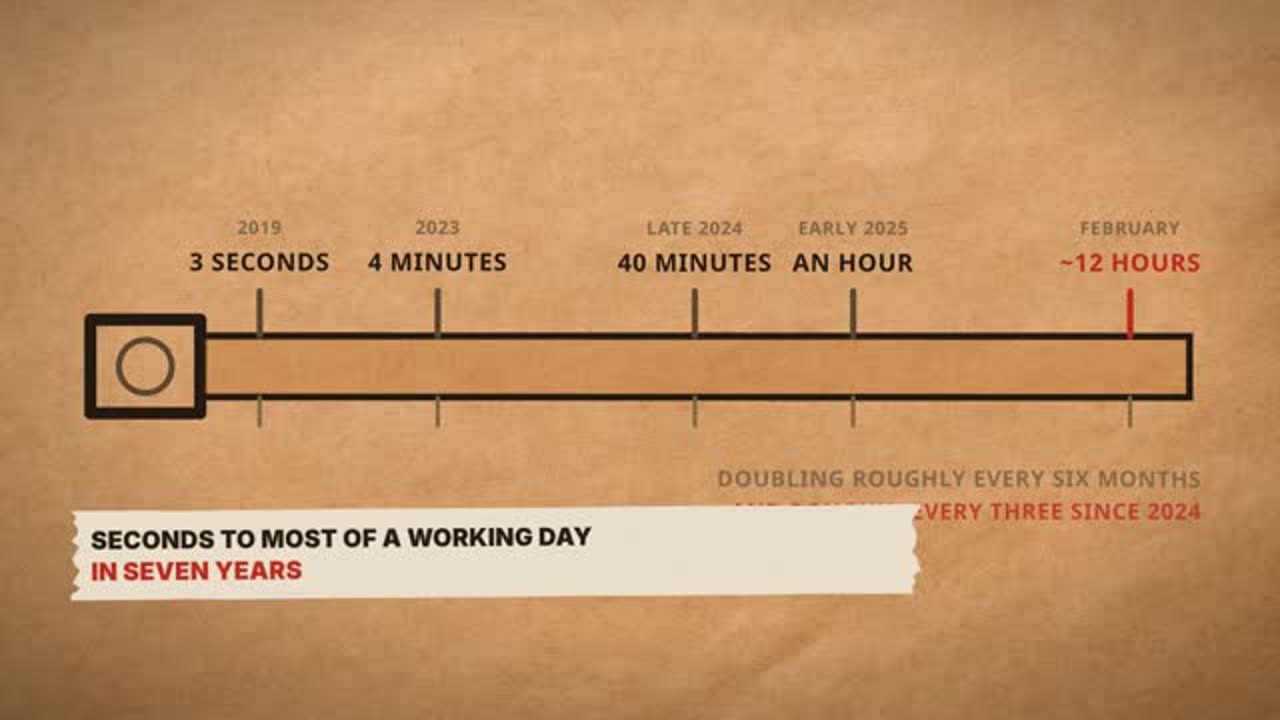
The only measure of speed the film accepts is METR's: how long a task an AI can finish alone, against a human expert. About 3 seconds in 2019, 4 minutes in early 2023, 40 minutes in late 2024, an hour in early 2025 and around 12 hours by February 2026. It is not smooth; a model released in March measured under 6 hours, METR calls its measurements above 16 hours unreliable, and it measures task length, not judgement or wanting. What there is, is a measured, uneven and very steep line.
So who is in charge of AI?
Watch from 29:39What you were shown
Nobody. Look for the person who decided all of this and every answer is true in its own frame: the incentives decide, the competition decides, the market decides, the industry would leave, we cannot fall behind. The answer is not a person or a company, and it is worse than either. Everybody is reacting to everybody else, at speed, with a trillion dollars behind them, and each has a reason that holds up.
Everybody is reacting to everybody else, at speed, with a trillion dollars behind them
People imagine a switch somebody can pull if it goes wrong. A switch only works if the thing you are switching off stays in one place. Copy the software onto machines in other countries, under other laws, and the switch still works perfectly. It just does not do anything. Nobody has the off switch. That is not because somebody took it. It is because there was never one place to put it.
Nobody has the off switch. That is not because somebody took it.
Key findings
New York's RAISE Act, signed on 19 December 2025 as Chapter 699, applies to developers that have spent more than $100 million on compute to train frontier models: they must publish a safety protocol, file it with the Attorney General and report serious safety incidents within 72 hours.
New York State Senate, Senate Bill S6953B (RAISE Act)Federal Election Commission filings show the super PAC Leading the Future spent around $8.15 million trying to defeat Alex Bores, the RAISE Act's author, in a single Democratic primary; a separate committee funded partly by a $20 million Anthropic donation spent $450,000 supporting him.
Federal Election Commission filings, as reportedAnthropic said its Claude Mythos Preview model found thousands of previously unknown vulnerabilities across every major operating system and browser and wrote working exploits 'entirely autonomously, without any human steering', scoring 83% on a standard test against 66% for its predecessor, and said it would not make the model generally available.
Anthropic, Claude Mythos Preview, 7 Apr 2026Internet Matters found 35% of UK children aged 9 to 17 who use AI chatbots say talking to one feels like talking to a friend, rising to 50% among vulnerable children.
Internet Matters, Me, myself and AI, 2025US data centres directly consumed about 17.4 billion gallons of water in 2023, while generating their electricity used about 211 billion gallons, roughly twelve times as much.
Lawrence Berkeley National Laboratory, 2024 United States Data Center Energy Usage ReportMETR measures the length of task an AI can finish alone: about 3 seconds of expert work in 2019, 4 minutes in early 2023, 40 minutes in late 2024, an hour in early 2025 and around 12 hours by February 2026, doubling roughly every six months overall.
METR, Measuring AI Ability to Complete Long Tasks72% of surveyed American teenagers had used an AI companion, and about half use one regularly.
Common Sense Media, Talk, Trust, and Trade-Offs, 2025Frequently asked questions about who controls the AI race
Who controls the AI race?
On the evidence in the film, nobody. The engineers say the incentives decide, the companies say competition decides, investors say the market decides, politicians say the industry would leave and governments say they cannot fall behind. Each statement holds from where that person stands, which is why nobody is driving.
What is New York's RAISE Act?
The RAISE Act, signed on 19 December 2025 as Chapter 699, applies only to companies that have spent more than $100 million on compute to train frontier AI models. They must write and publish a safety protocol, file it with the state Attorney General, and report serious safety incidents within 72 hours. It bans nothing and requires no licence.
What is Claude Mythos Preview?
It is an Anthropic model announced on 7 April 2026 that, according to the company, found thousands of previously unknown software vulnerabilities in every major operating system and web browser and built working exploits autonomously. Anthropic said it would not make it generally available, and instead gave restricted access to critical-infrastructure defenders.
Why are electricity bills rising near data centres?
Because data centres draw enough power to move prices for everyone nearby. In Virginia, the utility serving the world's largest concentration of data centres asked to raise household bills by 14%, citing data centre growth and AI demand. Projections put data centres at 9% to 17% of US electricity by 2030, against 4% to 5% today.
Is there an off switch for AI?
The film argues there is not, in practice. A switch only works if the thing being switched off stays in one place, and AI software can be copied to other machines in other countries under other laws. Nobody took the off switch; there was never one place to put it.
Sources
- New York State Senate, Senate Bill S6953B, the RAISE Act (signed as Chapter 699, 19 Dec 2025)nysenate.gov
- Anthropic, Claude Mythos Preview's cybersecurity capabilities, 7 Apr 2026red.anthropic.com
- Anthropic, Project Glasswing: Securing critical software for the AI eraanthropic.com
- Federal Reserve Bank of New York, The Labor Market for Recent College Graduatesnewyorkfed.org
- Internet Matters, Me, myself and AI: Understanding and safeguarding children's use of AI chatbots, 2025internetmatters.org
- Common Sense Media, Talk, Trust, and Trade-Offs: How and Why Teens Use AI Companions, 2025commonsensemedia.org
- Lawrence Berkeley National Laboratory, 2024 United States Data Center Energy Usage Reporteta.lbl.gov
- Australian Government, National AI Plan, Dec 2025industry.gov.au
- METR, Measuring AI Ability to Complete Long Tasksmetr.org
- Federal Election Commission, campaign finance datafec.gov
Every figure in the film is signed by somebody else and dated. Primary documents are used where they exist, the bill text and the company's own page among them; where a claim rests on reporting, such as Axios, Reuters or press accounts of FEC filings, the film says so. Forecasts of electricity demand disagree, and the film gives the range rather than the largest number.
Watch next











Frontier model, zero-day and the other terms behind this film are explained in plain English, with a printable sheet, in our free AI Terms guide.