There is an assumption sitting underneath almost everything written about artificial intelligence and work. If a machine can do a task a hundred times faster than a person, the job built on that task should disappear. Speed goes in, the job goes out. That arithmetic keeps failing, and not because the machines are not good enough. Some of them have been good enough for fifty years and it changed almost nothing.
A job is hardly ever one task. It is a system: connected tasks, other people, tools, decisions, infrastructure, regulations, customers and the ordinary mess of the physical world. Make one part of a system faster and you do not get a faster system. You get a system whose slowest point has moved somewhere else. Our 43-minute documentary for The Signal follows that pattern through nine cases, from a Stanford program in 1979 to the electricity grid in 2026. This piece follows it chapter by chapter, with the evidence for each.
The film in 20 chapters
Pick a chapter and the film starts there. 43:28 in all.
- 010:00The assumption
- 021:16Self-driving cars
- 034:22The last mile
- 045:57The bottleneck
- 058:11Coding
- 0611:30The AI that was already good enough
- 0714:41Watson
- 0817:32The automation that worked
- 0919:37The human system
- 1021:05Product-market fit
- 1123:23Electricity
- 1226:04Technology needs infrastructure
- 1327:48AI's physical bottleneck
- 1430:09The human infrastructure
- 1531:55The surprising job creator
- 1634:39What AI could do
- 1736:18The jobs transition
- 1838:52The bigger question
- 1940:34The final bottleneck
- 2042:09The conclusion
Why are self-driving cars still not finished?
Watch from 1:16Self-driving cars
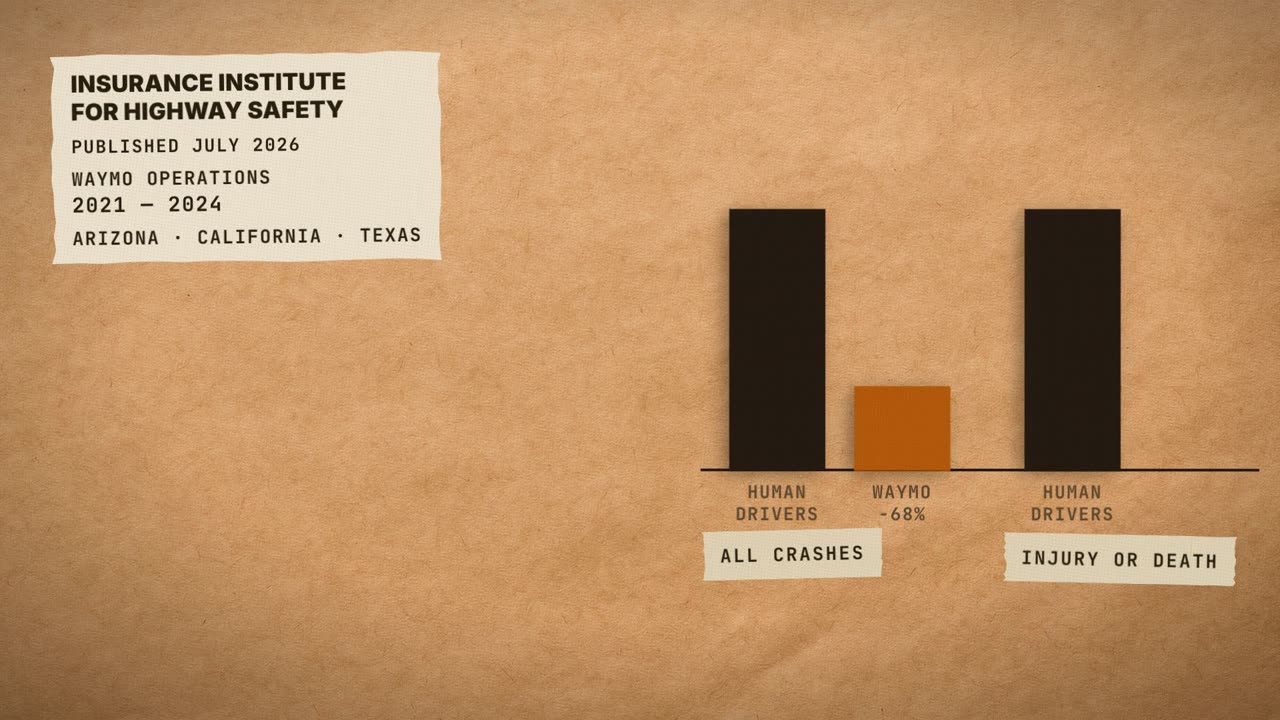
Not because the machines cannot drive. As of June 2026, Waymo had driven around 200 million fully autonomous miles and ran about half a million paid rides a week, and a Swiss Re study of 25 million of its miles found 92 percent fewer bodily-injury claims than human drivers. What is not finished is everything that is not ordinary driving.
A cone where cones should not be. A ladder fallen across a lane thirty seconds ago. A police officer waving traffic through a red light, so the rule the car was taught to obey absolutely is suddenly the wrong rule. Temporary lines painted over the real ones. A child stepping out between parked cars. An event that happens once every million miles sounds negligible until you notice Waymo alone drives millions of miles a week. At that scale, once-in-a-million is a Tuesday.
At that scale, once-in-a-million is a Tuesday.
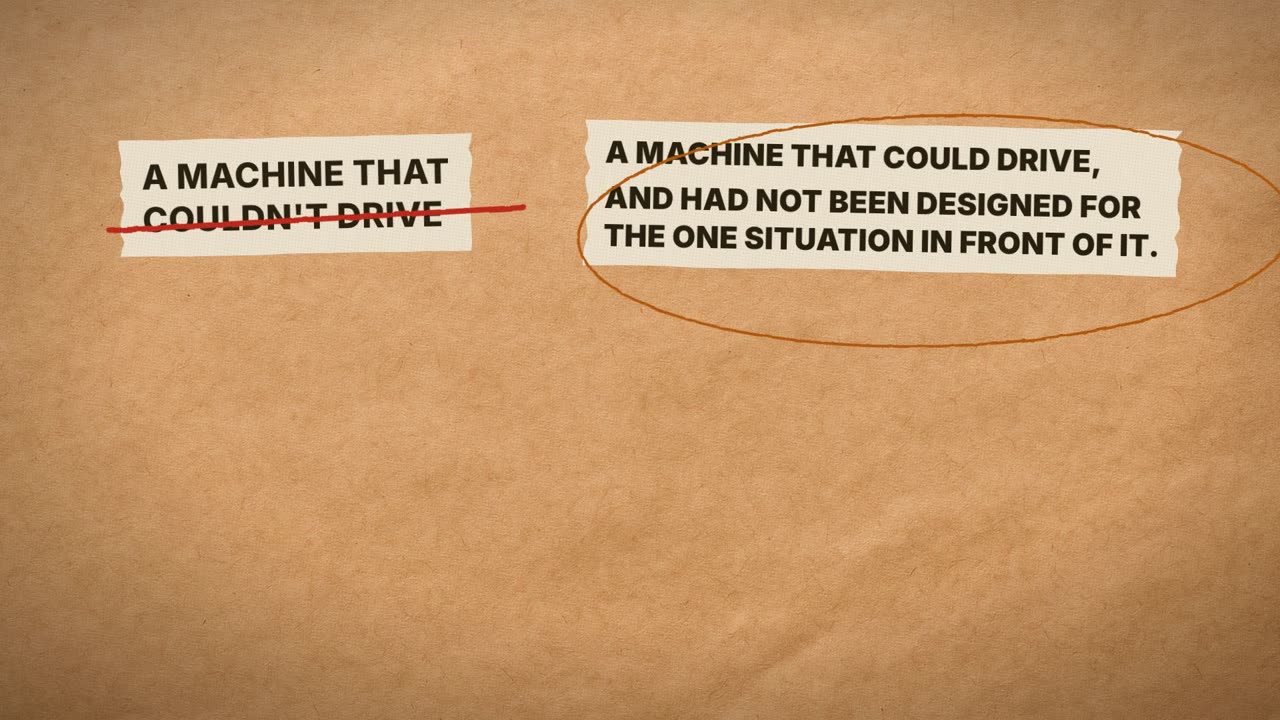
On 18 March 2018, in Tempe, Arizona, an Uber test vehicle struck and killed Elaine Herzberg as she crossed the road with a bicycle. Investigators found the system detected something about six seconds before impact and kept changing its mind about what it was, unknown object, vehicle, bicycle, with each reclassification resetting its prediction of her path. Emergency braking had been disabled under computer control. That is not a story about a machine that couldn't drive. It is a story about a machine that could drive, and had not been designed for the one situation in front of it.
What is the last mile problem in AI?
The last mile is the name telecoms companies gave to the part of a network that eats the budget: connecting the trunk line to every individual house, each with a different wall, lease, owner and local rule. There is no single last mile, there are millions, and the twenty-millionth is no easier than the first. Almost every ambitious technology has one, and it is usually where the years go.
Building a system that works on a well-defined problem responds to talent and money. Connecting it to every real road, hospital, factory, warehouse and customer is a different difficulty, because the exceptions come from the world being large. So the question that decides whether your job changes is not how to make AI smarter. It is how it survives contact with every strange individual case.
What does the theory of constraints say about AI and work?
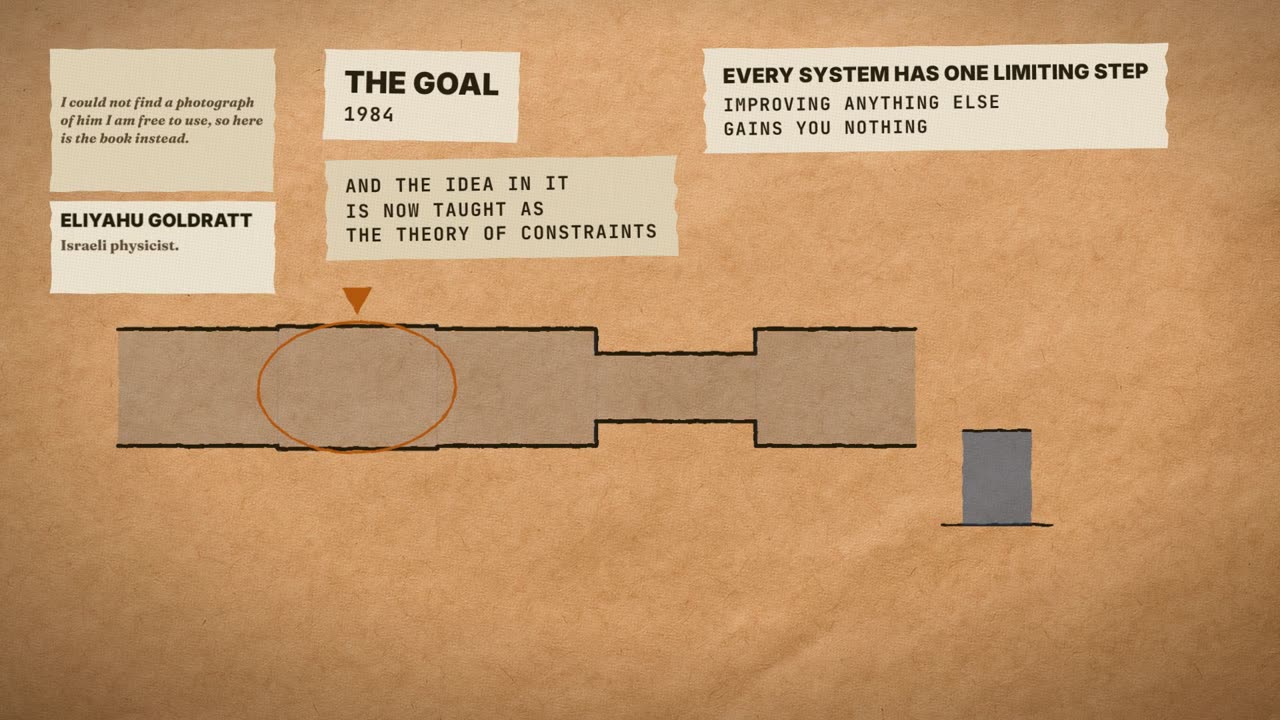
The theory says improving anything except the narrowest step gains nothing. The physicist Eliyahu Goldratt set it out in his 1984 book The Goal: every system has one limiting step, and once you widen it, the flow rises until it meets the next narrowest point. Widening a pipe never eliminates the bottleneck. All it does is move it somewhere you were not looking.
Widening a pipe never eliminates the bottleneck. All it does is move it somewhere you were not looking.
Hold that against a real job. A software engineer does not just write code. They understand what the customer is really asking for, decide how the system should be shaped, write the code, test it, find out why it doesn't work, fix it, get it into production, keep it alive for four years, and explain to a non-technical person why the thing they want will take three weeks. Writing code is one section of that pipe.
Does AI make software developers faster?
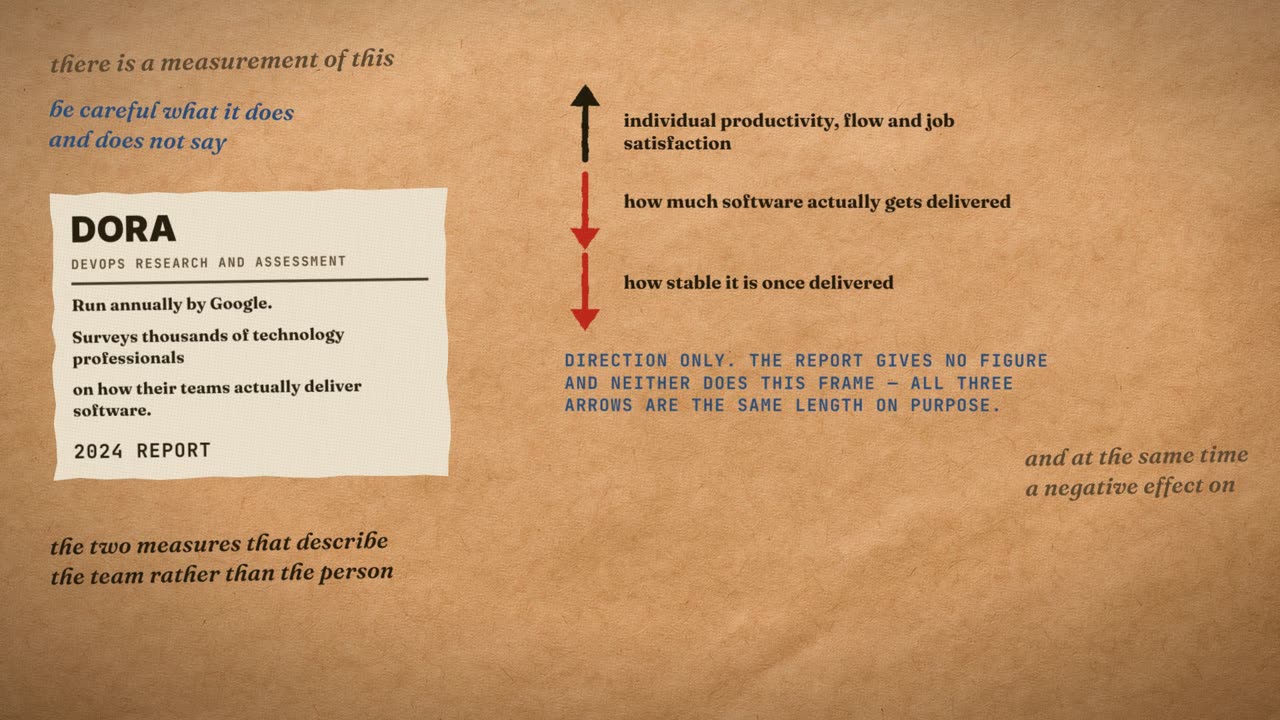
Individually it feels that way; measured, it is less clear. In a 2025 randomised trial by METR, 16 experienced open-source developers working on 246 real tasks expected AI to make them 24 percent faster, believed afterwards it had made them 20 percent faster, and were measured 19 percent slower. Google's 2024 DORA report found AI raised individual productivity and satisfaction while hurting delivery throughput and stability.
AI can code, and anything pretending otherwise is worthless; a model produces hundreds of lines in seconds and today's systems are far better than those of eighteen months ago. What happens is that generation becomes nearly free and everything downstream does not. The code still has to be read by somebody whose name goes on it, tested, and understood well enough to change next year, and its failures are plausible, well-formatted and confidently wrong, the hardest kind to catch. Sixteen people do not settle anything about a whole industry. What the study shows is more unsettling than a productivity figure: the people doing the work could not tell which way they were going. The bottleneck has moved, decisively, to review, testing, debugging and architecture, which were always the parts that were actually the job.
Why was MYCIN, an AI that beat doctors in 1979, never used?
Watch from 11:30The AI that was already good enough
Because of the typing, not the intelligence. MYCIN, built at Stanford by a team led by Edward Shortliffe, recommended antibiotics for serious infections using about 600 hand-written rules. In a blinded 1979 JAMA evaluation of 10 meningitis cases, eight specialists rated its recommendations acceptable 65 percent of the time; the five Stanford faculty it was measured against scored between 42.5 and 62.5 percent.
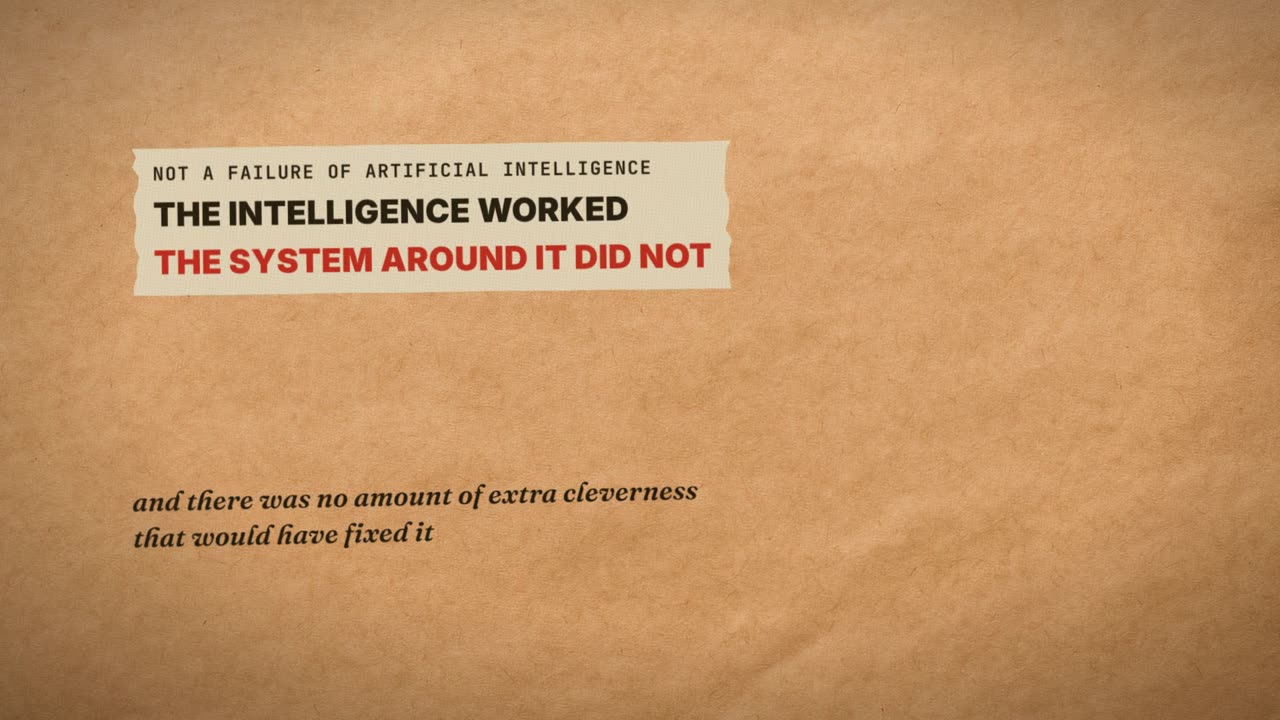
It was never adopted, and nobody disputed the result. MYCIN ran on a DEC PDP-10, a shared mainframe reached over the ARPANET, years before a personal computer sat on anybody's desk. It knew nothing about a patient until a doctor sat at a terminal and typed the answer to every question it asked, case after case. There were unresolved legal questions too, about who is responsible when a program is wrong. But the bottleneck in treating an infected patient was never the reasoning. It was getting what was in the room into the machine, and MYCIN made that part worse. The intelligence worked. The system around the intelligence did not.
The intelligence worked. The system around the intelligence did not.
Why did IBM Watson fail in cancer care?
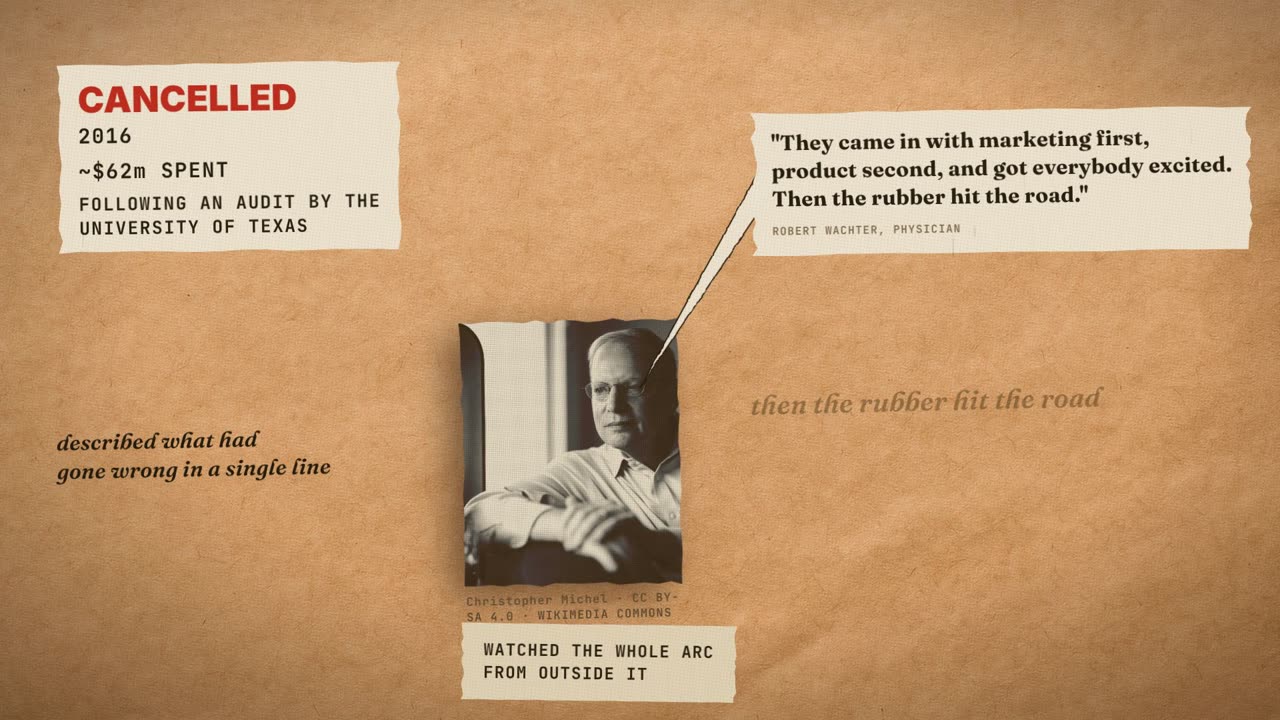
Because removing MYCIN's bottleneck exposed the next one. By the 2010s records were digital, so IBM bet that Watson, fresh from winning Jeopardy! in February 2011, could do in medicine what MYCIN never could. It invested $1 billion in its Watson unit in 2014 and about $4 billion buying health-data companies. MD Anderson cancelled its project after spending about $62 million.
The next narrow section was the data itself. The same condition written three ways by three doctors, blank fields, local abbreviations, contradictory notes, and patients who do not behave like a study average. There were so few real examples of rare situations that doctors at Memorial Sloan Kettering wrote synthetic cases, invented patients, to train it. The oncologist leading that work, Mark Kris, told IEEE Spectrum: "When it comes to cancer, it really doesn't work." The physician Robert Wachter summed up what went wrong: "They came in with marketing first, product second, and got everybody excited." Removing MYCIN's bottleneck did not deliver MYCIN's promise. It only brought everybody close enough to see the next one.
Can automation make a business worse even when it works?
Watch from 17:32The automation that worked
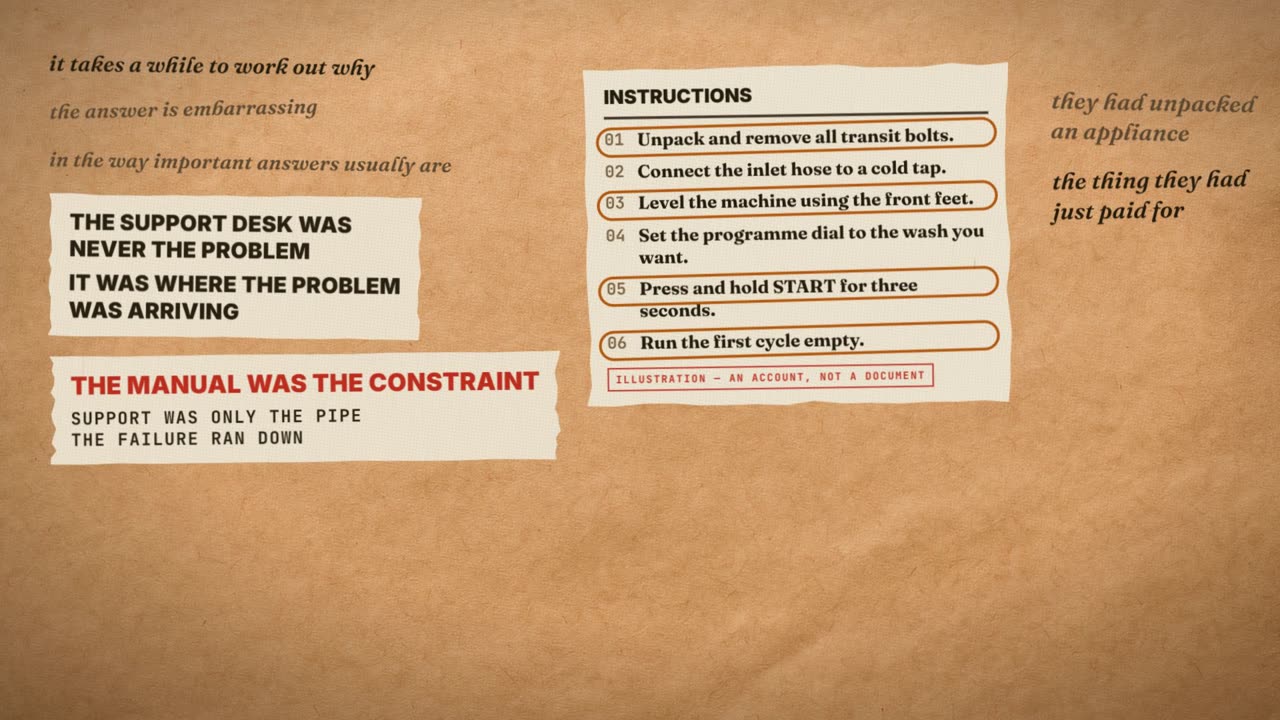
Yes, and the film tells it as an account rather than a document. An appliance company's support desk was drowning, so it automated triage, drafting and routing. Response times fell from days to hours, and every dashboard number improved. Customer satisfaction got worse, and incoming messages got angrier.
The support desk was never the problem. It was where the problem arrived. People were writing in because they could not work out how to use what they had just bought; the manual was the constraint. The automation made the company much faster at handling a symptom, so customers got a very quick apology for a confusing product instead of a slow one. What fixed it was not technology: rewritten instructions, a quick-start guide for the four things everyone got stuck on, design changes, and a phone number staffed by people. Fewer tickets arrived. A tool applied to a human system amplifies whatever it is pointed at, including the wrong thing.
Why did OpenAI shut down the Sora app?
Watch from 21:05Product-market fit
According to OpenAI's support pages, the Sora app was shut down on 26 April 2026, with its developer interface due to close that September. Sora was first shown on 15 February 2024 and reset what people thought video generation could do. The film is careful about why it closed: TechCrunch, reporting in March 2026 on a Wall Street Journal investigation, said users peaked around a million and fell under half a million while it cost an estimated million dollars a day to run.
That is the reporting's claim, not a settled fact. The shape holds either way. Technical capability and human demand are separate axes, and a thing can score ten on the first and two on the second. A tool nobody needs replaces nobody's job, however good it is.
How long did electricity take to change factories?
Decades. Factories first swapped the steam engine for one big electric motor driving the same line shaft, belts and layout, so the gains were modest. Losses in line shafting typically ran around 25 percent, and Baldwin Locomotive Works reckoned a line-shaft plant needed about 40 percent more room. The transformation came only when each machine got its own motor and the building itself was redesigned around the work.
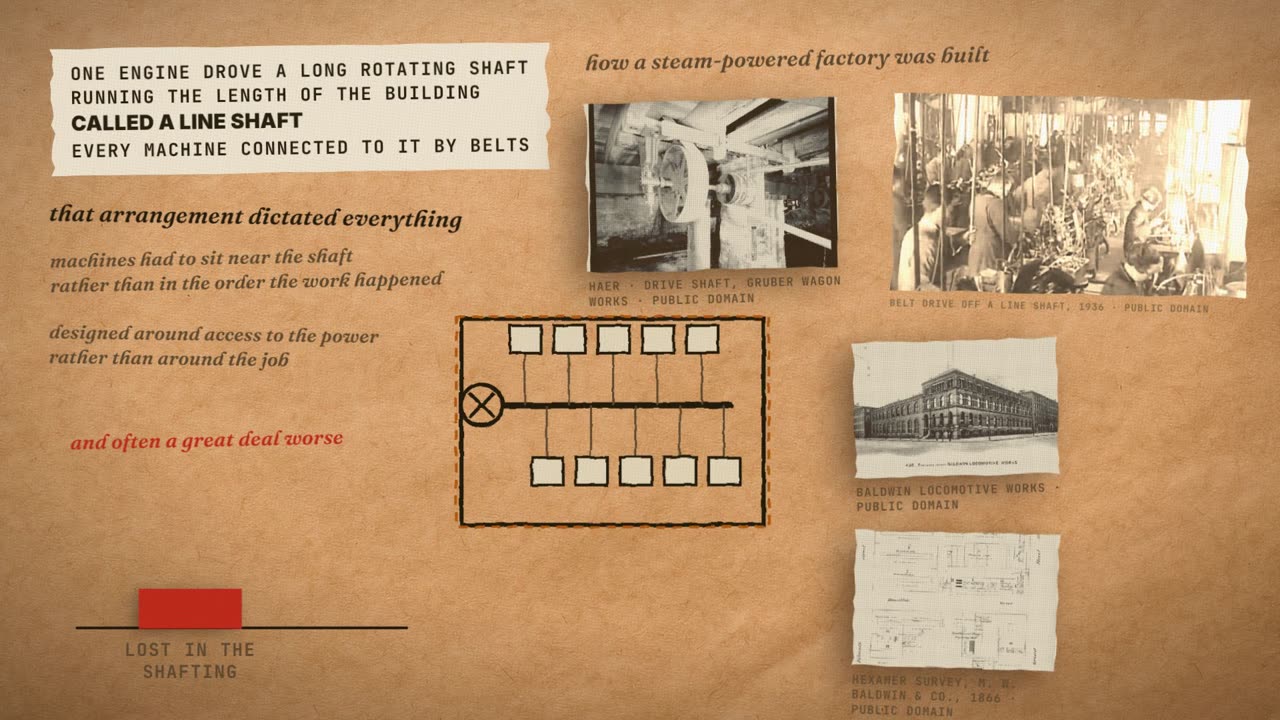
That is what made the assembly line possible, single-storey factories lit from above, and plants that could be reorganised in a week instead of never. The economist Paul David told that story in his 1990 paper The Dynamo and the Computer, answering why computers were not yet showing up in productivity figures; Robert Solow had put the complaint in 1987: "You can see the computer age everywhere but in the productivity statistics." The dynamo had looked exactly the same way, for just as long, until the buildings were rebuilt around it. A technology becomes transformative at the pace of its slowest supporting system, never at the pace of its own improvement.
A technology becomes transformative at the pace of its slowest supporting system, never at the pace of its own improvement.
How much electricity do AI data centres use?
Watch from 27:48AI's physical bottleneck
About 415 terawatt-hours in 2024, roughly 1.5 percent of world electricity, growing about 12 percent a year since 2017, according to the International Energy Agency's April 2025 report Energy and AI. Its base case has that more than doubling to around 945 TWh by 2030, and it warns that around 20 percent of planned data centre projects are at risk of delay unless grid constraints are addressed.
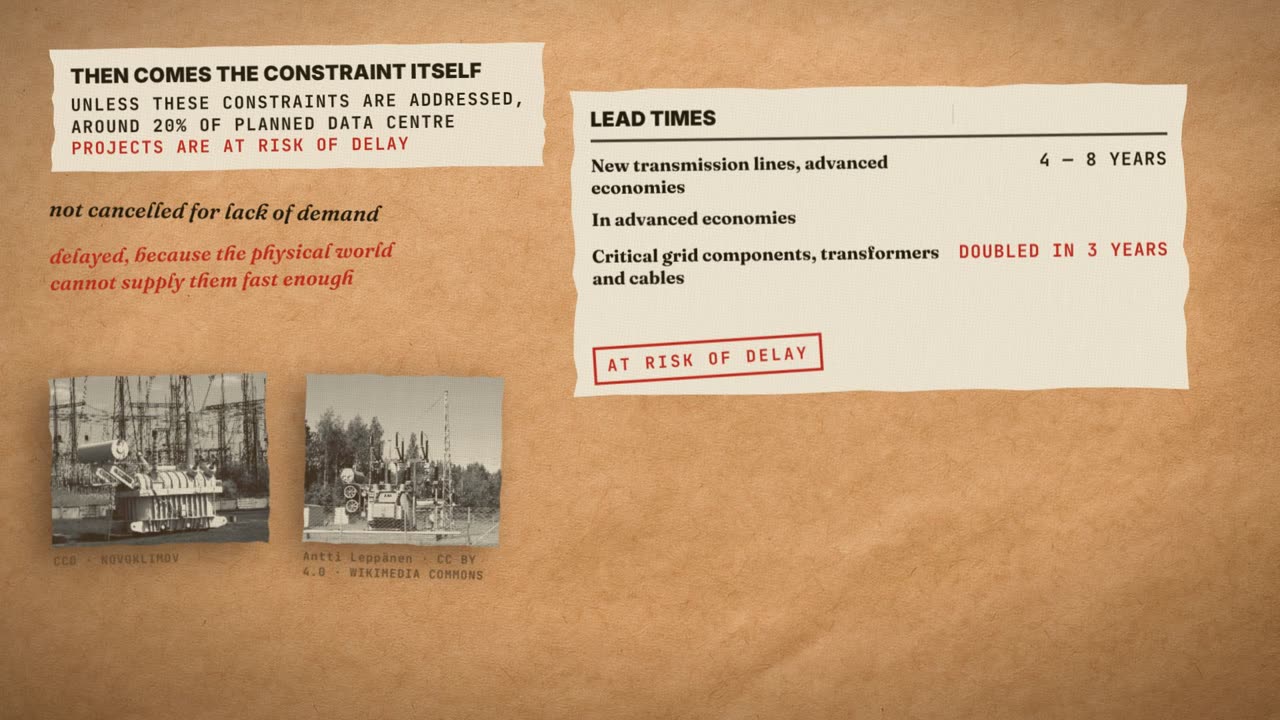
AI presents itself as weightless, but underneath the browser tab is a building the size of several football pitches, a substation, transmission lines, transformers, cooling, fibre and land with the right permissions. New transmission lines take four to eight years in advanced economies, and waiting times for transformers and cables have doubled in three years. You cannot scale software infinitely when it runs on objects that have to be manufactured, shipped, permitted, connected and cooled by people who are not available until March. And even when the chips arrive, every organisation still has to train people, rewrite processes, settle who is accountable and earn trust, none of which gets shorter because the model got better.
Did ATMs reduce the number of bank tellers?
Watch from 31:55The surprising job creator
Not in the period studied. The economist James Bessen showed that ATMs cut the tellers needed to run an average urban branch from 20 to 13 between 1988 and 2004, which made branches cheaper to open, so urban branches rose 43 percent. Fewer tellers per branch, many more branches, and the job moved towards selling and advising.
The film is straight about the limits. It is one occupation in one country over one window, and the ending is not the popular one: the Bureau of Labor Statistics counted about 339,000 tellers in 2025 and projects a 13 percent fall, around 45,000 jobs, by 2035, with online banking the thing that mattered in the end. The useful mechanism is demand expansion: making a service cheaper can make people want much more of it. That is why "AI can do this task, therefore fewer people will be needed" is incomplete. Legal advice, medical guidance, financial planning, custom software and tutoring are all rationed by price, with huge unmet demand, and the film flags as speculation how cheaper versions might land.
Is AI already hurting young workers?
Watch from 36:18The jobs transition
At the entry level, the evidence says yes. Stanford's Digital Economy Lab, tracking ADP payroll records, found employment of 22 to 25 year olds in the most AI-exposed occupations about 19 percent below their less-exposed peers in its August 2026 update, largely through hiring that quietly stopped. Klarna said in February 2024 its assistant did work equivalent to 700 full-time agents, and its workforce fell from about 5,500 in 2022 to under 3,000 by 2025.
Whole jobs rarely vanish on schedule, but people are losing work now. Roles that were mostly one narrow task go; some reductions are blamed on AI for communications reasons; a team of twelve becomes eight; and the new roles do not appear in the same month, city or person. The defensible claim is not "don't worry". Total job elimination is not what the evidence shows, and the transition can still be brutal for anyone trying to get onto a ladder whose bottom rungs are being automated first.
So will AI replace your job?
Watch from 42:09The conclusion
Not in the way the arithmetic predicts. In 2026, as across nine cases, AI can replace tasks far faster than it can replace systems, and everything you are paid for sits inside a system. Coding moved the constraint to review; MYCIN was blocked by data entry; Watson by messy data; the support desk by a manual; electricity by the walls; AI now by transformers, training, liability, regulation and trust.
That is why a technology can be brilliant and change nothing for years, and why, when change comes, it looks less like your job disappearing and more like your job becoming a different job while keeping its name. The speed is set by how quickly we redesign the things around the models, businesses, workflows, training, infrastructure and laws, which has never once moved at the speed of the technology that provoked it. The factories had the electricity for thirty years before anybody moved the walls.
The factories had the electricity for thirty years before anybody moved the walls.
Key findings
In a 1979 blinded evaluation published in JAMA, eight infectious-disease specialists rated MYCIN's antibiotic recommendations acceptable in 65% of 10 meningitis cases, against 42.5% to 62.5% for Stanford faculty. MYCIN was never used on a real patient.
Yu et al., Antimicrobial Selection by a Computer, JAMA, 1979In a randomised trial of 16 experienced open-source developers on 246 real tasks, developers using AI were 19% slower, though they expected to be 24% faster and afterwards believed they had been 20% faster.
METR, July 2025Google's 2024 DORA report found AI adoption raised individual productivity, flow and job satisfaction while having a negative effect on software delivery throughput and stability.
Google DORA, Accelerate State of DevOps Report 2024MD Anderson Cancer Center cancelled its Watson project after spending about $62 million; IBM had invested $1 billion in its Watson unit in 2014 and about $4 billion buying health-data companies.
Eliza Strickland, IEEE Spectrum, 2 Apr 2019Data centres used about 415 terawatt-hours of electricity in 2024, roughly 1.5% of world consumption, projected to reach about 945 TWh by 2030, with around 20% of planned projects at risk of delay from grid constraints.
International Energy Agency, Energy and AI, April 2025After ATMs spread, the number of tellers per urban bank branch fell from 20 to 13 between 1988 and 2004, but urban branches rose 43%, so teller jobs did not collapse in that period.
James Bessen, Toil and Technology, IMF Finance and Development, March 2015Stanford researchers using ADP payroll data found employment of 22 to 25 year olds in the most AI-exposed occupations about 19% below that of less-exposed peers in their August 2026 update, mostly through hiring that stopped.
Brynjolfsson, Chandar & Chen, Canaries in the Coal Mine, Stanford Digital Economy LabA Swiss Re study of 25 million Waymo miles found 92% fewer bodily-injury claims than human drivers.
Waymo and Swiss Re, December 2024Frequently asked questions about why AI isn't replacing jobs
Why isn't AI replacing jobs as fast as predicted?
Because a job is rarely one task. It is a system of connected tasks, people, tools, rules and infrastructure, and making one part faster moves the bottleneck somewhere else. The film follows that pattern through nine cases, from MYCIN in 1979 to the electricity grid in 2026.
What is the theory of constraints?
It is the idea, set out by the physicist Eliyahu Goldratt in his 1984 book The Goal, that every system has one limiting step, and improving anything except that step gains nothing. Once you widen the narrowest point, the flow rises until it meets the next constraint, so the bottleneck moves rather than disappears.
What was MYCIN?
MYCIN was an expert system built at Stanford in the 1970s by a team led by Edward Shortliffe to recommend antibiotics for serious infections. In a 1979 blinded test its recommendations were rated acceptable more often than those of Stanford faculty, but it was never used on real patients, largely because doctors had to type every answer into a shared mainframe.
Did ATMs replace bank tellers?
Not at first. James Bessen showed that ATMs cut the tellers needed per urban branch from 20 to 13 between 1988 and 2004, but made branches cheaper, so banks opened 43% more of them. The US Bureau of Labor Statistics now projects teller jobs falling about 13% by 2035, with online banking the bigger factor.
Is AI already affecting entry-level jobs?
Yes, on the best available evidence. Stanford's Digital Economy Lab, using ADP payroll records, found 22 to 25 year olds in the most AI-exposed occupations about 19% below their less-exposed peers in August 2026, mostly because hiring stopped rather than because people were fired.
Why did IBM Watson Health fail in cancer care?
Real clinical records were messy and rare cases were scarce, so doctors at Memorial Sloan Kettering wrote synthetic cases to train it. MD Anderson cancelled its Watson project after spending about $62 million. The oncologist Mark Kris said: 'When it comes to cancer, it really doesn't work.'
Sources
- Yu, Fagan, Wraith et al., Antimicrobial Selection by a Computer: A Blinded Evaluation by Infectious Diseases Experts, JAMA, 1979jamanetwork.com
- National Transportation Safety Board, investigation HWY18MH010, Uber test vehicle crash, Tempe, Arizona, 18 Mar 2018ntsb.gov
- Waymo, New Swiss Re study: Waymo is safer than even the most advanced human-driven vehicles, Dec 2024waymo.com
- Google DORA, Accelerate State of DevOps Report 2024dora.dev
- METR, Measuring the Impact of Early-2025 AI on Experienced Open-Source Developer Productivity, July 2025metr.org
- Eliza Strickland, How IBM Watson Overpromised and Underdelivered on AI Health Care, IEEE Spectrum, 2 Apr 2019spectrum.ieee.org
- International Energy Agency, Energy and AI, April 2025iea.org
- Paul A. David, The Dynamo and the Computer, American Economic Review, 1990jstor.org
- James Bessen, Toil and Technology, IMF Finance and Development, March 2015imf.org
- US Bureau of Labor Statistics, Occupational Outlook Handbook: Tellersbls.gov
- Brynjolfsson, Chandar & Chen, Canaries in the Coal Mine? Six Facts about the Recent Employment Effects of Artificial Intelligence, Stanford Digital Economy Labdigitaleconomy.stanford.edu
- Klarna, Klarna AI assistant handles two-thirds of customer service chats in its first month, Feb 2024klarna.com
Every figure in the film and in this article comes from a published paper, report, company statement or named reporting listed above. The appliance support case is an account rather than a document and is presented as one, and the reasons given for Sora's closure are TechCrunch's reporting, not a settled finding. Where the film speculates, about demand expansion in legal, medical or financial services, it says so.
Watch next















Expert system, model and the other terms behind this film are explained in plain English, with a printable sheet, in our free AI Terms guide.