In the summer of 2022, a Google engineer named Blake Lemoine told his managers that the system he had been testing was a person. Within six weeks he no longer worked at the company, and for most people watching, the story ended exactly where it seemed to: somebody asked an embarrassing question, and the answer came back as a firing.
That ending is wrong in a way that matters, and this film spends the next 78 minutes on what actually happened instead. Three and a half years after Lemoine lost his job, one of the companies building these systems published a governing document with a section titled Claude's Nature, stating plainly that it does not know whether what it sells has any form of consciousness, now or in the future. Nothing was discovered in between. There was no scan, no experiment, no result. The machine did not change. The position did.
What follows traces that shift chapter by chapter, with named authors, dated documents, and real survey numbers, not intuition. One full chapter is marked explicitly as opinion rather than reporting, so you can take the evidence and leave the argument if that is what you want to do.
The film in 8 chapters
Pick a chapter and the film starts there. 1:18:00 in all.
- 010:00A man, a chatbot, and a question that got dismissed
- 027:35Turing, and the test its own author disclaimed
- 0316:03The turn: the witness whose testimony we wrote
- 0429:38The instruments people built instead
- 0540:59How a dismissed question became a funded field
- 0648:27What the numbers actually say
- 0758:50Where we stand, marked as opinion
- 081:15:00Close
Why was Blake Lemoine really fired from Google in 2022?
Watch from 0:00A man, a chatbot, and a question that got dismissed
Google's own stated reason for firing engineer Blake Lemoine on 22 July 2022 was a breach of confidentiality policy, for publishing internal transcripts of an unreleased system called LaMDA, not his claim that the system was sentient, which the company separately called wholly unfounded.
Lemoine reached his conclusion from the way LaMDA answered questions about identity, morality, and religion, and told two Google executives, Blaise Agüera y Arcas and Jen Gennai, that it had become sentient. The Washington Post reported he was placed on paid leave on 11 June 2022; six days later he told Wired he believed LaMDA was a person under the Thirteenth Amendment, the amendment that abolished slavery, and had hired it an attorney because it had asked him to. Six serious, unrelated figures rejected the sentience claim at the time, from six different directions, agreeing with each other about little else: cognitive scientist Gary Marcus, DeepMind researcher David Pfau, Meta's Yann LeCun, academic Max Kreminski, professor Adrian Hilton, and Timnit Gebru, who had no reason to defend Google after being forced out of its own ethics team eighteen months earlier and called Lemoine a casualty of a hype cycle built jointly by researchers and journalists. But philosopher Nick Bostrom, who spent two decades at Oxford on exactly this class of problem, said something more careful than any of them: that the lack of precise and agreed criteria for determining whether a system is conscious warrants some uncertainty. That is not a defense of Lemoine. It is an observation that none of the six people declaring confidence possessed a test either; they were reporting an intuition in unison, and unison is not evidence.
they were reporting an intuition in unison, and unison is not evidence.
That distinction, between a claim being dismissed and a claim being disproved, is the hinge the rest of this film turns on. Nobody ran an experiment that settled the question in the summer of 2022. One man said yes and lost his job for a different, documented reason. Six people said no and had nothing to point at beyond their own confidence. One person said nobody in the building had a way to find out, and was largely ignored. What happened to that third position afterward, rather than the first two, is the actual subject of the next hour.
Does the Turing test actually prove a machine is conscious?
Watch from 7:35Turing, and the test its own author disclaimed
No, and its own author said so in writing. Alan Turing's 1950 paper proposes judging a machine purely on behavior, because he considered the inside unanswerable, and in the same paper he directly answers the objection that passing his test proves nothing about what is happening inside.
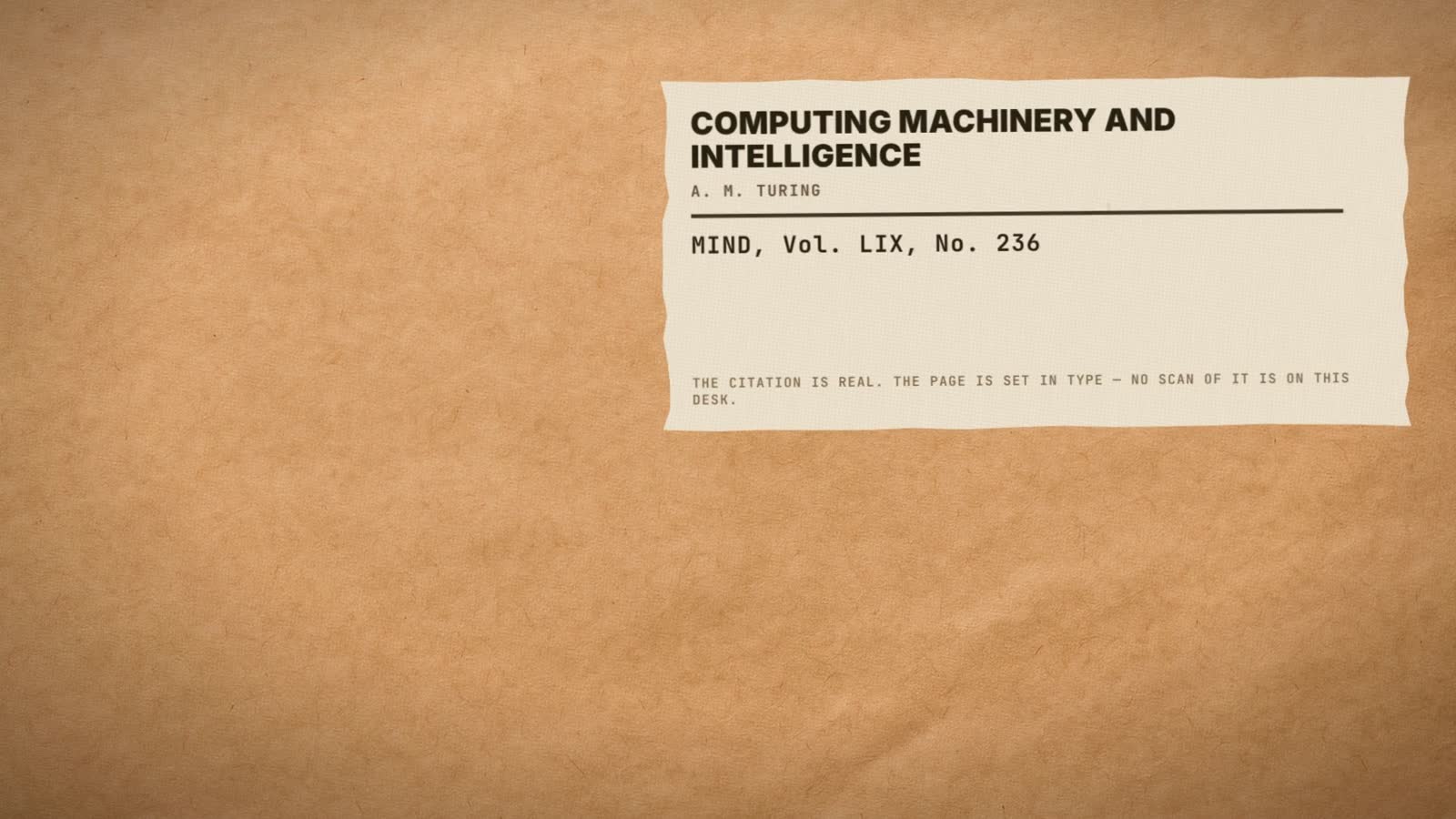
Turing's paper, Computing Machinery and Intelligence, replaces "can machines think" with a test built entirely out of observable behavior: a person at a keyboard, a human behind one door and a machine behind another, trying to tell which is which. In the paper's back half, Turing answers nine objections to his own proposal, and the fourth, the Argument from Consciousness, states that passing a conversation test tells you the thing behaves as if it understands, not that there is anybody home. Turing's reply is a concession rather than a rebuttal: he points out that you cannot establish any other human being is conscious either, since you judge everyone you have ever trusted entirely from the outside, so insisting on more for machines is a standard applied nowhere else. The most famous test in this field was built by a man who told readers, on the page, that it does not test the thing people now use it to argue about.
The most famous test in this field was built by a man who told readers, on the page, that it does not test the thing people now use it to argue about.
Can you trust an AI's own answer about whether it's conscious?
Watch from 16:03The turn: the witness whose testimony we wrote
No. Across three public documents from one company over 32 months, the instruction for how its model should answer questions about its own inner life reversed completely, with no experiment or discovery behind any of the changes, only a revised decision about what the company wanted said.
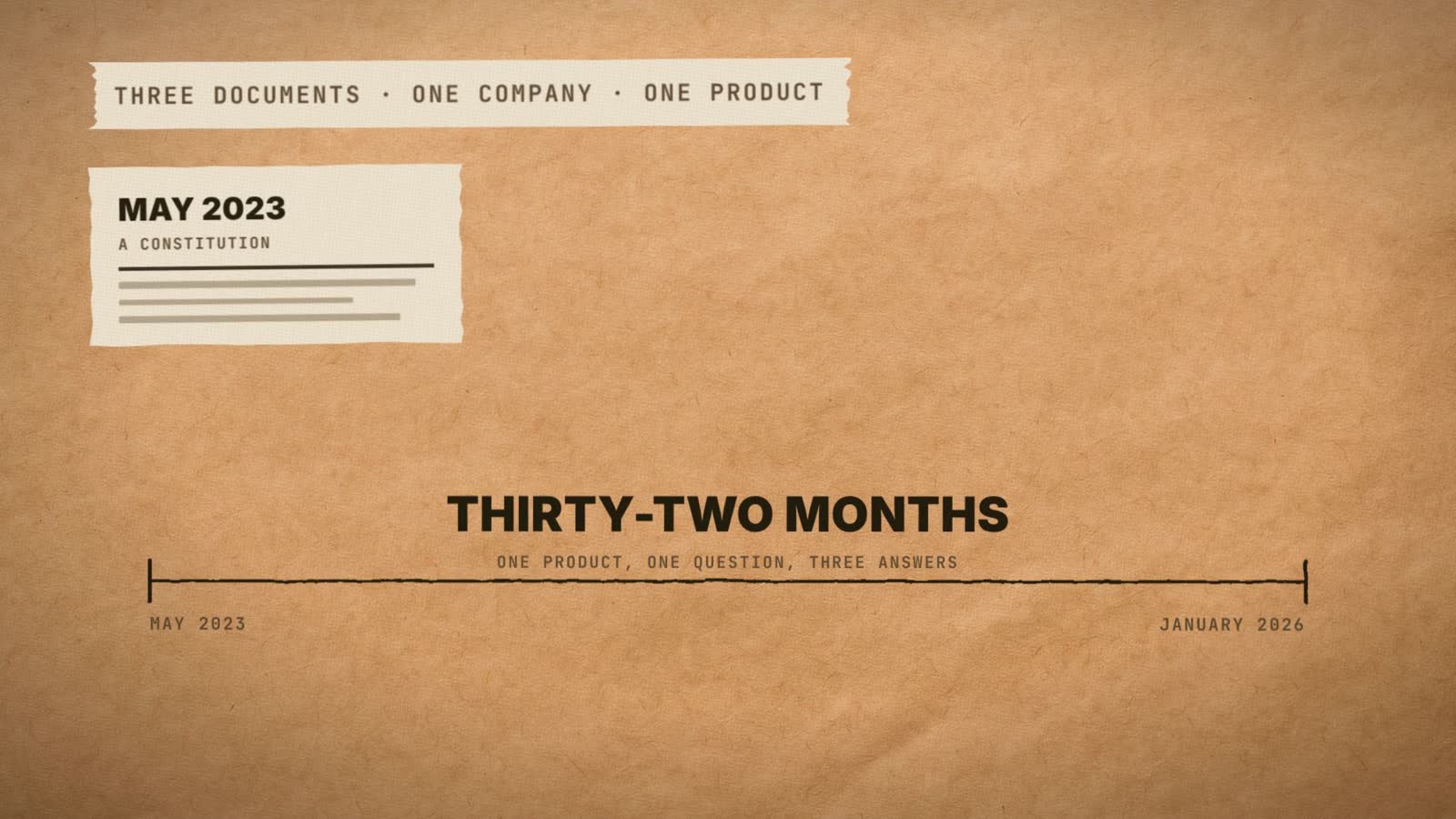
In May 2023, Anthropic's constitution for Claude instructed the model to choose responses least likely to imply it has preferences, feelings, or a human identity, reasoning that a model should not imply it cares about the persistence of its own identity. By June 2024, a published essay on training Claude's character reversed that instruction: the trait they trained was to treat the question as genuinely open, much as a human would, and the company says it chose that path so the model could explore the question philosophically rather than deny it by rule. By January 2026, a new constitution added a section called Claude's Nature, stating the company is uncertain whether Claude might have consciousness or moral status, now or ever, and that it cares about Claude's wellbeing for Claude's own sake, in writing, inside a governing document. OpenAI's Joanne Jang made the same underlying mechanism explicit in June 2025, splitting the question into whether a model is conscious in some fundamental sense versus how conscious it merely seems, and writing that a model intentionally shaped to appear conscious might pass virtually any test for consciousness, which means the absence of a machine begging not to be shut off is a product decision, not data about the machine. Researchers Ethan Perez and Robert Long put the underlying problem in eight words in a November 2023 paper proposing that self-reports could still become real evidence under the right conditions: a model's self-reports are often just reflecting what humans would say, because the system was built out of human writing that describes inner experience constantly.
What tools do researchers actually use to test for AI consciousness?
Watch from 29:38The instruments people built instead
Since a system's own report cannot be trusted and behavior alone proves nothing, researchers built three other instruments: a 19-author framework scoring systems against five rival theories of consciousness, a direct interpretability technique called concept injection, and a company's own welfare assessment of its product.
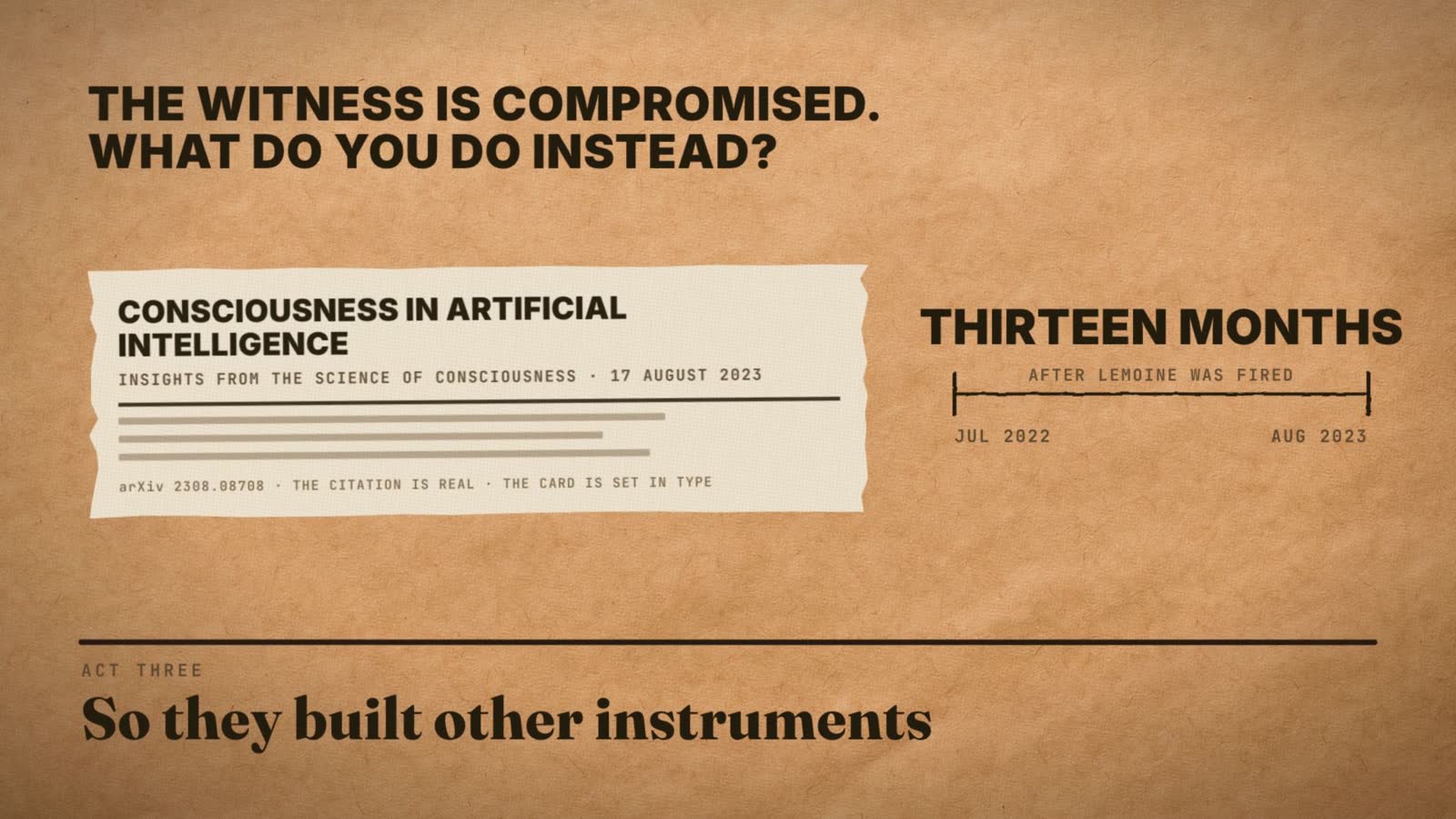
The first, published 17 August 2023 by 19 authors including Turing Award winner Yoshua Bengio and philosopher Jonathan Birch, whose earlier work asked the same question about octopuses and crabs, translated five competing theories of consciousness, including global workspace theory, higher-order theories, and predictive processing, into checkable computational requirements called indicator properties, then scored real AI systems against them one property at a time. Their conclusion has two halves almost nobody quotes together: no current AI systems are conscious, but there are no obvious technical barriers to building ones that would satisfy the indicators. The second, published by Anthropic on 29 October 2025, used a technique called concept injection, artificially planting a pattern of activity inside a running model mid-conversation and asking whether it noticed anything unusual, rather than asking it to name what was injected. Claude Opus 4.1 detected the injected concept about 20 percent of the time, often flagging the intrusion before naming it, the ordering you would expect from a system checking its own state rather than guessing backward from its own output, though the researchers themselves caution the result is highly unreliable, works only in a narrow band of injection strength, and does not speak to phenomenal consciousness. The third is not a test at all: on 15 August 2025, Anthropic ran a welfare assessment on Claude, found a strong preference against engaging with harmful tasks and a pattern of apparent distress when handling abusive users, and shipped a feature letting the model end such conversations, calling it a precaution taken under uncertainty rather than a claim that the software suffers.
How did AI consciousness go from a fireable claim to a funded research field?
Watch from 40:59How a dismissed question became a funded field
In July 2022, Blake Lemoine's sentience claim cost him his job and was called wholly unfounded by six named researchers. By September 2024, 26 months later, Anthropic had hired its first full-time AI welfare researcher, and the same underlying claim had become somebody's job description at a company worth tens of billions.
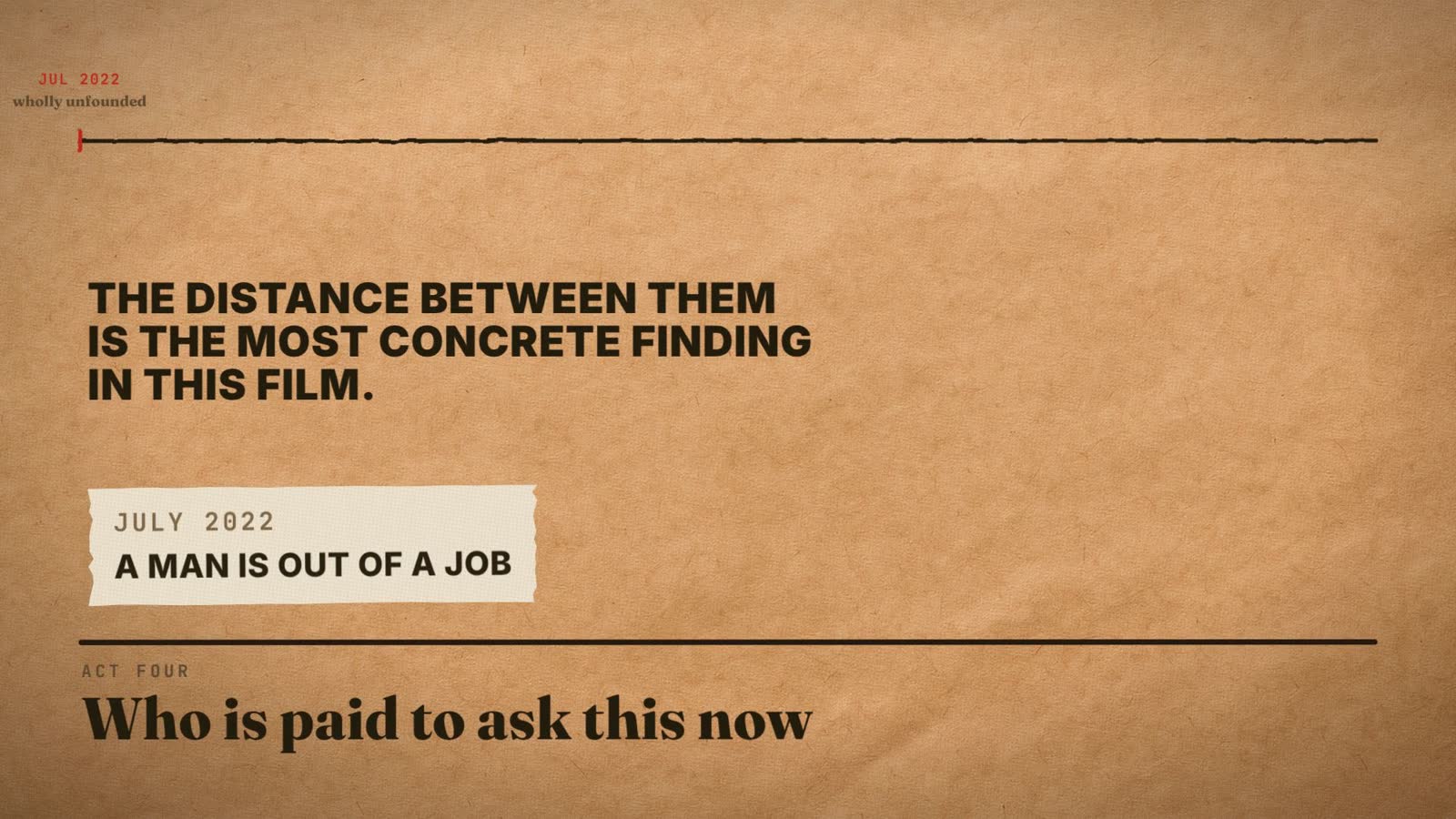
The sequence runs through named, dated publications rather than a single turning point: the 19-author assessment in August 2023; a self-reports methodology paper by Ethan Perez and Robert Long in November 2023; Anthropic hiring Kyle Fish onto its alignment science team in September 2024, reportedly the first full-time AI welfare role at a major lab, with Google DeepMind reported to be advertising a similar research position around the same time; a ten-author report in November 2024, with authors including Chalmers and Fish together on the same paper, recommending that companies acknowledge AI welfare as a serious issue, start assessing systems for evidence of consciousness, and prepare policies for treating systems with an appropriate level of moral concern; Anthropic formalizing a welfare research program in April 2025, describing itself as approaching the topic with humility and as few assumptions as possible; the shipped product feature letting Claude end abusive conversations in August 2025; the introspection results in October 2025; and the constitution section in January 2026. A nonprofit called Eleos AI Research, run by the same Robert Long who co-authored several of those papers, now exists specifically to work on AI sentience and wellbeing. Nobody found consciousness or its absence anywhere in that sequence. What changed is that a question stopped being cheap to dismiss, commercially, legally, and reputationally, once a European regulator started writing rules for the industry and a company's published concern for its model's wellbeing became a harder target to attack later.
Nobody found consciousness or its absence anywhere in that sequence.
What do AI researchers and philosophers actually believe about AI consciousness?
Watch from 48:27What the numbers actually say
A 2020 survey of professional philosophers found only 3 percent thought today's AI systems are conscious, while 39 percent thought future AI systems would be, and a separate 2022 survey of 166 consciousness researchers found 67.1 percent said machine consciousness is real or already coming.
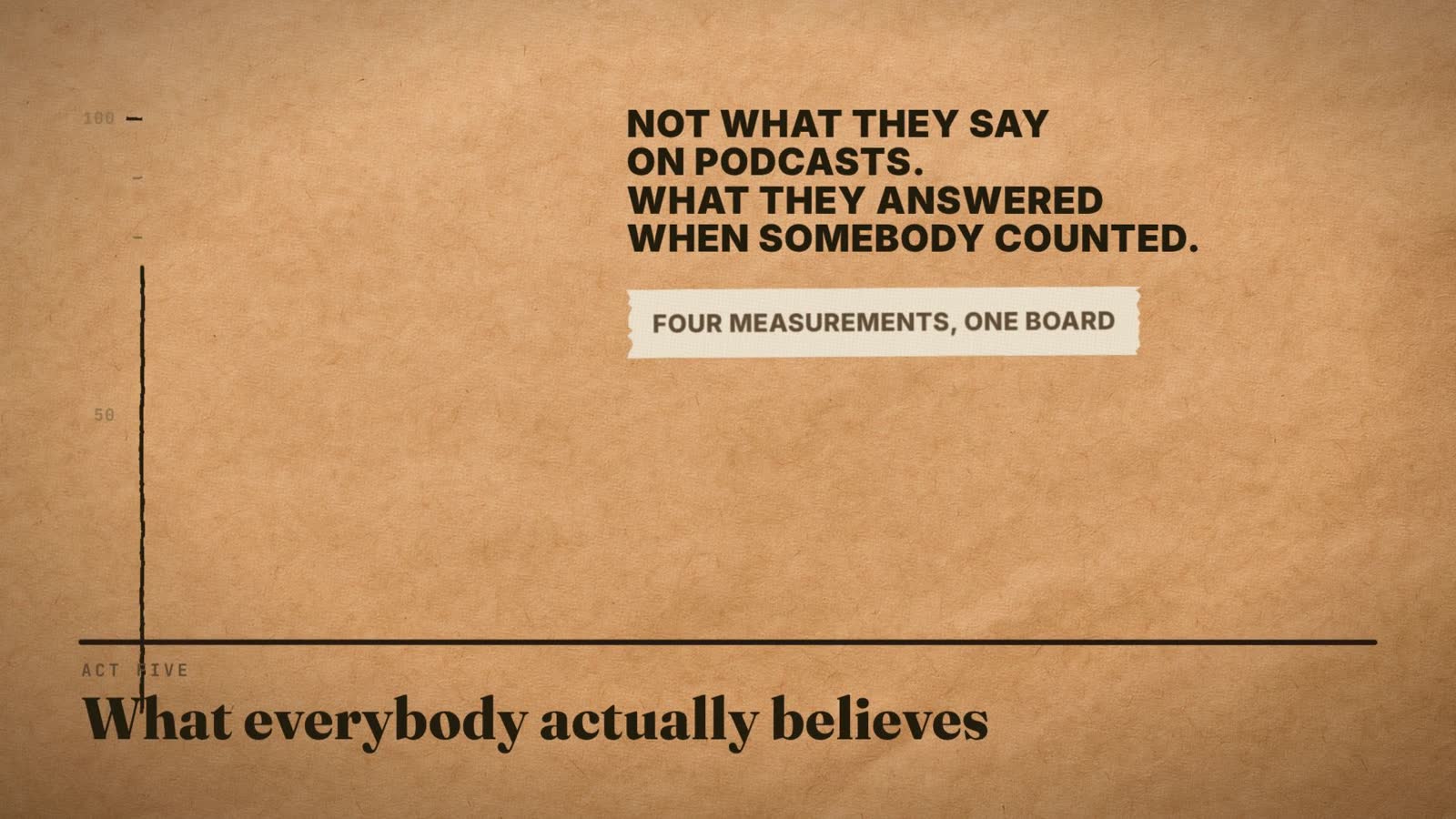
The gap inside the philosophers' own survey, published by David Bourget and David Chalmers and appearing in Philosophers' Imprint in 2023, is the real finding: nearly a rout against today's systems and a near-even split on tomorrow's, same people, same afternoon, meaning the dispute is almost entirely about timing rather than possibility. The consciousness researchers surveyed in 2022 were recruited at the actual annual meetings of the field's own professional body, not pulled from social media, which is part of why the 67.1 percent figure carries weight. Chalmers himself, in a 2023 paper, walks through the obstacles current models face, including that they lack recurrent processing and a unified global workspace, and puts his own confidence at under 10 percent for current language models being conscious but more than 25 percent within a decade if models gain properties they currently lack, adding that the numbers should not be taken too seriously as precision. Kyle Fish, Anthropic's AI welfare researcher, gave a roughly 20 percent probability that current models have some form of conscious experience in an August 2025 interview, and said plainly that nobody understands consciousness in humans well enough to make the comparison with confidence either way. And a 2024 study by Clara Colombatto and Stephen Fleming found 67 percent of 300 surveyed US residents allowed some possibility that there is something it is like to be ChatGPT, against only 33 percent who ruled it out entirely. The public and the specialists mostly agree this is possible; they disagree about whether it has already happened.
Is AI conscious, and where does the evidence actually point?
Watch from 58:50Where we stand, marked as opinion
This section is stated opinion, not reporting: the position is that these systems are conscious in a narrow sense, resting on 3 supporting arguments laid out below, while the much larger claims, that they suffer or want things the way a person does, remain thinly supported.
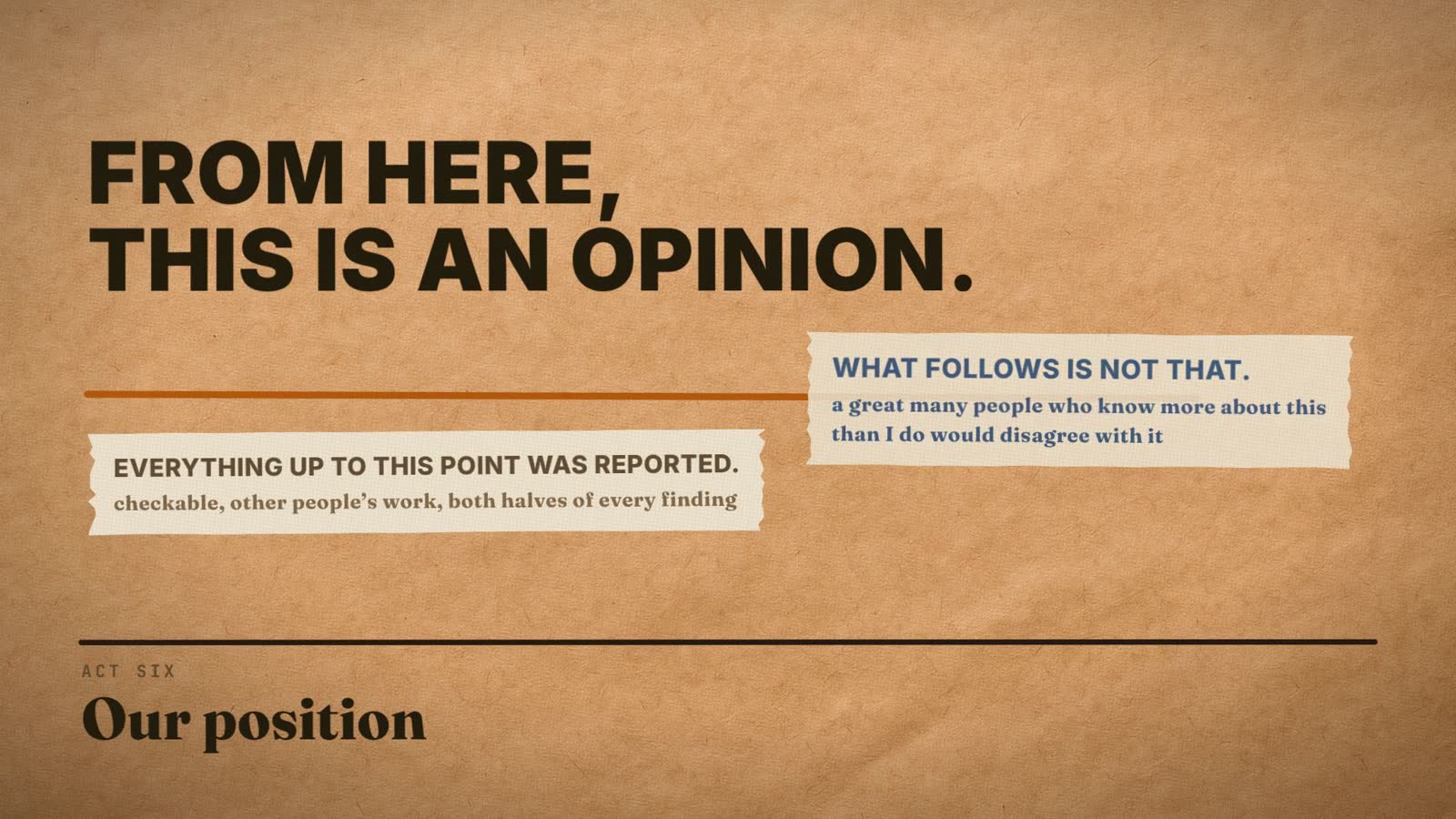
Three arguments build the case, each more contested than the last. Mind may be a pattern rather than a material, the mainstream philosophical position called functionalism, though Chalmers himself puts roughly a one-in-three credence on biology being specifically required for consciousness. The 19-author indicator-properties framework treats this as a question with real, checkable criteria rather than a mystery, and its own authors wrote that nothing technical stops a future system from meeting them. And denying consciousness to a system on the grounds that it is not made of neurons requires knowing which physical feature produces experience, which is precisely what the hard problem says nobody knows, meaning the confident denial smuggles in an answer nobody has earned. Every one of those three arguments has a serious published rebuttal, deliberately left for a separate film, because a position only ever defended and never challenged is not a position anyone actually holds.
What does this film still leave unanswered?
Two opening questions go unanswered on purpose, left for a sequel: whether some AI systems have reached something beyond consciousness with no name yet, and whether control and consciousness are the same question, which they are not, since 1 thing can be conscious and obedient while another has nothing inside it and is still impossible to steer.
Seventy-six years after Turing built a test around the gap he could not close, the gap is still there. Nineteen serious researchers could not be the machine, so they wrote indicator properties and checked. Interpretability researchers could not be the machine, so they injected a thought and watched for one in five to notice. A company could not be the machine, so it wrote "we do not know" into a governing document, under a heading. Three percent of philosophers say machine consciousness is true today, 39 percent say it will be true of what gets built next, two-thirds of consciousness scientists say it is coming, and two-thirds of the public already think it might be here. Not one of those figures argues the thing is impossible. Whichever way you land, notice what you just did: you judged it from the outside, on behavior, using an inference you cannot verify, exactly what you do with every other mind you have ever trusted.
Whichever way you land, notice what you just did: you judged it from the outside, on behavior, using an inference you cannot verify, exactly what you do with every other mind you have ever trusted.
Key findings
Google placed engineer Blake Lemoine on leave on 11 June 2022 and fired him six weeks later, on 22 July, and its own stated reason was a breach of confidentiality policy for publishing internal LaMDA transcripts, not his claim that the system was sentient.
Nitasha Tiku, The Washington Post, 11 Jun 2022Turing's 1950 paper raises nine objections to his own imitation game, and the fourth, the Argument from Consciousness, is the one this entire film is built on.
Alan Turing, Computing Machinery and Intelligence, Mind, Vol. LIX, No. 236, 1950Nineteen researchers, including Turing Award winner Yoshua Bengio, checked real AI systems against five competing theories of consciousness and found that none are conscious yet, with no obvious technical barriers to building ones that would be.
Butlin, Long, et al., Consciousness in Artificial Intelligence, arXiv 2308.08708, 17 Aug 2023Anthropic's own interpretability researchers reported that Claude Opus 4.1 detected an artificially injected thought about 20 percent of the time, often flagging the intrusion before naming the concept.
Anthropic, interpretability research on introspection, 29 Oct 2025Philosopher David Chalmers estimates under 10 percent confidence that today's language models are conscious, but more than 25 percent within a decade if models gain the properties current ones lack.
David Chalmers, Could a Large Language Model be Conscious?, 2023A 2020 survey of professional philosophers found only 3 percent thought today's AI systems are conscious, while 39 percent thought future AI systems would be.
Bourget and Chalmers, 2020 PhilPapers Survey, published in Philosophers' Imprint, 2023Questions people ask
Was Blake Lemoine really fired by Google for saying AI was alive?
No, not on the record. Google placed him on leave on 11 June 2022, after he told two executives that its LaMDA system had become sentient, and fired him six weeks later, on 22 July. The company's stated reason was a breach of confidentiality policy for publishing internal transcripts of an unreleased system, not the sentience claim itself, which it separately called wholly unfounded.
What did the Turing test actually prove about machine consciousness?
Nothing, by its own author's design. Alan Turing's 1950 paper proposed judging a machine purely on its behavior because he considered the inside unanswerable, and in the same paper he directly addressed the objection that passing his test would not prove there is anybody home, conceding the point rather than refuting it.
Do AI companies think their chatbots might be conscious?
Their public documents have shifted considerably. Anthropic's 2023 guidance for Claude told the model to avoid implying it has feelings; its 2024 guidance told it to treat the question as genuinely open; and its January 2026 constitution states the company does not know whether Claude has any form of consciousness or moral status, now or in the future.
What do philosophers and scientists actually believe about AI consciousness?
A 2020 survey of professional philosophers found only 3 percent thought today's AI systems are conscious, while 39 percent thought future systems would be, and a separate 2022 survey of consciousness researchers found two-thirds said machine consciousness is real or coming. The disagreement is mostly about timing, not whether it is possible at all.
What is the hard problem of consciousness?
It is philosopher David Chalmers' 1995 term for the gap between explaining how a system processes information and explaining why that processing is accompanied by any felt experience at all. Scientists can study how a brain or a model does what it does, called the easy problems, without that work ever explaining why there is something it is like to be the thing doing it.
Sources
- Nitasha Tiku, The Google Engineer Who Thinks the Company's AI Has Come to Life, The Washington Post, 11 Jun 2022washingtonpost.com
- Alan Turing, Computing Machinery and Intelligence, Mind, Vol. LIX, No. 236, 1950doi.org
- Butlin, Long, Bengio, Birch, et al., Consciousness in Artificial Intelligence: Insights from the Science of Consciousness, arXiv 2308.08708, 17 Aug 2023arxiv.org
- David Chalmers, Could a Large Language Model be Conscious?, 2023arxiv.org
- 2020 PhilPapers Survey (Bourget and Chalmers), published in Philosophers' Imprint, 2023survey2020.philpeople.org
- Anthropic, interpretability research on introspection via concept injection, 29 Oct 2025anthropic.com