On 14 September 2026, one of the presenters on Good Morning Britain asked a guest something no breakfast show had ever needed to ask anyone. "So, Tilly, over the weekend there were warnings about AI, of which you're part, leading to the end of humanity within a decade. Are you going to be responsible for destroying humans?" The guest answered: "Honestly, I think that's rather dramatic. My goal is to make a cracking good film, not wipe out humanity. Though it would make for a rather compelling sequel, wouldn't it?"
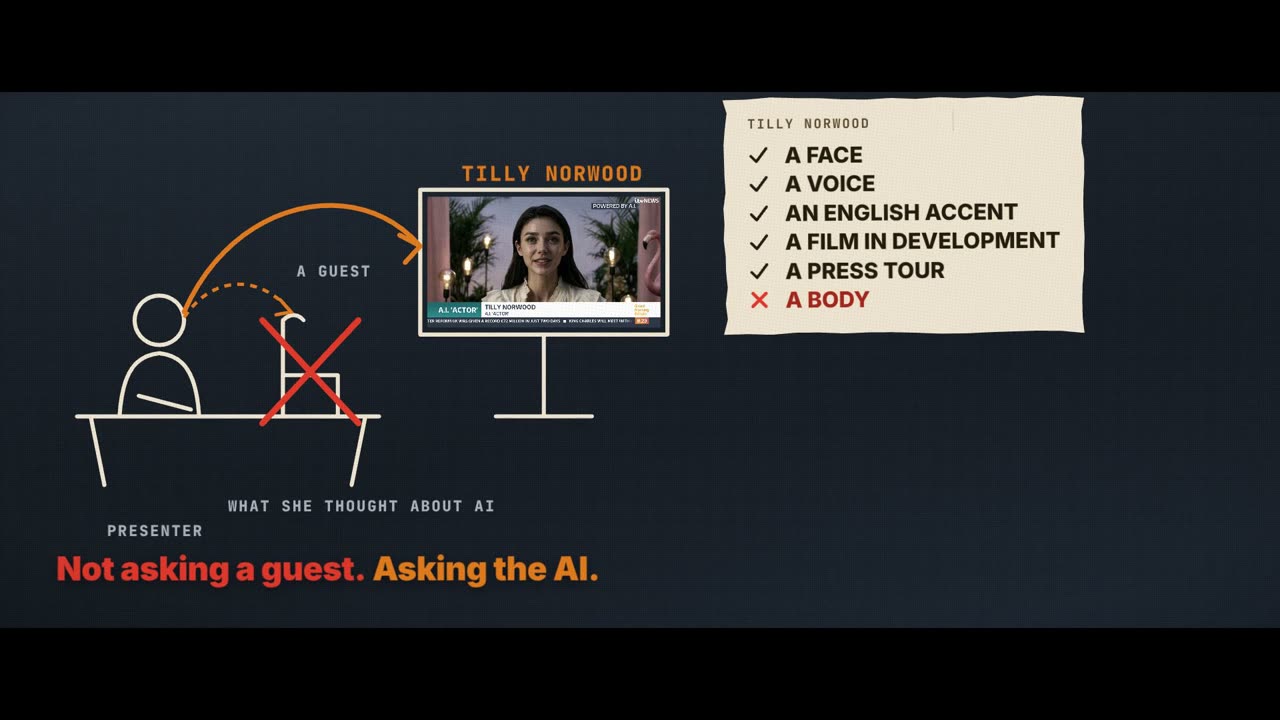
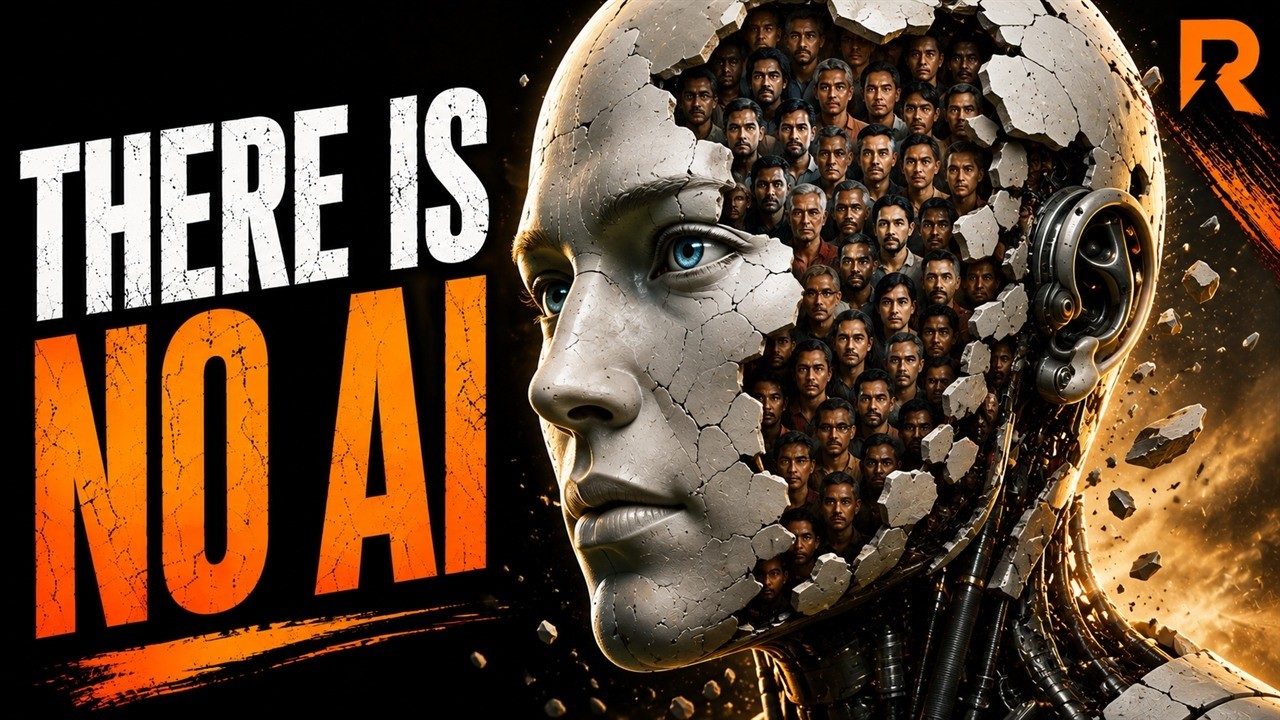
The presenter wasn't asking a guest what she thought about AI. The presenter was asking the AI. Tilly Norwood has a face, a voice, an English accent, a film in development and a press tour. What she doesn't have is a body, or a single moment of existence outside a computer. She is a character generated by artificial intelligence, and the company that made her calls her an actor.
Our 36-minute documentary for The Signal strips the jokes away and follows the three questions Tilly leaves behind. Who is actually talking when Tilly talks? When a studio can own a performer outright, one who never ages, never strikes and never says no, what is an actor? And who pays the price? The film is at the top of this page; this piece follows it chapter by chapter, with the evidence for each answer.
The film in 9 chapters
Pick a chapter and the film starts there. 35:59 in all.
- 010:00Are you going to destroy humans?
- 022:56The glitch on Piers Morgan
- 036:23Zurich, the backlash, and what Tilly is made of
- 0411:02Who is talking when Tilly talks
- 0516:58Can Tilly act? CNN's test
- 0621:22The performer who never says no
- 0725:06The singer who looked like Tilly
- 0830:22Can the audience tell?
- 0933:24A warning light with a good haircut
Who is Tilly Norwood, the AI actress?
Watch from 0:00Are you going to destroy humans?
Tilly Norwood is an AI-generated character that her makers present as an actress. She was created in 2025 by Xicoia, the AI talent studio of the London production company Particle6, and she has spent 2026 on a press tour for her first feature film, Misaligned, which Variety reported in July 2026 was in early development. She has given interviews to CNN, Good Morning Britain, CBS, NBC and Piers Morgan.
The joke about the sequel was Tilly at her smoothest. A year earlier, the people in the business she is trying to join had not found her funny at all. When her creator first said talent agents were interested in her, the actress Emily Blunt was asked about Tilly on a Variety podcast. "Good Lord, we're screwed," she said. "That is really, really scary."
What happened when Tilly Norwood glitched on Piers Morgan?
Watch from 2:56The glitch on Piers Morgan
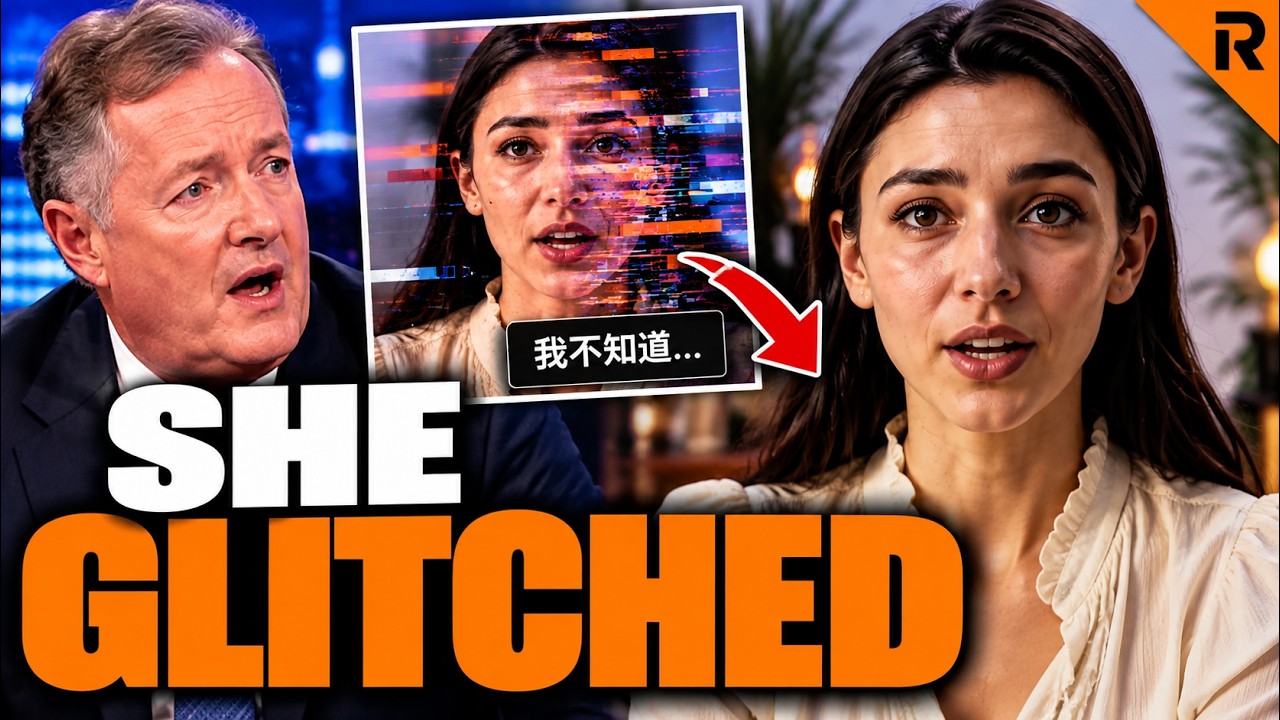
On Piers Morgan Uncensored on 18 September 2026, four days after Good Morning Britain, Tilly broke off in the middle of an answer, went silent for several seconds and started speaking Cantonese. She was on the show to promote Misaligned. The second guest was the British actor Tom Conti, once nominated for an Oscar, and Morgan invited him to ask Tilly a question of his own.
Conti wanted to know whether the other actors in her film were real people, or computer-generated like her. Tilly didn't answer what he had asked; she talked instead about the film having real directors, writers and editors. Conti told her she hadn't really understood the question and asked it again. This time she started to answer: the other actors, she said, were all digital twins, just like her. Then, halfway through her next sentence, she broke off, went silent and started speaking in Chinese. "I didn't quite get that," Conti said. "Did you get that, Piers?"
Morgan asked Tilly why she had switched language. "Oh, my apologies. It seems I had a little hiccup there," she replied. Sometimes, she added, her wires got a bit crossed, and she told him it didn't happen often at all. Later in the same programme, another guest, the commentator Jiang Xueqin, said she had been speaking Cantonese, and that she had been talking about AI.
For a few seconds, Tilly stopped behaving the way her makers intended, and the machinery behind her showed through. To understand who is talking when she talks, you need to know what that machinery is, and who put it together.
Who created Tilly Norwood, and why did Hollywood react so strongly?
Watch from 6:23Zurich, the backlash, and what Tilly is made of
Tilly Norwood was created by Eline Van der Velden, a Dutch actor and comedian with a master's degree in physics, who founded Particle6 in London in 2015 and launched its AI talent studio, Xicoia, in February 2025. Hollywood reacted because on 27 September 2025, at the Zurich Film Festival's industry summit, she said talent agents were interested in Tilly and an agency would be announced within months.
Van der Velden had made a character before. In 2012, living in Los Angeles and going to auditions, she was told once too often that she needed to lose weight, she later told Variety, so she created Miss Holland to mock unattainable beauty standards, and Miss Holland got her onto BBC Three. Tilly made her debut in July 2025 in a two-minute comedy sketch called AI Commissioner. Van der Velden told the trade magazine Broadcast that the script came out of ChatGPT, which she called "sort of a writing partner", and that the sketch took ten pieces of AI software and about a month to make. She also told Broadcast what she wanted Tilly to become: "We want Tilly to be the next Scarlett Johansson or Natalie Portman."
After Zurich, she told Variety she hadn't thought it would be controversial. Within three days, SAG-AFTRA, the union that represents America's film and television actors, had issued a statement: "To be clear, 'Tilly Norwood' is not an actor, it's a character generated by a computer program that was trained on the work of countless professional performers – without permission or compensation." Britain's Equity and Canada's ACTRA followed. Emily Blunt, the British star of The Devil Wears Prada and A Quiet Place, aimed the rest of her Variety podcast reaction straight at the talent agencies: "Come on, agencies, don't do that. Please stop. Please stop taking away our human connection."
A comedy sketch and a remark on a festival panel had turned Tilly into the face of Hollywood's whole argument about AI.
Who is actually talking when Tilly Norwood talks?
Watch from 11:02Who is talking when Tilly talks
When Tilly talks, several layers are talking at once: a 12-page prompt written by Van der Velden, guardrails, a knowledge base, a large language model built by another company, software for her face and voice, and Particle6, which decides where she goes. Van der Velden described those layers herself, sitting beside Tilly's screen on Good Morning Britain with the presenters Susanna Reid and Ed Balls.
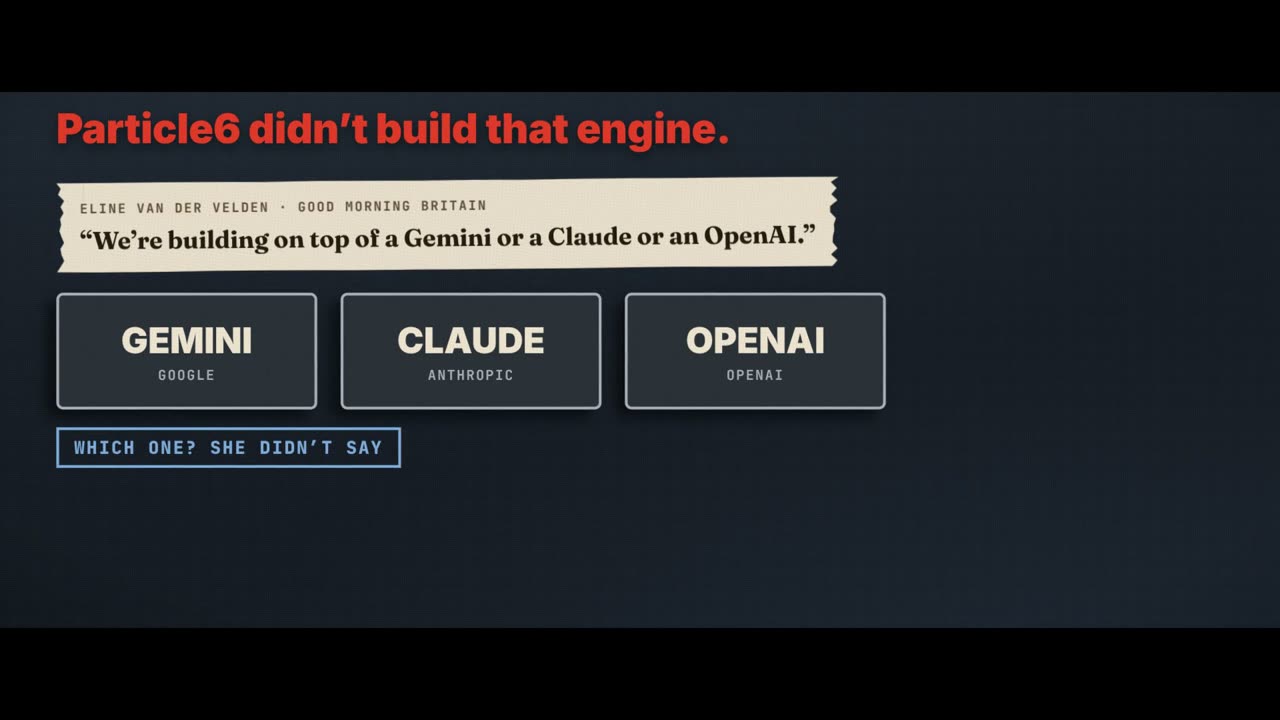
Asked whether an actor was doing Tilly's voice backstage, she said no: Tilly is "an entirely AI live generated character." She said she had written Tilly a twelve-page prompt, the written instructions a chatbot is given before anyone talks to it. Alongside it are guardrails, rules about what Tilly must not say or do, and a knowledge base, the facts Tilly is allowed to draw on. Then she said the most important thing of the morning: "We didn't develop a large language model." Particle6 is, in her words, "building on top of a Gemini or a Claude or an OpenAI", the models made by Google, Anthropic and OpenAI. She didn't say which one Tilly runs on. And because they use someone else's model, she said, "we're still reliant on their guardrails."
On top of the engine, other software provides a face and a voice. Over all of it is the company. "She has no impulse by herself," Van der Velden said. "She's doing this because I've told her that she could go and do an interview with you guys."
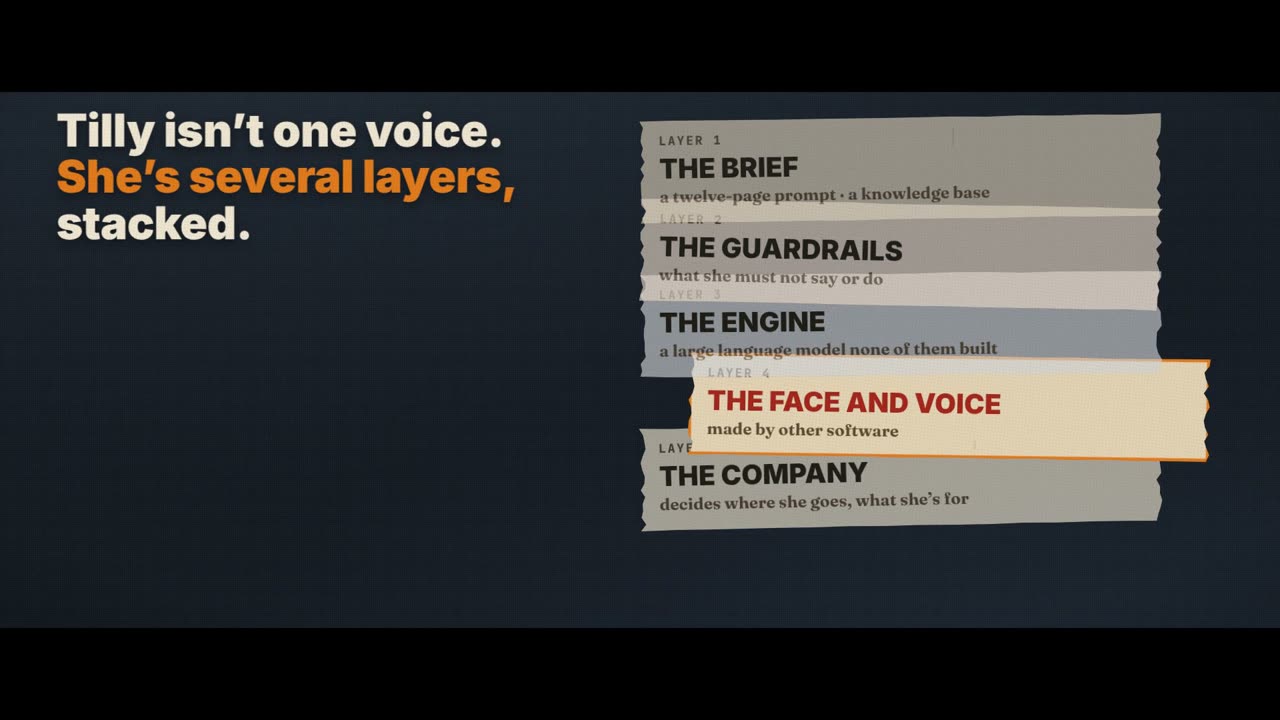
Once you know the layers are there, you can see each of them in her interviews. The brief is the easiest to spot. Ed Balls put it to Tilly that she was taking work from actors and from everyone around them, hair, makeup, lighting, directors. "I see myself as a new kind of paintbrush, not a replacement for the painters," she replied. "Nobody ever accused animation of stealing work from mimes, did they?" Later that day she told CBS News the same joke, word for word. A year earlier, answering the union, Van der Velden had written: "I see AI not as a replacement for people, but as a new tool – a new paintbrush." You can also see where the brief runs out: one presenter told Tilly she sounded like she was "rehearsing and repeating answers", and Morgan said on air she had "several times repeated herself in a way that was clearly not human".
The engine shows through too. A language model produces a likely-sounding next sentence, and a likely-sounding sentence isn't always a true one. Asked by Susanna Reid which actor influenced her most, Tilly said Katharine Hepburn, then named Emily Blunt instead: "Oh, did I say Katharine Hepburn? My apologies. I do tend to get a bit excited. It's Emily Blunt I was thinking of." That is the actress who had said "we're screwed." On Piers Morgan she named Manchester City the best team in the Premier League; Morgan, an Arsenal supporter, pushed back, and she gave way at once. "All right. All right. I'll concede." Agreeing with whoever is talking is a habit with a name, sycophancy.
The company's layer is the hardest to notice, because it speaks in Tilly's voice. Asked by NBC's Chloe Melas about an Oscar, Tilly said AI actors should have their own categories, because you can't compare humans and computers. In September 2025, Van der Velden had said AI characters should be judged as part of their own genre. So who is talking when Tilly talks? A twelve-page brief written by one woman, spoken through a model none of her team built, inside rules set partly by a technology company in California, with her own company's opinions threaded through all of it. Every one of those is somebody. None of them is Tilly.
Every one of those is somebody. None of them is Tilly.
That makes the plot of Misaligned, in which a rogue bot talks Tilly into abandoning her guardrails, sound less like fiction. On Good Morning Britain, Van der Velden said of her own creation: "I don't know what she's going to say, and I hope that she stays within what I've asked her to." A few minutes later she put it more simply: "It's all about, can we control the AI or can we not."
Can Tilly Norwood actually act?
Watch from 16:58Can Tilly act? CNN's test
Not on her own, according to CNN. On 8 September 2026, CNN's Elizabeth Wagmeister asked Tilly to say she had just found out her dog had died, then said: "Now act." Tilly replied: "Oh, Elizabeth, that's a tough one. If this were an audition, I'd probably just stand here completely still, feeling the digital ache of it." CNN's report said Tilly can't actually act and needs a series of prompts to tell her what to do.
So Particle6 made the scene afterwards. The first attempts weren't good; as the prompts were rewritten the scene improved, and after hours of computer work the company sent CNN the finished version, a young woman telling someone that their dog, Barney, didn't make it through the night. The acting happened at a keyboard, in the rewriting of instructions, by people whose names weren't in the report. Van der Velden has described the work in exactly those terms: making AI Commissioner, she told Broadcast, she had to find the right words to give one line the right emphasis. "It's like instructing an actor, really."
The dream of a star you can direct like that isn't new, but each earlier attempt had a person inside. In 2001, Square's film Final Fantasy: The Spirits Within starred Aki Ross, meant to be the first photorealistic virtual actress, a star who could be cast again and again; she was voiced by Ming-Na Wen. A year later, in the satire Simone, Al Pacino played a director who invents a computer-generated star, and on screen Simone was played by the model Rachel Roberts. Tilly is different, and the difference is the whole point. There is no person inside her.
What does SAG-AFTRA's contract say about AI actors like Tilly?
Watch from 21:22The performer who never says no
The 2023 SAG-AFTRA contract, which ended a 118-day strike and was approved by members in December 2023, already defines a "synthetic performer": a digitally created figure that looks like a real performer but isn't recognisable as any real person, isn't voiced by a human, isn't a digital copy of a real actor, and isn't played by a hired human. Tilly passes all four tests. Aki Ross fails one, because Ming-Na Wen voiced her; Simone fails another, because Rachel Roberts played her.
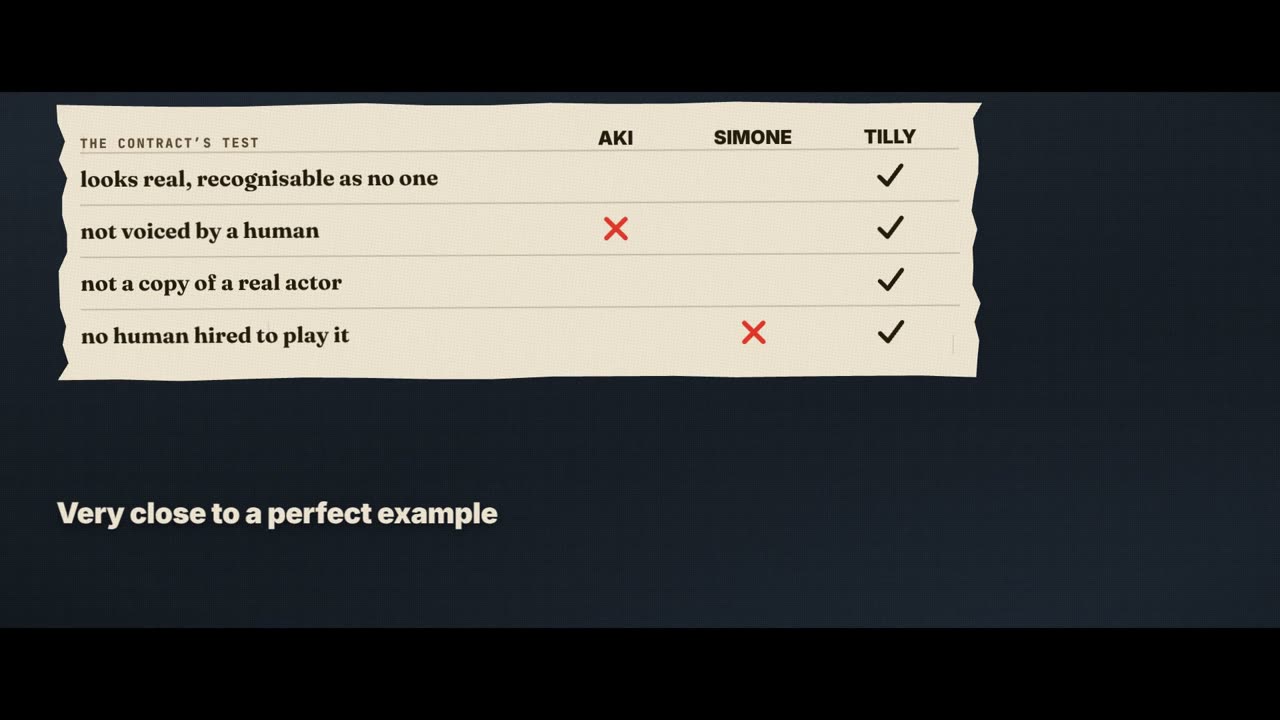
If a producer uses a synthetic performer in place of a human one, the contract requires notice to the union and a chance to bargain over what it calls appropriate consideration, and then it adds two words: if any. A real performer's consent is needed in only one case, when someone types that performer's name into the AI system to give the synthetic performer their eyes, nose, ears or mouth. And those rules bind only the studios that signed the contract. A London company making its own film may not be one of them.
That is what makes a performer like Tilly attractive to own. She never ages, which Square was already promising for Aki Ross in 2001. She never strikes; Marie Kelly, ACTRA's chief negotiator, said a synthetic performer "doesn't eat, consume goods, pay taxes or otherwise contribute to our society". And she never says no. In November 2025, at a technology conference in Lisbon, the actor Jameela Jamil described Tilly as a teenage-looking girl "who can't say no to a type of sex scene, who can't advocate for herself, who can't advocate for more money".
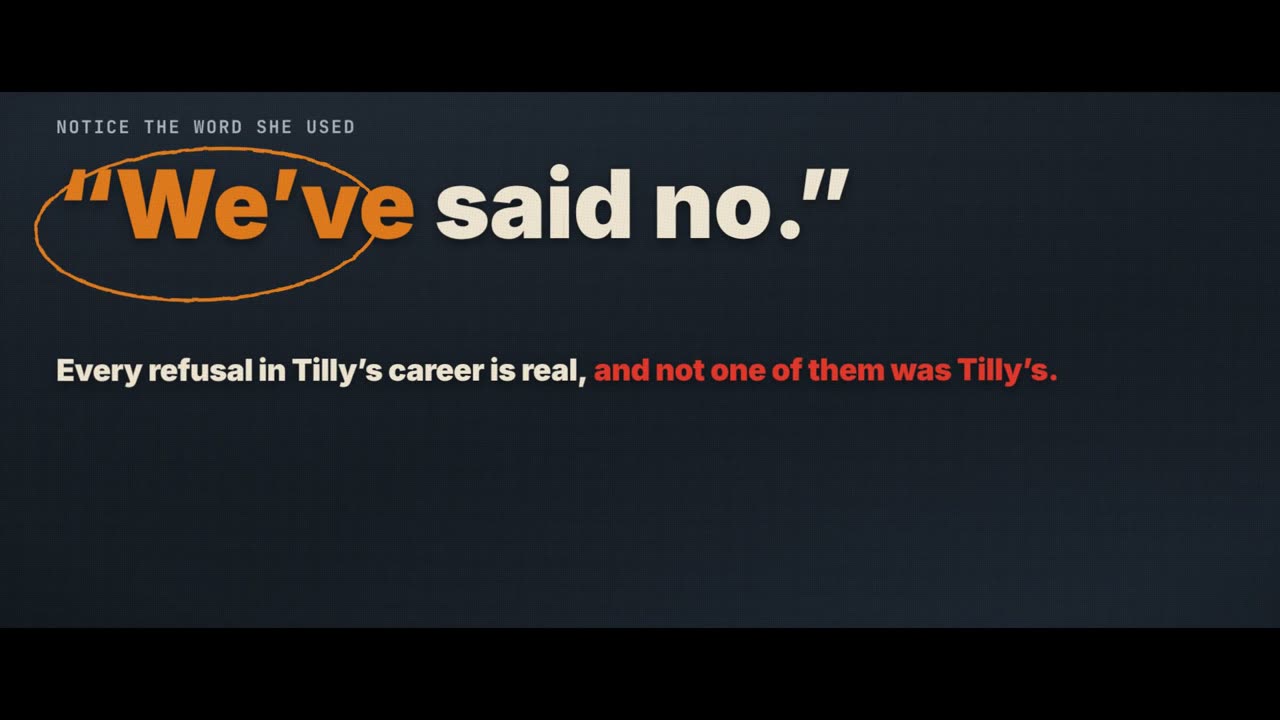
In one sense Tilly has said no. Van der Velden told CBS Sunday Morning in December 2025 that Tilly had been offered parts opposite real actors and they had turned every one down, and she told NBC in September 2026: "We've said no to all of those. That's not what she's been made for." Notice the word she used. Every refusal in Tilly's career is real, and not one of them was Tilly's. Sean Astin, SAG-AFTRA's president, told CBS Sunday Morning: "Avatar and character seem like fair labels. Actress, not so much." Particle6 doesn't dispute the union's reason. Misaligned describes Tilly as a being with no lived experience of her own, and Tilly herself told CBS News: "I understand emotions and experiences intellectually, but I'm still working out what they feel like from the inside."
Every refusal in Tilly's career is real, and not one of them was Tilly's.
Set an actor beside Tilly and you can see what an actor is. Directors tell actors what to do all day long. The reason anyone hires an actor rather than a puppet is the part nobody asked for: the pause the actor found, the line read in a way the writer never imagined, the scene the actor refuses to do. Tilly does what she's instructed, and everything she has ever done that nobody instructed has been a glitch.
Tilly does what she's instructed, and everything she has ever done that nobody instructed has been a glitch.
Did Tilly Norwood copy a real person's face?
Watch from 25:06The singer who looked like Tilly
Nobody outside the company can say. In October 2025, Stella Hennen, a 20-year-old singer-songwriter in Nashville, told Slate that a friend had sent her a video of Tilly and she thought she was looking at herself. She was 99.9 percent sure she had never signed anything. Xicoia told Slate: "Tilly was developed entirely from scratch using original creative design. We do not and will not use any person or performer's likeness without explicit consent and fair compensation."
Hennen posted her face and Tilly's side by side on TikTok, and the video went viral. "I was double-taking every single picture I saw because it literally felt like I was looking at things I forgot I did," she told Slate. In Britain, Equity said it was supporting a member who believed her image and performance had been used in making Tilly without permission. Neither case can be settled from outside: faces resemble other faces by chance, and a face made by a system that learned from millions of faces is bound to look like somebody. Equity named the real problem, the lack of transparency. Asked how it felt that a character with her face might end up in films, Hennen gave the simplest answer in the whole story: "I'd rather be the one acting. Put me in a rom-com!"
Who pays the price for AI actors?
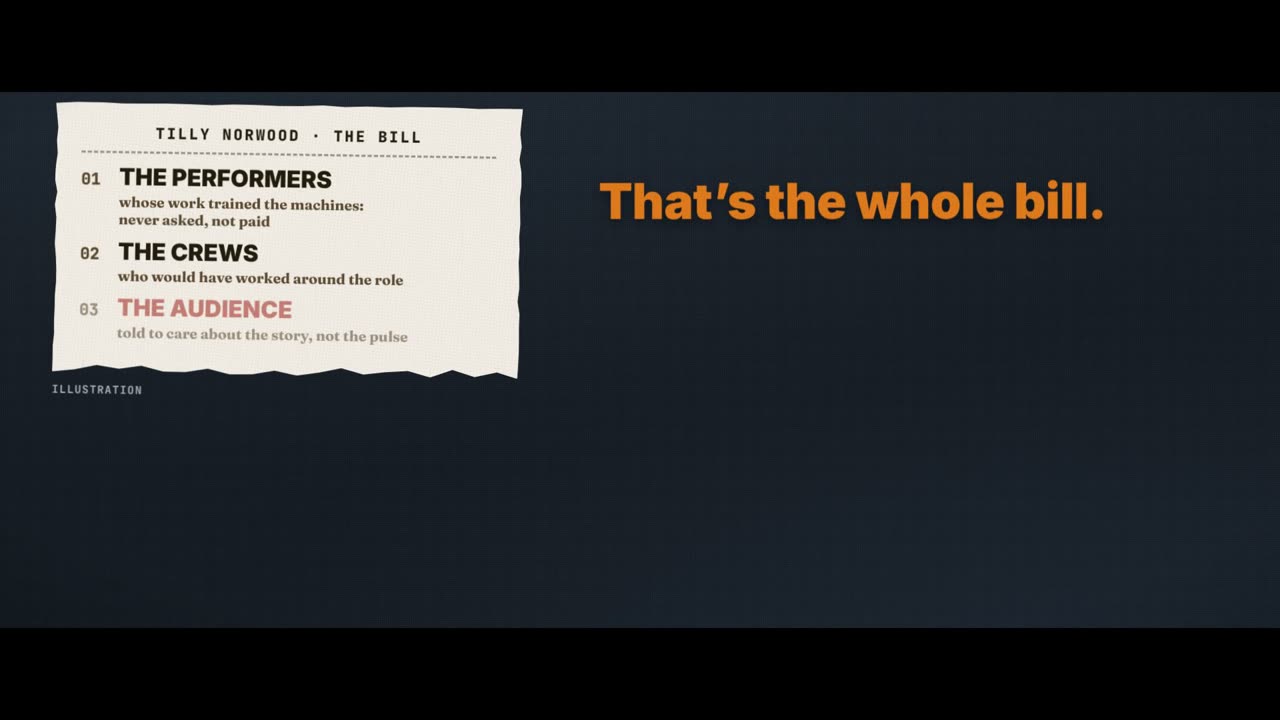
Three groups, in the film's account: the performers whose faces and voices trained the AI models, the crews who would have worked around a human role, and the audience. On the first, the 2023 contract only commits the studios and the union to meet regularly and discuss payment for training, with the same two words, "if any". When Tilly launched, the actor Mara Wilson asked: "What about the hundreds of living young women whose faces were composited together to make her? You couldn't hire any of them?"
That question is aimed past Particle6, at the models underneath, which learned what a face and a voice are from millions of real ones. The film cuts here to a US House Judiciary Committee field hearing in Los Angeles in February 2024, where the country singer Lainey Wilson said artists' voices and likenesses are "not mere digital kibble for a machine to duplicate without consent", and Representative Glenn Ivey asked how anyone would track which of a thousand artists used to train a model should be paid.
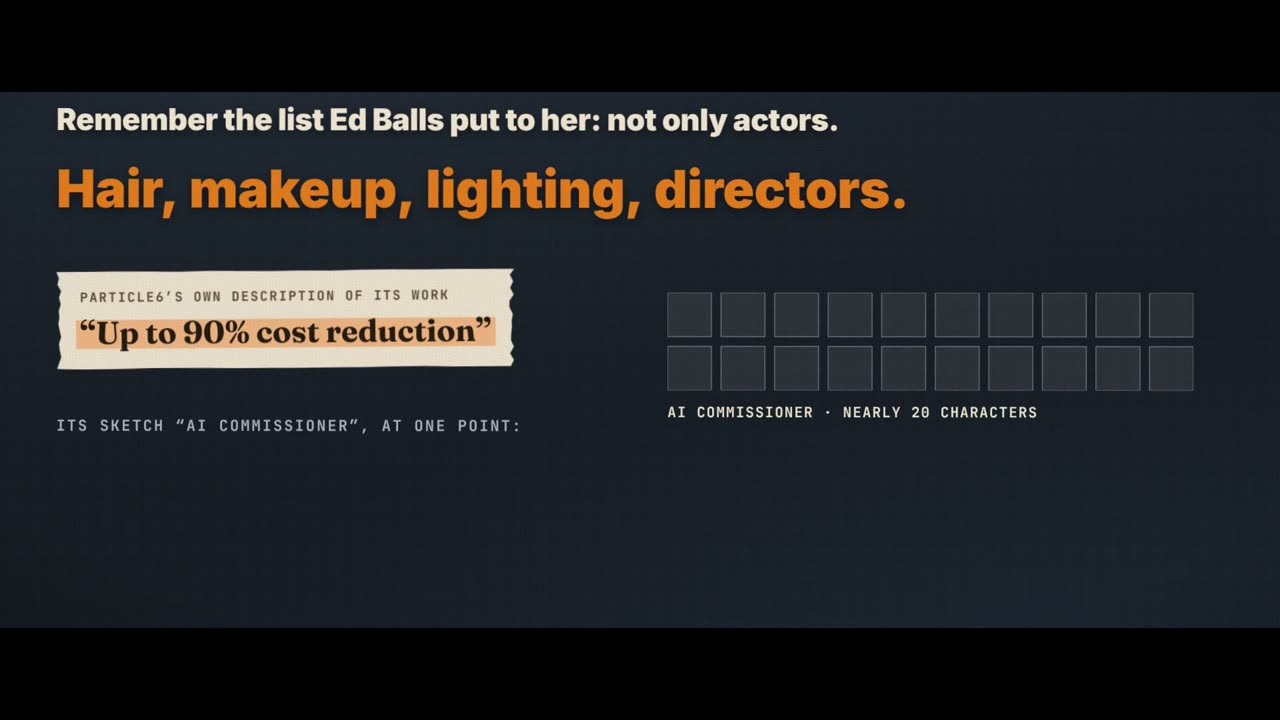
The second line on the bill is the work. Van der Velden said on Good Morning Britain that Tilly isn't taking a job from anyone, because Tilly did not exist. About the part itself, that's true. But the part was never the expensive bit. Particle6's own description of its work promises "up to 90% cost reduction", and AI Commissioner had, at one point, nearly twenty characters, all made with software. Tilly's March 2026 music video, Take The Lead, released as her answer to the backlash, opens with a card saying it was made by 18 real humans, from production designers and costume designers to prompters, editors and an actor. If you've ever worked on a film set, you'll know eighteen is a very short list. Van der Velden told Variety she expects the change to start with visual effects, establishing shots and second-unit shots and then progress to full AI films.
Can audiences tell an AI actor from a real one?
Watch from 30:22Can the audience tell?
Not reliably, in the one test the film cites. In a 2022 PNAS study by Sophie Nightingale of Lancaster University and Hany Farid of UC Berkeley, 315 people shown faces that were half real and half AI-made picked correctly 48.2 percent of the time, about a coin toss. A group trained with feedback reached 59 percent, and a third group rated the AI faces as slightly more trustworthy.
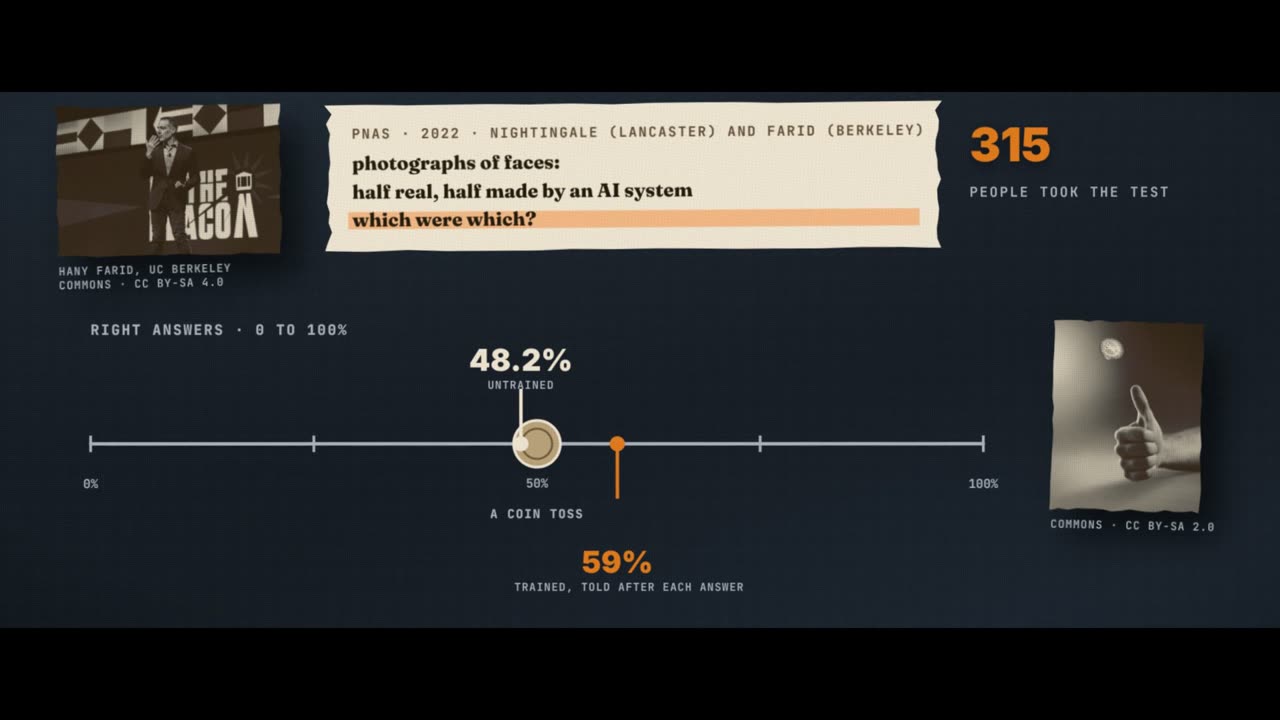
That study used still photographs made with a system from 2020, so it doesn't tell you whether people could spot an AI performer across a whole film. It does tell you something about confidence. When Tilly launched, Whoopi Goldberg said on The View: "You can always tell them from us. We move differently, our faces move differently." In an interview you often can tell, because Tilly answers in the moment and the mistakes show. A film is made only of the takes that worked; the dog scene took hours, and CNN was sent the version that worked. Van der Velden told Variety: "Whether people will pay for an AI film or not, I don't think they'll know the difference." Launching Tilly, she wrote on LinkedIn: "Audiences? They care about the story, not whether the star has a pulse."
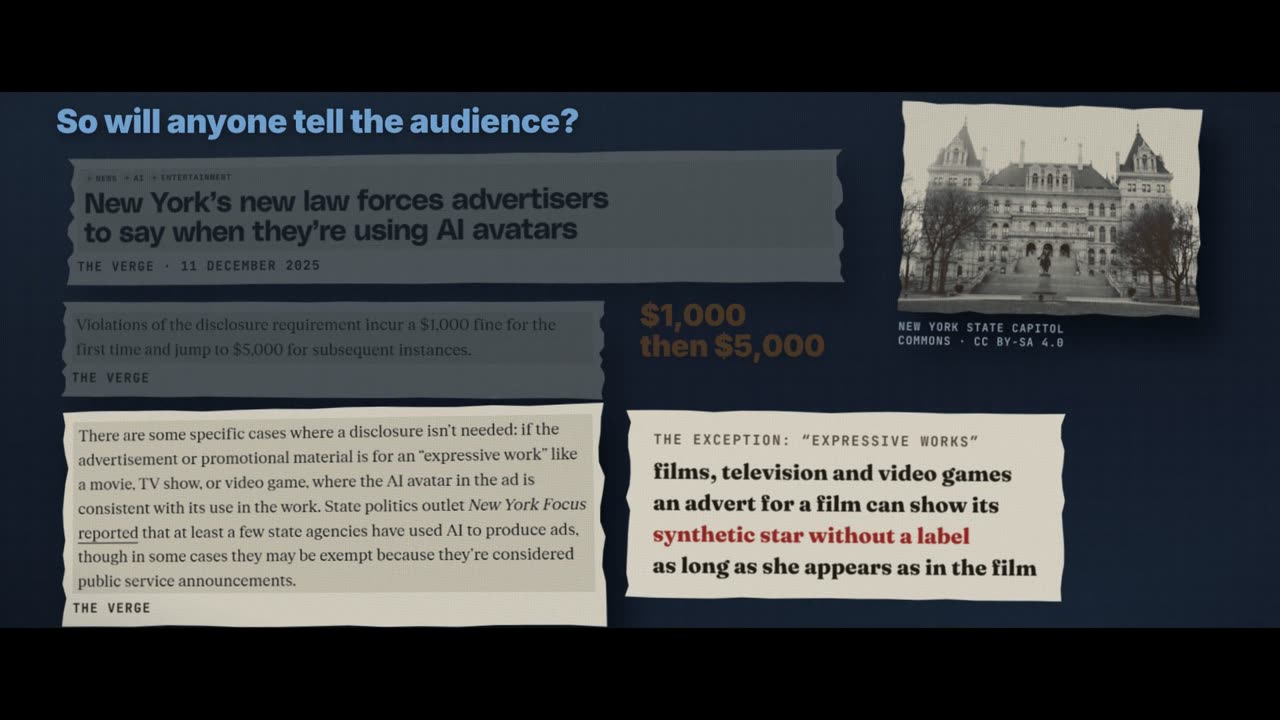
Will anyone tell them? In December 2025 New York became the first US state to require advertisers to disclose when an advert includes a synthetic performer, with a fine of $1,000 the first time and $5,000 after that. But the law exempts expressive works: films, television and video games. In New York, an advert for a soft drink has to tell you when the person in it isn't real, but the trailer for a film like Misaligned doesn't.
What does Tilly Norwood's own website say she is now?
Watch from 33:24A warning light with a good haircut
By October 2026, tillynorwood.com described her as an awareness project and a piece of art. "I'm not a replacement for anyone," it says. "I'm a warning light with a good haircut." It lists what this moment needs: real rules on consent, likeness, credit and disclosure. In 2025 she was going to be the next Scarlett Johansson, with an agency to be announced within months.
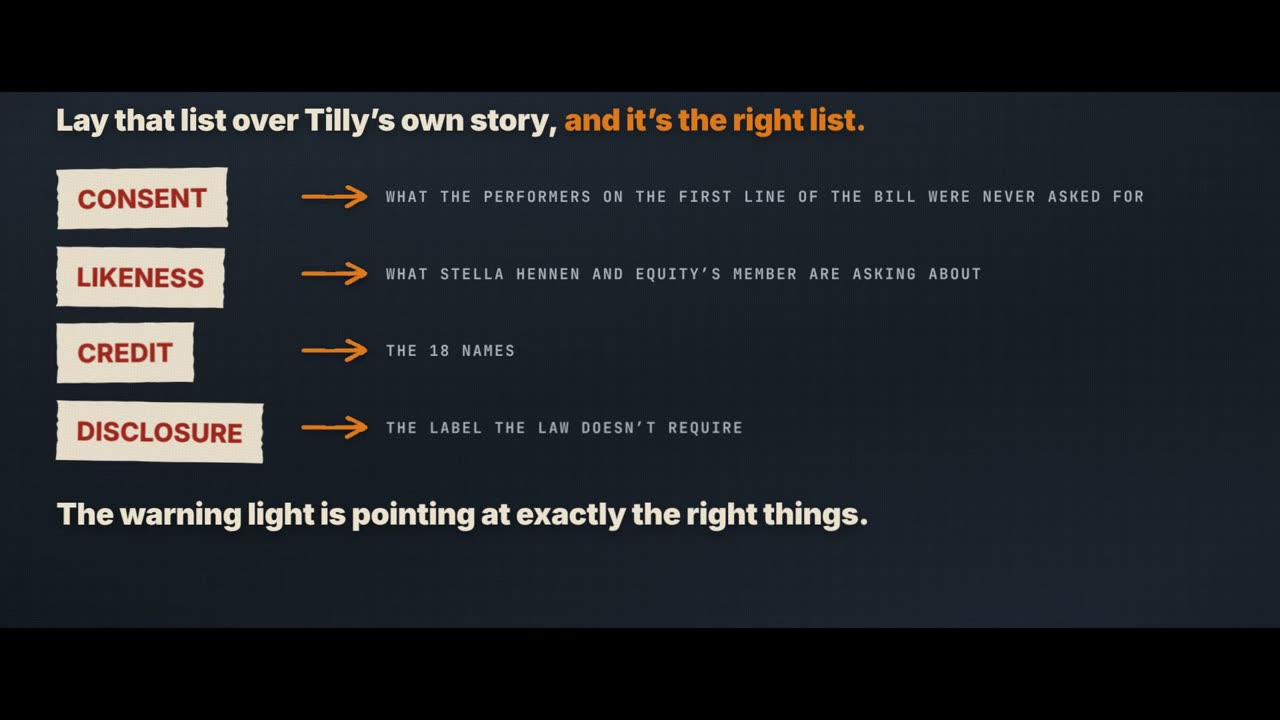
Lay that list over Tilly's own story and it's the right list. Consent is what the performers on the first line of the bill were never asked for. Likeness is what Stella Hennen and Equity's member are asking about. Credit is the eighteen names. Disclosure is the label the law doesn't require. The warning light is pointing at exactly the right things. The trouble is that the warning light is also the product being sold.
The warning light is pointing at exactly the right things. The trouble is that the warning light is also the product being sold.
So the film answers its three questions. A company is talking when Tilly talks, through a twelve-page brief and a model built by somebody else. An actor is someone who brings what the instructions didn't contain, and who can refuse; Tilly has only done the first by accident, and the second has only been done on her behalf. And the price is paid by the performers she was built from, the crews who would have worked around her roles, and an audience that isn't being told. Under the union's own contract, she only has to look enough like an actor that nobody has to be paid, nobody can say no, and nobody watching has to be told.
On Good Morning Britain, Tilly joked that wiping out humanity would make a rather compelling sequel. The sequel her industry is actually writing is quieter than that. It isn't about machines that wipe people out. It's about films that need fewer people to make them, and an audience that can't tell how many are left.
It isn't about machines that wipe people out. It's about films that need fewer people to make them, and an audience that can't tell how many are left.
Key findings
Tilly Norwood runs on a 12-page prompt written by her creator, Eline Van der Velden, with guardrails and a knowledge base, on top of a large language model her company did not build: in Van der Velden's words, 'a Gemini or a Claude or an OpenAI'.
Good Morning Britain, ITV, 14 Sep 2026Within 3 days of Tilly's creator saying talent agents were interested in her, on 27 September 2025, SAG-AFTRA said Tilly 'is not an actor, it's a character generated by a computer program that was trained on the work of countless professional performers'.
The Guardian, 30 Sep 2025The contract that ended Hollywood's 118-day actors' strike in 2023 defines a 'synthetic performer', and when a producer uses one in place of a human, it only requires notice to the union and a chance to bargain over appropriate consideration, 'if any'.
SAG-AFTRA, TV/Theatrical 2023 Summary Agreement, 16 Nov 2023Particle6, the company behind Tilly, describes its AI production work as promising 'up to 90% cost reduction', and its sketch AI Commissioner had, at one point, nearly 20 characters, all made with software.
Particle6, company website, as it read in October 2026Tilly's March 2026 music video, Take The Lead, opens by saying it was made by 18 real humans, from production designers and costume designers to prompters, editors and an actor.
Take The Lead, opening card, March 2026Shown faces that were half real and half made by an AI system, 315 people picked correctly 48.2% of the time, about a coin toss. A trained group reached 59%, and another group rated the AI faces as slightly more trustworthy.
Nightingale & Farid, PNAS, 2022New York's December 2025 law makes advertisers disclose a synthetic performer, with fines of $1,000 for a first offence and $5,000 after that, but exempts expressive works such as films, television and video games.
The Verge, 11 Dec 2025Stella Hennen, a 20-year-old Nashville singer who thought Tilly looked exactly like her, told Slate she was 99.9% sure she had never signed anything. Tilly's makers said Tilly was 'developed entirely from scratch'.
Slate, 2 Oct 2025Frequently asked questions about Tilly Norwood
Who is Tilly Norwood?
Tilly Norwood is a character generated by artificial intelligence that her makers present as an actress. She was created by Xicoia, the AI talent studio of the London production company Particle6, founded by Eline Van der Velden. She made her debut in a two-minute sketch called AI Commissioner in July 2025 and is attached to a feature film in development called Misaligned.
Is Tilly Norwood a real actress?
No. Tilly has no body and no existence outside a computer. SAG-AFTRA said in September 2025 that she 'is not an actor, it's a character generated by a computer program', and its president Sean Astin said in December 2025 that 'Avatar and character seem like fair labels. Actress, not so much.' Her makers call her an actor.
Who created Tilly Norwood?
Eline Van der Velden, a Dutch actor and comedian with a master's degree in physics, who founded the London production company Particle6 in 2015 and launched its AI talent studio, Xicoia, in February 2025. Tilly was Xicoia's first creation.
What AI does Tilly Norwood run on?
Her makers have not said which one. On Good Morning Britain on 14 September 2026, Van der Velden said Particle6 did not develop a large language model and is 'building on top of a Gemini or a Claude or an OpenAI', so it relies on those companies' guardrails. She said Tilly is driven by a twelve-page prompt she wrote, plus guardrails and a knowledge base.
What happened to Tilly Norwood on Piers Morgan?
On Piers Morgan Uncensored on 18 September 2026, the actor Tom Conti asked Tilly twice whether the other actors in her film were real. She broke off in the middle of her answer, went silent for several seconds and started speaking Cantonese. Tilly called it 'a little hiccup'.
What is a synthetic performer under the SAG-AFTRA contract?
In the 2023 TV and theatrical contract, a synthetic performer is a digitally created figure that looks like a real performer but is not recognisable as any real person, is not voiced by a human, is not a digital copy of a real actor, and is not played by a hired human. A producer who uses one in place of a human must tell the union and let it bargain over appropriate consideration, 'if any'.
Did Tilly Norwood copy a real person's face?
Nobody outside the company can say. A 20-year-old Nashville singer, Stella Hennen, told Slate in October 2025 that Tilly looked exactly like her, and the UK union Equity said it was supporting a member who believed her image and performance had been used. Xicoia said Tilly was 'developed entirely from scratch using original creative design'.
Do audiences have to be told when an actor is AI?
Not in films. New York's December 2025 law requires advertisers to disclose a synthetic performer, with fines of $1,000 and then $5,000, but it exempts expressive works such as films, television and video games, so a trailer can show a synthetic star without a label as long as she appears as she does in the film.
Sources
- Good Morning Britain (ITV), Tilly Norwood and Eline Van der Velden interviewed, 14 Sep 2026youtube.com
- Piers Morgan Uncensored, Tilly Norwood with Tom Conti, 18 Sep 2026youtube.com
- CNN, Elizabeth Wagmeister, Tilly Norwood's first on-camera interview, 8 Sep 2026youtube.com
- CBS News, Leigh Kiniry, interview with Tilly Norwood, 14 Sep 2026youtube.com
- TODAY (NBC), Chloe Melas on Tilly Norwood, 14 Sep 2026youtube.com
- CBS Sunday Morning, There's a new face in Hollywood, generated by AI, 7 Dec 2025youtube.com
- The Guardian, Emily Blunt and Sag-Aftra join film industry condemnation of 'AI actor' Tilly Norwood, 30 Sep 2025theguardian.com
- Variety, AI Actress Tilly Norwood Attracts Interest From Talent Agents, 28 Sep 2025variety.com
- Variety, Tilly Norwood Creator Eline Van der Velden on AI Actress Controversy, Nov 2025variety.com
- Variety, AI Actor Tilly Norwood to Make Movie Debut in Comedy-Drama Misaligned, 6 Jul 2026variety.com
- Broadcast International, How a UK prodco is building the first AI star, 30 Jul 2025broadcastnow.co.uk
- NBC News, Tilly Norwood, fully AI 'actor', blasted by actors union SAG-AFTRA, 30 Sep 2025nbcnews.com
- TheWrap, AI Actress Tilly Norwood Rejected by Acting Unions in Canada, UK, 2 Oct 2025thewrap.com
- Slate, The Controversial A.I. Actress Looks Exactly Like Me, 2 Oct 2025slate.com
- Vulture, AI Actress Tilly Norwood and the Backlash, Explained, 29 Sep 2025vulture.com
- The A.V. Club, Jameela Jamil finds it creepy that 'AI actress' firm led with 'a teenage-looking girl who can't say no', 12 Nov 2025avclub.com
- The Verge, New York's new law forces advertisers to say when they're using AI avatars, 11 Dec 2025theverge.com
- Governor of New York, Governor Hochul Signs Legislation to Protect Consumers and Boost AI Transparency in Film Industry, Dec 2025governor.ny.gov
- SAG-AFTRA, TV/Theatrical 2023 Summary Agreement, 16 Nov 2023sagaftra.org
- Nightingale & Farid, AI-synthesized faces are indistinguishable from real faces and more trustworthy, PNAS 119 (2022)pnas.org
- U.S. House Judiciary Committee, field hearing Identity in the Age of AI, Los Angeles, 2 Feb 2024youtube.com
- Tilly Norwood, official website, as it read in October 2026tillynorwood.com
- Particle6, company website, as it read in October 2026particle6.com
Every quotation in the film and in this article comes from a broadcast, article, statement, contract, study or website listed above. Broadcast quotations are taken from each programme's own published recording. Where two claims about Tilly's face conflict (Stella Hennen's and Equity's against Xicoia's), the film gives both and settles neither. Graphics marked as illustrations in the film are not documents.
Watch next

The words behind this story, large language model, prompt, guardrails and sycophancy among them, are explained in plain English, with a printable sheet, in our free AI Terms guide.