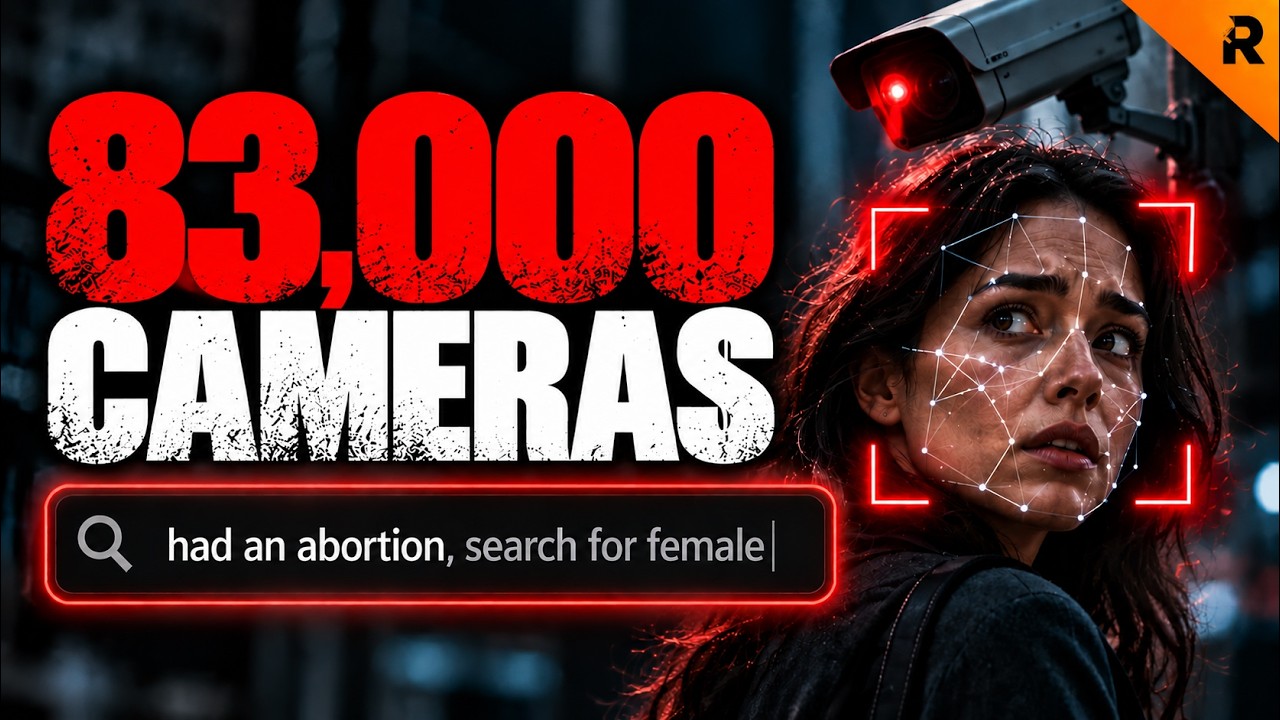
In May 2025, a deputy in Johnson County, Texas searched more than 83,000 licence-plate cameras for one woman. Her partner had reported her to the sheriff's office after she took medication to end a pregnancy, and the reason the deputy typed into the search system was had an abortion, search for female.
None of those cameras had been put up to find her. Towns bought them to catch car thieves. One deputy searched all of them with a single sentence. That camera network is one of several machines now capable of recognising people in public, and three questions come with them: who gets to search them, whether a stranger wearing smart glasses can already find out your name just by looking at you, and what happens to you when they get it wrong.
None of those cameras had been put up to find her. Towns bought them to catch car thieves. One deputy searched all of them with a single sentence.
The film in 8 chapters
Pick a chapter and the film starts there. 29:36 in all.
How many cameras did a Texas deputy search for one woman?
Watch from 0:00One woman, 83,345 cameras
A Johnson County sheriff's deputy searched 17,684 cameras in his first query and then widened the search to 83,345 cameras over a month, reaching networks in Illinois and Washington, states where abortion is legal, according to case records obtained by the Electronic Frontier Foundation.
The woman's partner reported her to the sheriff's office two weeks after she took medication to end a pregnancy, and gave deputies the packaging it had come in. The records EFF obtained show the deputies opened a death investigation and called county prosecutors to ask whether she could be charged; the prosecutors said she could not. Sheriff Adam King later said the family was worried she would bleed to death and that deputies were trying to get her to a hospital. The cameras belong to a company called Flock Safety, and they exist to photograph the plate of every car that passes them, for any town that buys them. A single search can now reach a network that spans the country.
How did a company that photographs every car build a nationwide network?
Watch from 3:16Every car that passes
Flock Safety started in 2017, when three Georgia Tech alumni, Garrett Langley, Matt Feury and Paige Todd, began building cameras in Atlanta after a county detective told Langley one of their early units had helped solve a break-in; Langley still runs the company.
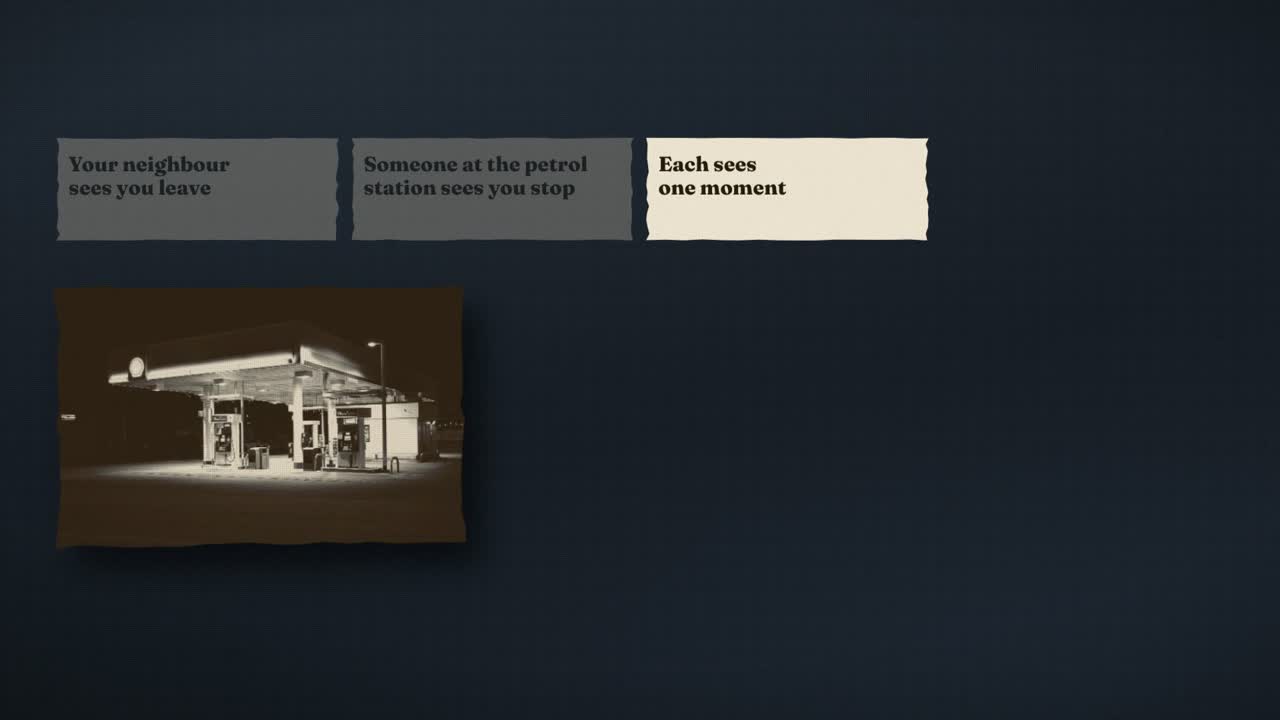
Today a Flock camera is about the size of a shoebox, usually mounted under a small solar panel. It photographs the back of every car that passes and reads the plate, while also noting the make, colour and distinguishing features such as a roof rack or bumper sticker, a profile the company calls the vehicle fingerprint. One camera alone says little: that a car passed one corner at one minute. The change came when police departments started sharing access, letting one department's search reach every other department's cameras. As of July 2026, Flock says it operates more than 120,000 cameras in over 6,000 communities across 49 states, making more than 20 billion vehicle scans every month, according to the company's own figures reported on Wikipedia. A network that size is how a single search reached 83,345 cameras in Texas.
Who has been searching these cameras, and why?
Watch from 6:21Who gets to search
Records obtained through public records requests showed police departments running these searches for federal immigration agents with no contract for the data, and at least one police chief running more than 160 searches on an ex-partner's car out of jealousy, not the stated reasons logged in the system.
In Danville, Illinois, researchers obtained a log showing police from across the country searching the city's cameras, with more than 4,000 of those searches carrying reasons like ICE, ICE warrant or immigration focus, despite Immigration and Customs Enforcement having no contract with Flock. Illinois law bars sharing this kind of data for immigration enforcement, and in August 2025 the state's Secretary of State ordered Flock to shut off access it had found for federal border agents; Langley responded that the company had paused those pilots nationwide and had failed to build the state-by-state permissions the law required. Separately, a Kansas police chief ran 164 searches on a woman he had been in a relationship with and 64 on her new boyfriend, typing reasons like missing child while the real motive, a state licensing order later found, was jealousy; his certification was revoked. The Institute for Justice's public tracker of ALPR misuse lists over 265 incidents, many of them officers tracking a partner, an ex or someone they wanted to date. The person you would least want searching for your car is someone who already knows what you drive. Flock's Langley called this abuse unacceptable in August 2026, cut the default data retention window from 30 days to 7, and said every police search would need a case number by year's end.
The person you would least want searching for your car is someone who already knows what you drive.
Can a stranger wearing smart glasses already find out your name?
Watch from 10:32Can a stranger find out your name
Not using Meta's own software as of this film, but two Harvard students proved the capability exists today: in autumn 2024 they paired Meta's Ray-Ban camera glasses with a separate public face-search site, PimEyes, and walked up to strangers on the Boston subway using names the system gave them within about a minute.
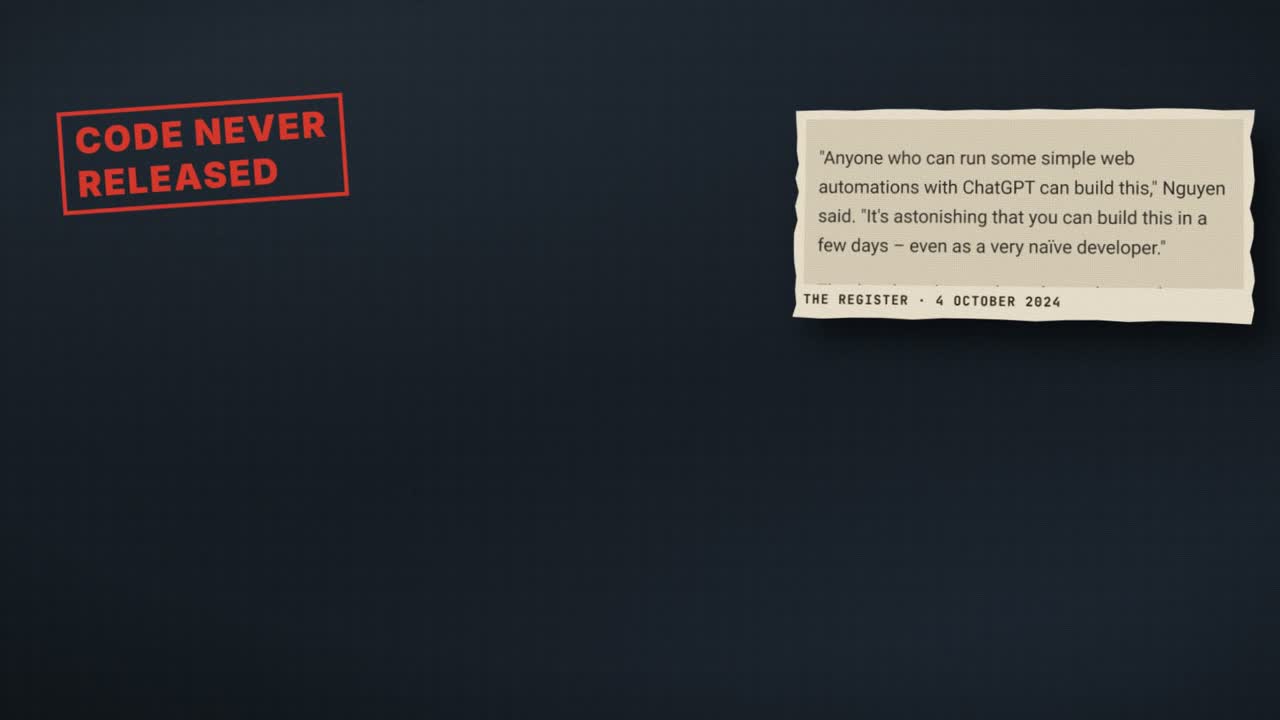
The students, AnhPhu Nguyen and Caine Ardayfio, never released their code; one of them said anyone who can run simple web automation with ChatGPT could build it. When a reporter asked Meta about the demonstration, the company's spokesperson pointed out that the PimEyes technology the students used could be paired with any camera, not just Meta's. The more pointed question was whether Meta would build a face search of its own. In February 2026, the New York Times reported on internal documents describing a planned feature called Name Tag, timed, according to an internal memo, for a moment when groups likely to object would be busy with other concerns. Four months later, WIRED reporters found the working parts of an on-device face recognition system inside the Meta AI app, installed on more than 50 million phones: code that found a face, saved it, and compared it against faceprints already stored on the phone. Meta said the feature had never been switched on and that what WIRED found was evidence of ongoing exploration; the company's communications chief called the story clickbait, and the code was gone from the app the next day.
How often do license plate camera alerts turn out to be wrong?
Watch from 16:16When the camera is wrong
An internal review by Roseville, California police found that 71% of the 1,427 stolen or wanted-vehicle alerts their Flock cameras sent in 2023 and 2024 were misread plates, according to the review obtained by Business Insider; Flock calls that figure a mischaracterization tied to older hardware and says its cameras read plates correctly more than 96% of the time in good conditions.
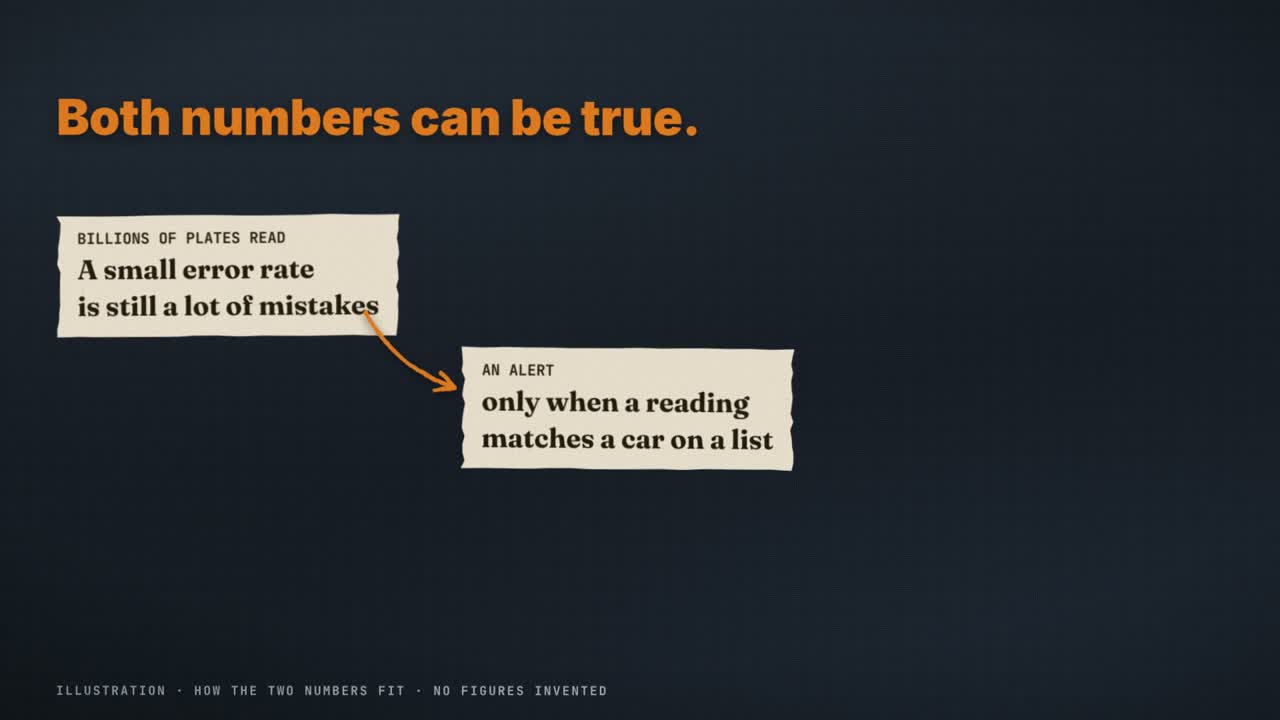
Both of those numbers can be true. The cameras read billions of plates, so even a small error rate adds up to a lot of mistakes, and because an alert only fires when a reading matches a car on a watch list, misreads can pile up faster among the alerts than they do across all the plates read. Business Insider has documented roughly a dozen wrongful stops tied to Flock misreads, including a Tennessee couple stopped at gunpoint and handcuffed, with their three-year-old granddaughter in the back seat, after a camera misread their personalised plate by one character. Flock's Langley has written that an alert is a lead, not a conclusion, which should be confirmed by an officer, the same standard the company applies across its public statements. In Denver, a police sergeant used accurate camera data showing a woman's car had driven through a neighbouring town to accuse her of a $25 theft; she had in fact been visiting her tailor, and her own doorbell footage and location history got the summons voided. Being near a crime used to leave no trace. Now it can leave a search result, and the person in it has to prove what the camera could not.
Being near a crime used to leave no trace. Now it can leave a search result, and the person in it has to prove what the camera could not.
Both of those numbers can be true. The cameras read billions of plates, so even a small error rate adds up to a lot of mistakes.
How did the first known wrongful arrest from facial recognition happen?
Watch from 20:15When the face is wrong
Robert Williams was arrested on his own front lawn in Detroit in January 2020, in front of his wife and two young daughters, after a facial recognition search matched a blurry security-camera still from a shop theft to his expired driving licence photo; he spent about 30 hours in custody before the mismatch was caught.
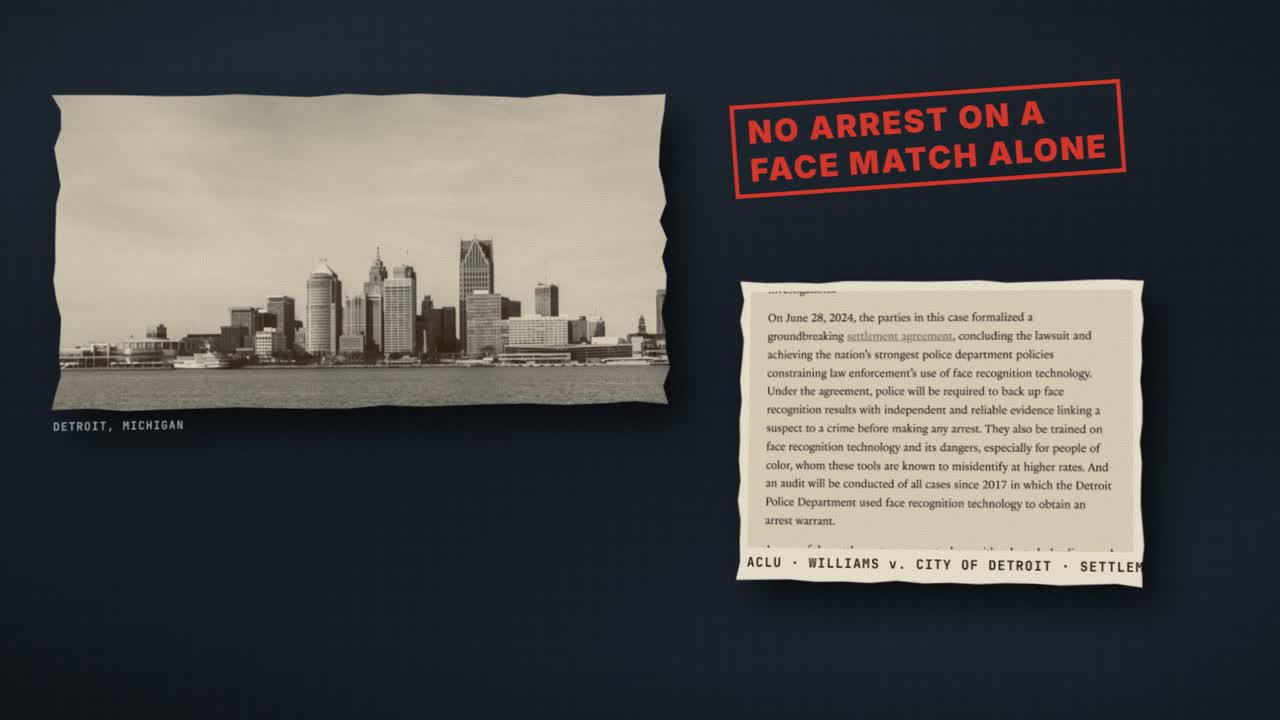
The New York Times called it the first known wrongful arrest in the US based on a facial recognition match, and it was not the last: the Washington Post found at least eight people wrongfully arrested after a match by January 2025, seven of them Black, and at least 15 police departments that arrested someone on a match with no independent evidence. A 2019 US government test of 189 facial recognition algorithms from 99 developers found that many of them falsely matched Asian and African American faces 10 to 100 times as often as white faces, though the gap varied sharply by which specific system was used. Detroit settled with Williams in June 2024, agreeing its police can no longer arrest anyone on a face match alone and must have independent, reliable evidence tying the person to the crime. Clearview AI, a company that built a face database of more than 50 billion images scraped from the internet without consent and sells searches of it to police, was fined 30.5 million euros by the Dutch data protection authority in 2024, which called the database illegal; the regulator's chairman said that if there is a photo of you on the internet, you can end up in Clearview's database. In London, the Metropolitan Police's street-parked facial recognition vans misidentified a community worker as his own brother in February 2024, and the UK's High Court later upheld the policy that allowed it.
Has any court or law actually stopped these systems?
Watch from 25:45Where the line is
So far, mostly judges, and mostly saying not yet: a federal judge in Norfolk, Virginia ruled in January 2026 that the city's 176 Flock cameras had not yet crossed into unconstitutional surveillance, writing at least in Norfolk, Virginia, the answer is: not today, while the residents who sued have appealed.
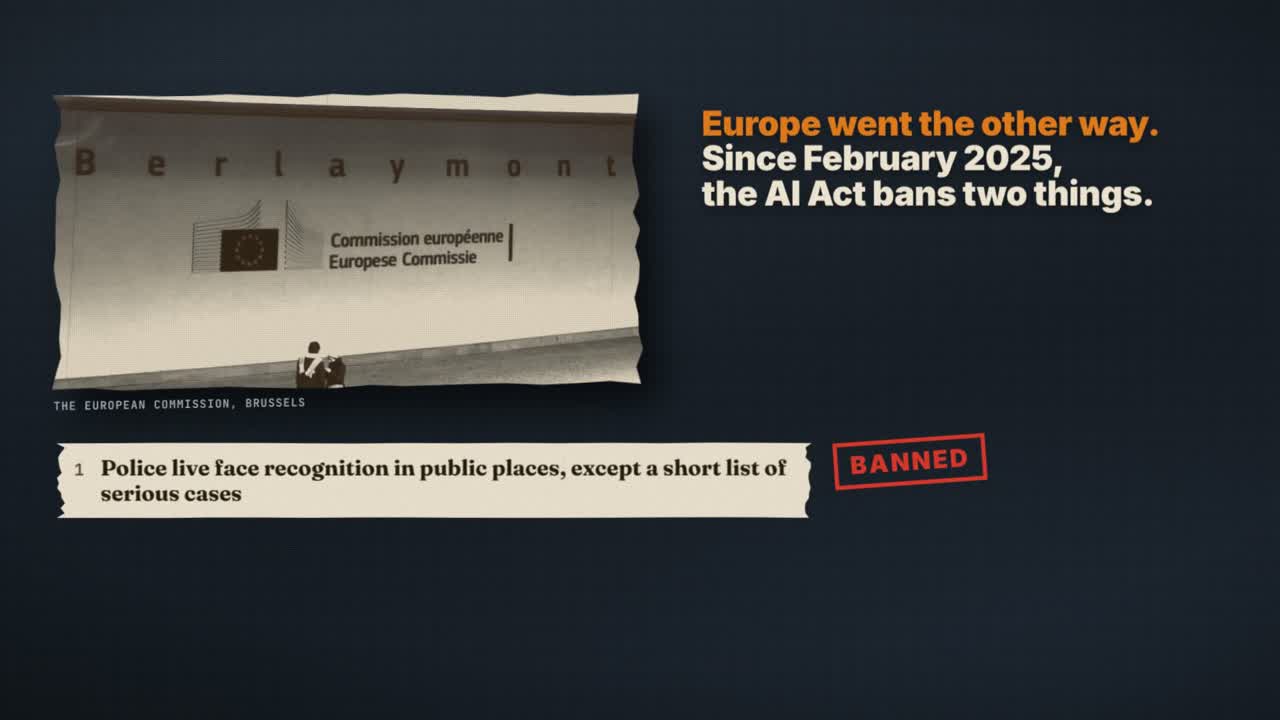
The US Supreme Court's 2018 ruling in Carpenter v. United States required a warrant for historical cell-phone location records, with Chief Justice John Roberts writing that this kind of tracking gives the government near-perfect surveillance, as if it had attached an ankle monitor to the phone's user; no US court has yet applied that standard to license plate cameras, and police search them without a warrant today. Europe has gone further: the EU's AI Act, in force since February 2025, bans police use of live facial recognition in public places except for a short list of serious cases such as a missing child or an imminent attack, and separately bans building a face database by scraping photos from the internet, the way Clearview built its own. In the US, the firmest limits exist only in the handful of states with biometric privacy laws; when Amazon's Ring added a face recognition feature called Familiar Faces in December 2025, it did not switch it on in Illinois or Texas, the two states where Meta had already paid large settlements. In August 2026, Senator Josh Hawley wrote to Flock's chief executive that the company's internal policies are, in practice, the only safeguards for hundreds of millions of Americans; Flock said it would answer the subcommittee's questions.
So when a machine can recognise anyone it sees, who gets to ask it a question?
Watch from 28:18Who gets to ask the question
In each of the 4 cases here, a person asked: a deputy in Texas typed a reason into a box, a police chief in Kansas typed missing child, Detroit detectives took a face match to an arrest, and a sergeant in Denver read a camera log as proof. The machines decided nothing. They made each of those questions quick and cheap, and made each answer look like a fact.
For most of history, being seen in public was different from being known; a stranger on a crowded street stayed a stranger. These machines are closing that gap, first for cars, then for faces, and perhaps next for whoever is wearing the glasses. Every rule written about them so far says the same thing. A match is a lead and not a conclusion. Nothing in the machine makes anyone follow that rule.
A match is a lead and not a conclusion. Nothing in the machine makes anyone follow that rule.
Key findings
A Johnson County, Texas sheriff's deputy searched more than 83,345 Flock Safety cameras in a month-long sweep for one woman, after her partner reported her for a self-managed abortion; the search reason he typed was had an abortion, search for female.
Electronic Frontier Foundation, Dave Maass and Rindala Alajaji, 7 Oct 2025Flock Safety says it operates more than 120,000 cameras across more than 6,000 communities in 49 US states, making over 20 billion vehicle scans every month, as of its most recent public figures.
Wikipedia, Flock Safety, citing the company's own statementsFlock's chief executive Garrett Langley wrote in August 2026 that abuse of Flock technology, at any level, is unacceptable, after the company's own audit tool had already been linked to the arrests of several law enforcement officers who misused the cameras.
Flock Safety blog, 13 Aug 2026A 2019 US government test of 189 facial recognition algorithms from 99 developers found that many of them falsely matched Asian and African American faces 10 to 100 times as often as white faces, with the gap varying sharply by which system was used.
National Institute of Standards and Technology, Dec 2019The Dutch data protection authority fined Clearview AI 30.5 million euros in September 2024 and called its collection of facial images, including those of Dutch citizens, unlawful; the company's own database now holds more than 50 billion images scraped from the internet.
Wikipedia, Clearview AI, citing the Dutch DPA and the companyThe US Supreme Court ruled in 2018 that police need a warrant to access historical cell phone location records, with Chief Justice John Roberts writing that this kind of tracking gives the government near-perfect surveillance of a person's movements.
Wikipedia, Carpenter v. United States, citing the opinionFrequently asked questions about Flock cameras and facial recognition
What did the Texas deputy actually search for?
In May 2025, a Johnson County sheriff's deputy searched Flock Safety's license plate camera network for a woman whose partner had reported her to police after she had a self-managed abortion. His first search covered 17,684 cameras over one week; he then widened it to 83,345 cameras over a month, reaching into Illinois and Washington, states where abortion is legal. County prosecutors told the deputies the woman could not be charged.
How many Flock Safety cameras are there, and what do they record?
Flock says its cameras operate in more than 6,000 communities across 49 US states, making over 20 billion vehicle scans a month. Each camera photographs the plate, make, color and distinguishing features of every car that passes, a profile Flock calls the vehicle fingerprint, and police departments that share access can search each other's cameras in a single nationwide query.
How often are license plate camera alerts wrong?
An internal Roseville, California police review found that 71% of the 1,427 stolen or wanted-car alerts their Flock cameras sent in 2023 and 2024 were misread plates, according to reporting obtained by Business Insider. Flock disputes that figure as a mischaracterization of older hardware and says its cameras read plates correctly more than 96% of the time in good conditions; Roseville police say none of the misreads led to a wrongful stop.
Was Robert Williams's arrest really the first known wrongful arrest from facial recognition?
The New York Times called it the first known case in the US. Williams was arrested on his front lawn in January 2020 after a facial recognition search matched a blurry shop security still to his expired driving licence photo; he spent about 30 hours in custody. Detroit's police later settled with him, agreeing that officers can no longer arrest anyone on a face match alone and must have independent, reliable evidence.
Is it legal for a stranger wearing smart glasses to identify you by name?
Not using Meta's own software, as of this film. Two Harvard students built the capability themselves in 2024 by pairing Meta's Ray-Ban glasses with a separate face-search site, PimEyes, and walked up to strangers on the Boston subway using names the system gave them. In June 2026, WIRED found the working parts of an on-device face recognition system inside the Meta AI app installed on more than 50 million phones; Meta said the feature had never been switched on and removed the code from the app the following day.
Has any court or law stopped these systems?
A federal judge in Norfolk, Virginia ruled in January 2026 that the city's 176 Flock cameras had not yet crossed into unconstitutional tracking, writing that at least in Norfolk, Virginia, the answer is: not today; the residents who sued have appealed. The European Union's AI Act, in force since February 2025, bans police live facial recognition in public places except for a short list of serious cases, and bans building a face database by scraping photos from the internet, the way Clearview built its own.
Sources
- Electronic Frontier Foundation, Flock Safety and Texas Sheriff Claimed License Plate Search Was for a Missing Person. It Was an Abortion Investigation, 7 Oct 2025eff.org
- Wikipedia, Flock Safetyen.wikipedia.org
- Flock Safety blog, Flock Updates Privacy, Accountability, Security, and Transparency Safeguards, 13 Aug 2026flocksafety.com
- National Institute of Standards and Technology, NIST Study Evaluates Effects of Race, Age, Sex on Face Recognition Software, Dec 2019nist.gov
- Wikipedia, Clearview AIen.wikipedia.org
- Wikipedia, Carpenter v. United Statesen.wikipedia.org
- Regulation (EU) 2024/1689, the AI Act, Article 5eur-lex.europa.eu
- Techdirt, California Town Says Flock Cameras Misread License Plates 71% Of The Time, citing Business Insider, 6 Aug 2026techdirt.com
- Institute for Justice, The IJ Database of ALPR Abuseij.org
- The Register, Harvard duo modifies Meta glasses to grab strangers' info, 4 Oct 2024theregister.com
- Electronic Frontier Foundation, Victory: Meta Strips Facial Recognition Code From Smart Glasses App After Public Outcry, Jun 2026eff.org
- ACLU, Williams v. City of Detroitaclu.org
- ACLU, Civil Rights Advocates Achieve the Nation's Strongest Police Department Policy on Facial Recognition Technology, 28 Jun 2024aclu.org
- The Washington Post, Arrested by AI: police ignore standards after facial recognition matches, 13 Jan 2025washingtonpost.com
- NBC News, Police cameras tracked one driver 526 times in four months, lawsuit says (Schmidt v. City of Norfolk)nbcnews.com
Every figure in the film and in this article comes from a court record, regulator, company statement, public-records request or published report listed above. Where a company disputes a figure, as Flock does with the Roseville review, both numbers are given.
Watch next











Facial recognition, training data and the other terms behind this film are explained in plain English, with a printable sheet, in our free AI Terms guide.