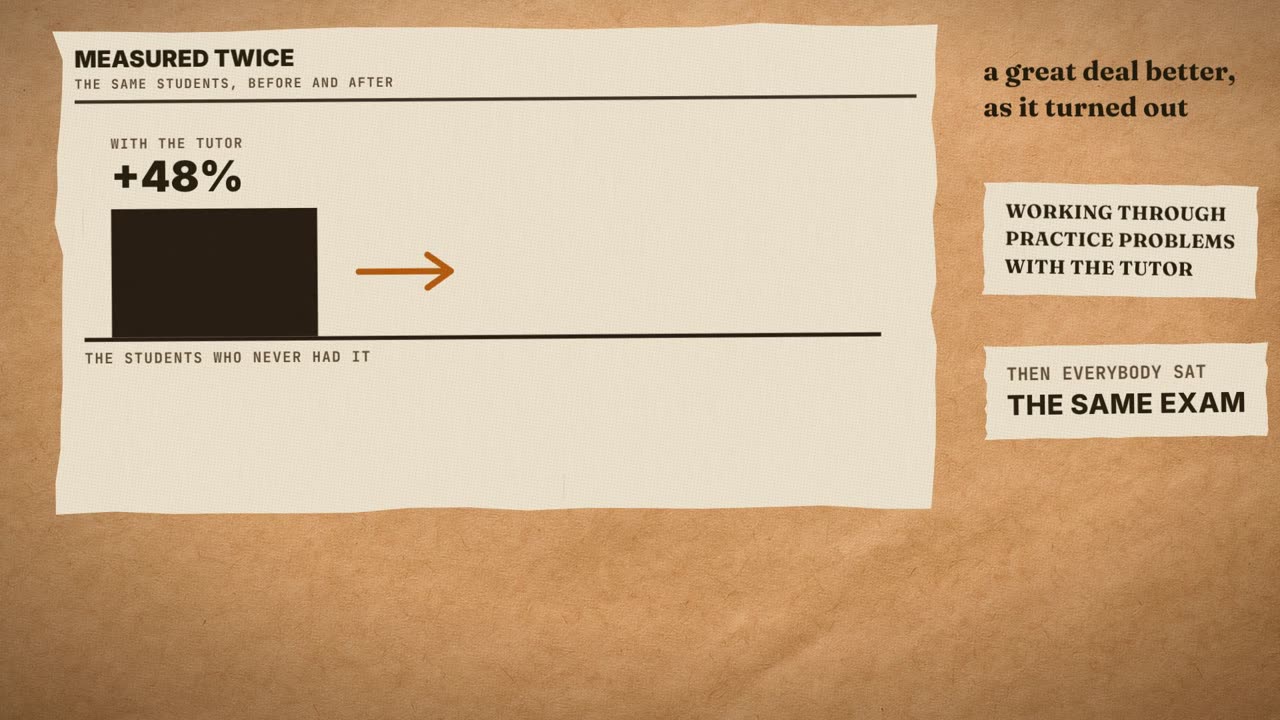
In 2023, nearly a thousand high school students in Turkey were given something no student in history had had: a private GPT-4 tutor that never tired of them. Working through practice problems with it, they scored 48 percent better than students without it. Then the researchers took it away and gave everyone the same exam. The students who had been using it scored 17 percent worse than students who had never had it at all.
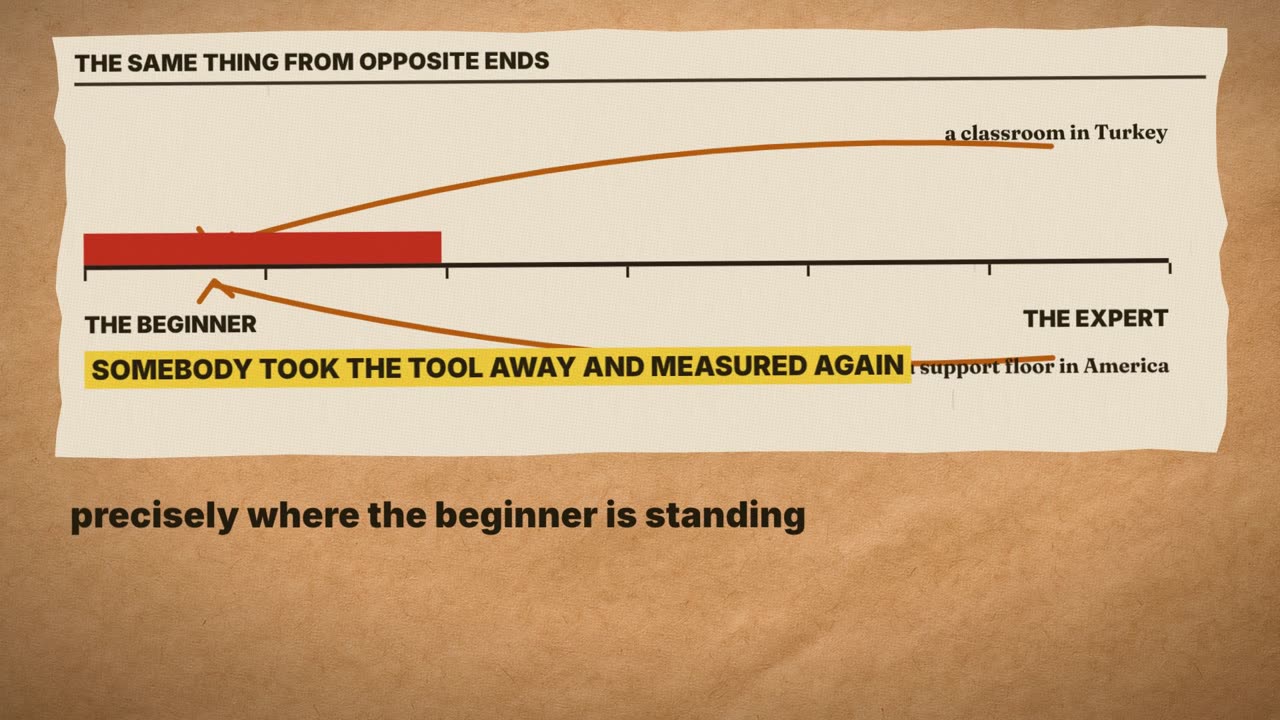
At a large American company, 5,179 customer support agents got an AI assistant. On average they resolved 14 percent more issues an hour; for the best agents it did almost nothing, and for the newest and least skilled the gain was 34 percent. Both studies say the same thing from opposite ends: these systems are at their most powerful where the beginner is standing. Every expert holding your company together got good by doing work slightly too hard for them, badly, in public, while someone more experienced watched. If that work stops being handed out, where do the next experts come from? Our 54-minute documentary for The Signal follows that question, and holds the third arm of the Turkish trial to the end, because it is the answer.
The film in 18 chapters
Pick a chapter and the film starts there. 54:29 in all.
- 010:00Two trials
- 022:40The seven hundred people who were never there
- 036:10The door that stopped opening
- 049:54The argument nobody shows you
- 0512:48What AI actually takes
- 0615:49Three doors
- 0718:50The invisible company
- 0821:21The liberation
- 0924:01Three people and a machine
- 1026:30Looks good is not is good
- 1129:19The conversation
- 1232:52Fifteen minutes
- 1336:34The conveyor belt
- 1439:20The manager of machines
- 1542:25What actually survives
- 1645:51Two companies
- 1748:05The third result
- 1851:05The staircase
Did Klarna really replace 700 workers with an AI chatbot?
Watch from 2:40The seven hundred people who were never there
No. In February 2024 Klarna said its OpenAI-built assistant handled 2.3 million conversations in its first month, about two-thirds of all chats, and did "the equivalent work of 700 full-time agents." That is a productivity comparison a company made about its own software, not a list of people dismissed. Klarna's earlier 700 redundancies, in May 2022, were blamed on the war in Ukraine and inflation.
Klarna did shrink, from about 5,500 employees in 2022 to under 3,000 by 2025, and its chief executive, Sebastian Siemiatkowski, has said how: no redundancies, a hiring freeze outside engineering, and ordinary churn of 15 to 20 percent a year. Nobody was marched out. The door simply stopped opening. In May 2025 he told Bloomberg the company had cut too far, that quality had fallen, and that Klarna was hiring human agents again. A company that makes people redundant leaves a record. A company that stops hiring leaves nothing.
Nobody was marched out. The door simply stopped opening.
Is AI reducing jobs for young workers?
Watch from 6:10The door that stopped opening
For the youngest workers in the most exposed jobs, yes. Erik Brynjolfsson, Bharat Chandar and Ruyu Chen at Stanford's Digital Economy Lab used ADP payroll records covering about 4.6 million workers in more than 730 occupations. Employment of 22 to 25 year olds fell about 11 percent in the most AI-exposed occupations between November 2022 and June 2026, and grew about 10 percent in the least exposed. Their August 2026 update put the gap at 19 percent.
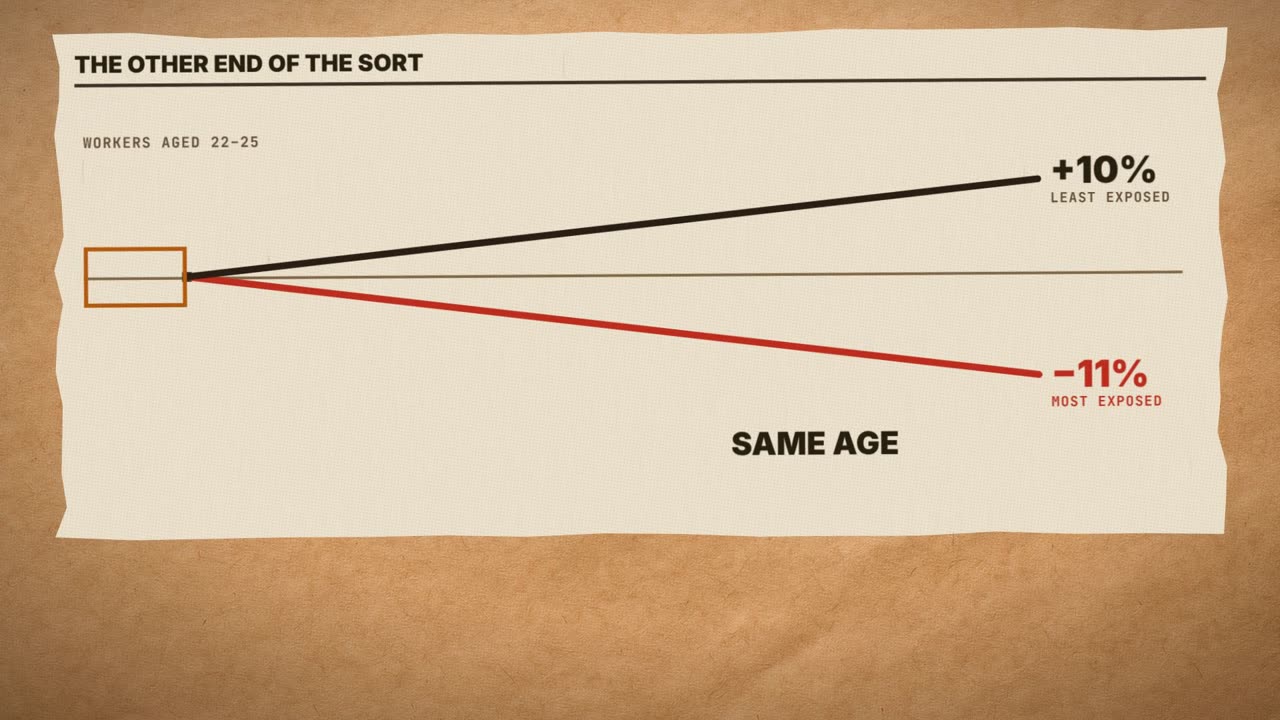
Their first finding belongs at the front: they do not see widespread, economy-wide displacement. The adjustment runs through reduced hiring, not increased separations, and concentrates where AI substitutes for a person rather than assists one. The film draws a company as a pyramid becoming a diamond, and labels the drawing its own, not a finding. If a company is a machine for turning inexperienced people into experienced ones, remove the intake and it keeps producing for about a decade on its existing stock. Then it doesn't.
Is the AI jobs effect real, or are economists misreading it?
Watch from 9:54The argument nobody shows you
Both readings come from good data. Yale's Budget Lab found the overall occupational mix changed by about 1 percent in the 33 months after ChatGPT, less than in the early years of the personal computer or the internet, and Brookings published "no AI jobs apocalypse, for now." Economists at Google pointed to interest rates; Torsten Slok at Apollo to a low-hire market that hits the young first.
The Stanford authors answered part of it: exposure to AI and to interest rates run in different directions across occupations, and they call their results descriptive, not causal. The film's reading is that no economy-wide displacement and a widening gap at the entrance are both probably true, because the people affected have not been hired yet and so cannot show up as a job loss. They appear later, as an absence: a company that cannot find anyone with eight years of experience, in a decade when nobody was given the first year.
Which tasks does AI take first?
Watch from 12:48What AI actually takes
The same tasks we have always given to beginners. Anthropic's Economic Index, mapping one million real conversations in its February 2026 edition onto government task catalogues, found about 49 percent of occupations now have at least a quarter of their tasks done with its model some of the time, and very few where most work goes that way. Jobs are being hollowed, unevenly, from inside.
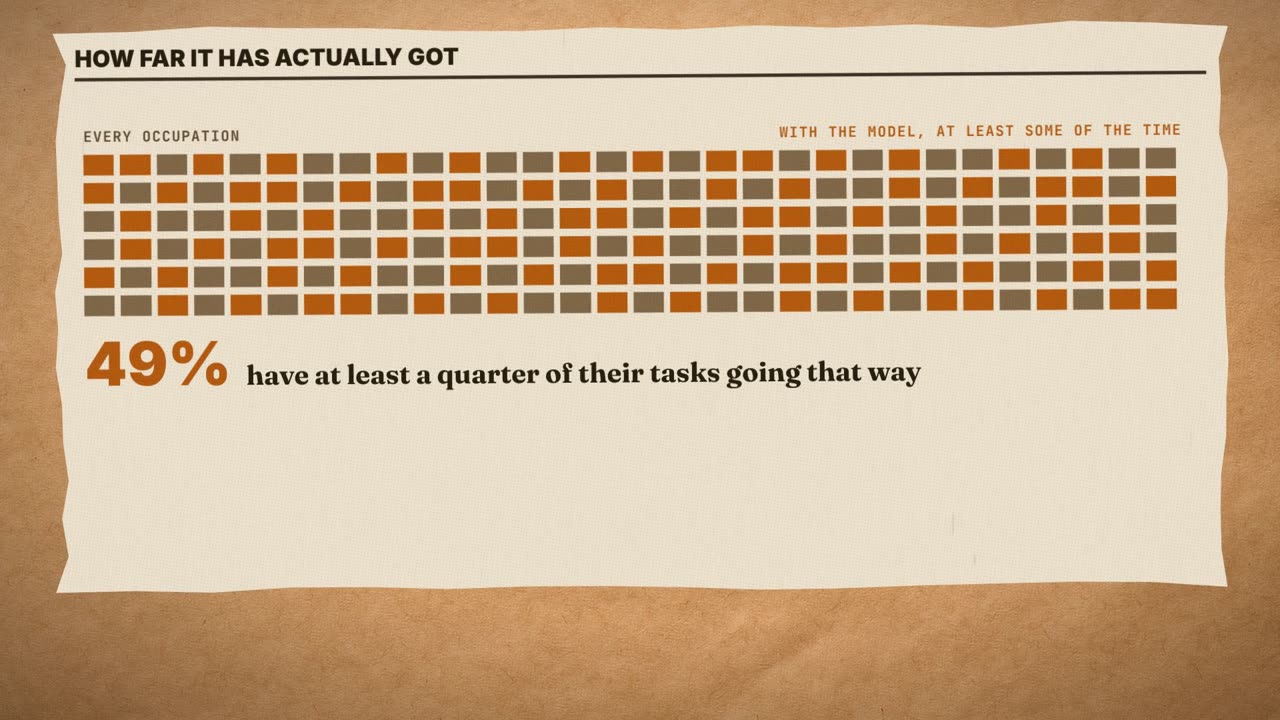
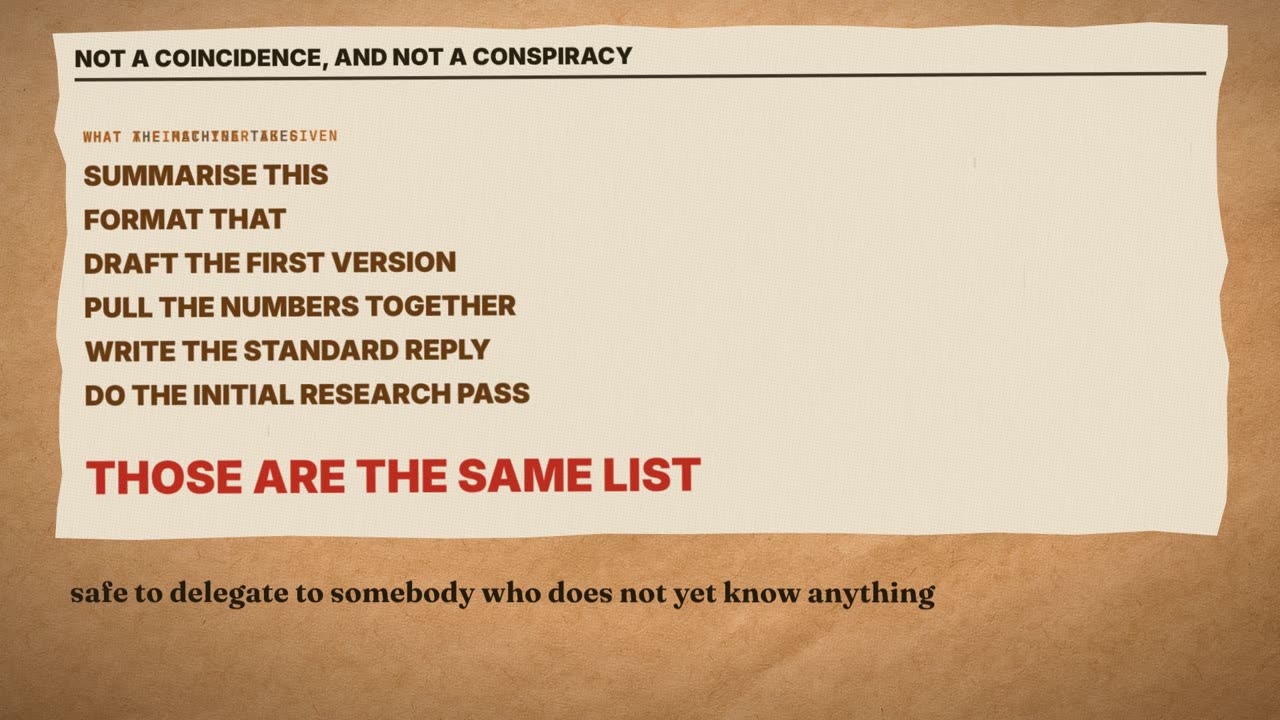
The tasks that go first are the easiest to specify, most repetitive, most self-contained and easiest to check: summarise this, format that, draft the first version, pull the numbers together. That is also the list handed to the newest person in the room for a hundred years, because a first-year cannot do much damage with it and doing it teaches them where everything is. What makes a task automatable turns out to be identical to what makes it safe to delegate. We built the training ground out of exactly the material the machine takes first.
We built the training ground out of exactly the material the machine takes first.
What are generative, agentic and physical AI?
Three doors, each larger than the last. Generative AI produces text, images, code and analysis, then stops. Agentic AI operates: it browses, fills in forms, clicks through software and chains steps without being told each one. Physical AI takes those hands off the screen into robots. Think, then act, then move.
The clearest view of the third door came in October 2025, when the New York Times obtained internal Amazon strategy documents describing automation of as much as 75 percent of operations, and avoiding more than 160,000 US hires by 2027 and more than 600,000 by 2033 while sales doubled. 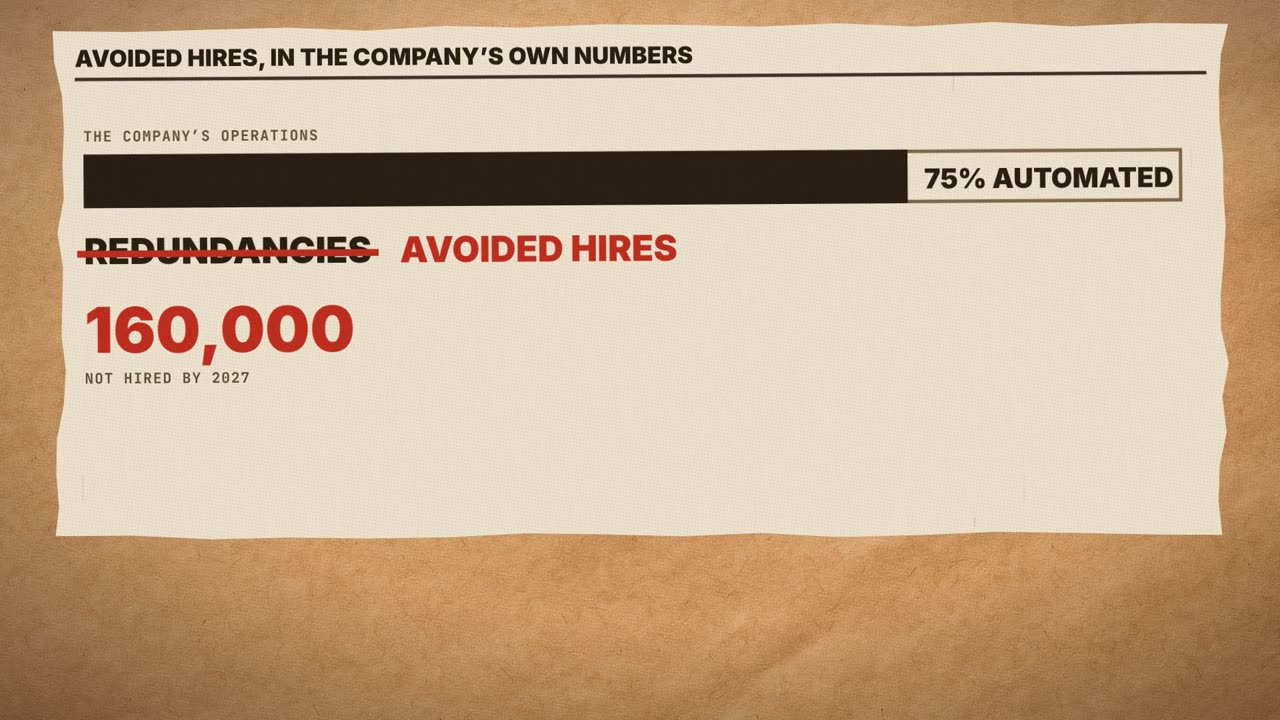
Its Shreveport, Louisiana site runs around a thousand robots with about a quarter fewer people. Amazon disputed the framing, but the plan was written in hires avoided rather than jobs cut. The same mechanism, a third time: not firing, not opening.
How many workers hide their use of AI?
Watch from 18:50The invisible company
More than half, in the largest study of its kind. KPMG and the University of Melbourne surveyed more than 48,000 people in 47 countries between November 2024 and January 2025; 57 percent said they hide their use of AI at work and present its output as their own. A separate 2026 survey of office professionals found 66 percent had used unapproved AI tools.
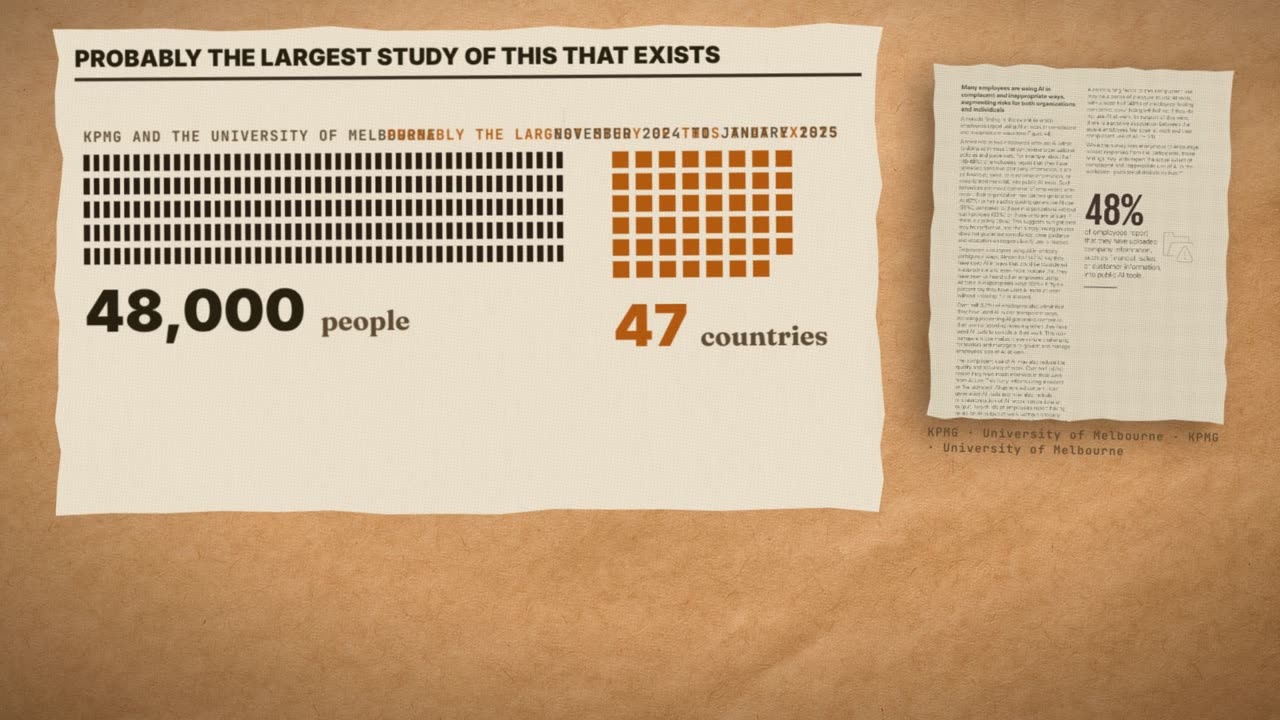
So every executive planning an AI rollout is working from a wrong picture of a company where it is already deployed. And it breaks the training loop. A junior's work has always been the raw material of their education: they produce something, a senior reads it, and the feedback teaches them. With a hidden model in the middle, praise might land on a system and correction might teach a person about a mistake they never made. You cannot coach the part you cannot see.
Can AI actually help less experienced workers?
Watch from 21:21The liberation
Yes, and the evidence is strong. Erik Brynjolfsson, Danielle Li and Lindsey Raymond studied 5,179 support agents as an AI assistant was rolled out in stages, so later groups served as a comparison. Issues resolved per hour rose 14 percent on average and 34 percent for the least experienced, customer sentiment and retention improved, and the tool seemed to spread the best agents' practices to everyone.
That is the strongest argument against the film's thesis, from the same economist behind the entry-level data. If a machine can carry the best worker's judgement to the newest worker's screen, it is not destroying the apprenticeship; it is the apprenticeship, a patient senior colleague at three in the morning. The film says hold that number, 34 percent, and comes back to it. It also separates what is sold from what is measured: Epoch AI puts Anthropic's revenue per employee near $14 million and OpenAI's near $6.5 million, against about $300,000 for a typical software company, but that measures a market position as much as a method.
What is workslop, and what does it cost?
Watch from 26:30Looks good is not is good
Workslop is AI-generated content that masquerades as good work but lacks the substance to move a task forward, as named in Harvard Business Review in September 2025 by BetterUp Labs and Stanford's Social Media Lab. Of 1,150 full-time US workers, 41 percent had received it in the past month, and each instance cost an average of 1 hour 56 minutes.
That is a transfer, not a productivity statistic: the producer saved twenty minutes and the receiver lost two hours. Bad human work used to announce itself on the surface. What arrives now is fluent, well-formatted and confident, with a wrong assumption somewhere inside, the failure engineered, accidentally, to survive review. Catching it takes what lawyers call judgement, doctors clinical instinct and engineers smell: compressed experience, the residue of having been wrong yourself in that exact domain.
Does working beside colleagues make people better at their jobs?
Watch from 29:19The conversation
Measurably. Natalia Emanuel, Emma Harrington and Amanda Pallais studied a large firm's software engineers and found those in the same building as their team received 18.3 percent more feedback on their code, concentrated among the younger and less tenured. When offices closed in 2020, women who had sat with their teams lost 38.9 percent more comments per program than women already working remotely.
The engineers trained on co-located teams later wrote better code with fewer bugs. And the honest part: experienced engineers wrote more programs when not sitting near juniors. The training was always paid for out of somebody's afternoon. The film is explicit that no dataset shows AI silencing offices. What it offers is the mechanism: a model answers the question you asked, while a colleague often answers the question you should have asked. The interruptions were the curriculum. The inefficiency was doing work.
The interruptions were the curriculum. The inefficiency was doing work.
What happened to surgical training when robots arrived?
Watch from 32:52Fifteen minutes
Surgical training was squeezed out sideways by something better. The researcher Matt Beane, of UC Santa Barbara, found that in a four-and-a-half-hour robotic procedure, a resident would be lucky to get fifteen minutes at the console, generally a ten- to twenty-fold cut in hands-on surgery. Robotic surgery is genuinely superior for many procedures, but on the robot the surgeon can do the whole operation alone.
A minority of residents got good anyway through what Beane calls shadow learning: watching hundreds of hours of recordings in their own time, specialising absurdly early, skipping the lectures that were supposed to be their education. That is a survival strategy, not a system. In his 2024 book The Skill Code, Beane says expertise is built from challenge, complexity and connection. A good AI workflow removes all three: the hard part arrives done, you are handed the clean slice, and you no longer need to ask anybody.
Are entry-level job postings falling?
Watch from 36:34The conveyor belt
Yes, while senior postings rise. Indeed's Hiring Lab reported US entry-level postings down 7.5 percent year on year as of May 2026, trending down since a 2022 peak, while senior postings rose almost 15 percent; UK graduate postings in July 2026 were down about 7 percent on the year. Employers want experience and are advertising less of the thing that produces it.
The film complicates its own line: Handshake data has entry-level healthcare postings up 13 percentage points, with cybersecurity and skilled trades holding up. The first rung is vanishing in specific places, which matters more to an eighteen-year-old than the headline. The Turkish students show the step before: their practice results were superb, but practice had quietly become production.
Is "manager of AI agents" the new entry-level job?
Watch from 39:20The manager of machines
Many companies will try it, and it is a better job than the one it replaces. Anthropic's Economic Index reported in March 2026 that users with more than six months' experience had about a 10 percent higher success rate and tried harder tasks, so operating these systems is a real, improvable skill. But it is a skill in operating the tool, not in the subject.
You can be excellent at prompting and still unable to tell whether the financial model rests on an assumption the client will not accept, or whether the code will fall over under load in eighteen months: a conductor who has never played an instrument and cannot hear the second violin is wrong. And 41 percent of workers just told a survey they received work last month that looked finished and was not. The new role is unsolved, not impossible, and being deployed as though it were solved.
Which skills survive AI?
Watch from 42:25What actually survives
Whatever was always scarce: knowing which problem is worth solving, being the person a client tells the truth to, being accountable when it goes wrong, and seeing that something polished is wrong and saying why. In 2026 execution is getting cheap, so those rise in relative value. Here is the sting. Every single one of those is downstream of having done the execution.
Every single one of those is downstream of having done the execution.
Judgement is compressed experience, and nobody starts there. So every company faces a trade: efficiency, lower cost and more output, all landing this quarter, against apprenticeship and jobs for beginners, landing in ten years with no number attached. One side arrives with numbers and the other does not, and any system that measures one thing optimises for it. The apprenticeship survived because it was invisible, carried inside a slightly inefficient way of working. The moment somebody could see it clearly enough to remove it, they did.
How should companies use AI without losing their future experts?
The film sets out two companies. Company A stops hiring at the bottom, fires nobody, and lets attrition do the rest; costs fall and margins rise. Company B uses the same tools, removes the same drudgery, and then deliberately rebuilds the difficulty, giving juniors real problems early and running what some law firms call deconstruction sessions, where a senior and a junior take apart an AI draft and argue about what it assumed and missed.
On a quarterly report the two look the same, and Company A may look better. The film will not invent a ten-year ending for a technology three years old. Except that somebody did run the experiment, not for ten years and not in a company, but in a school with a control group.
What was the third result of the Turkish GPT-4 tutor study?
Watch from 48:05The third result
The guardrailed tutor did no harm. The PNAS study by Hamsa Bastani, Osbert Bastani, Alp Sungu and colleagues, "Generative AI without guardrails can harm learning", had three groups: no AI, GPT Base, an ordinary chat that answered the question, and GPT Tutor, the same model instructed to give teachers' hints and withhold answers. In practice, GPT Base raised scores 48 percent and GPT Tutor 127 percent.
Then the AI was removed. GPT Base students scored 17 percent worse than students who never had AI; GPT Tutor students scored about the same as the control. The harm was not in the model. The harm was in the interface. Identical capability, deployed two ways, produced opposite outcomes, and both groups experienced it as help. The fix was cheap: functionally, a change to a prompt.
The harm was not in the model. The harm was in the interface.
Who trains the next generation of experts?
Nobody, unless someone decides to. Picture a company as a staircase from intern to executive: a pay structure that worked for about a century as a training programme, because you could not reach the fifth step without standing on the second. For three years the bottom steps have been removed, one at a time, and everyone has applauded, because from every angle available to a business it looks like progress.
How does anybody reach the top if the bottom of the staircase is gone? AI is not the villain; it works, so well and so early in a career, at precisely the tasks people used to get better by struggling through. New steps can be built: deliberately hard work, real relationships between those who know and those who don't, a senior who loses an afternoon on purpose, and an interface designed to make somebody better rather than faster. Every one costs something now and pays back in a decade, which is why no company's system will recommend it. Nobody is going to be assigned that job. Somebody is going to have to decide it is theirs.
Key findings
In a trial with nearly 1,000 Turkish high school students, an ordinary GPT-4 chat interface raised practice scores 48% but left students 17% worse on an exam without it; a version that gave hints instead of answers raised practice 127% and left exam scores about the same as the control.
Bastani, Bastani, Sungu et al., Generative AI without guardrails can harm learning, PNAS, 2025Among 5,179 customer support agents, an AI assistant raised issues resolved per hour by 14% on average and by 34% for the least experienced, with almost no effect for the most skilled.
Brynjolfsson, Li & Raymond, Generative AI at Work, NBER / Quarterly Journal of EconomicsStanford researchers using ADP payroll records for about 4.6 million workers found employment of 22 to 25 year olds in the most AI-exposed occupations fell about 11% while it grew about 10% in the least exposed; their August 2026 update put the gap at 19%.
Brynjolfsson, Chandar & Chen, Canaries in the Coal Mine, Stanford Digital Economy LabIn a KPMG and University of Melbourne survey of more than 48,000 people in 47 countries, 57% said they hide their use of AI at work and present its output as their own.
KPMG and University of Melbourne, Trust, attitudes and use of AI: a global study 2025In a survey of 1,150 US full-time workers, 41% had received AI-generated 'workslop' in the past month, and each instance took an average of 1 hour 56 minutes to deal with.
BetterUp Labs and Stanford Social Media Lab, Harvard Business Review, Sep 2025Software engineers sitting in the same building as their teammates received 18.3% more feedback on their code, with the gains concentrated among younger and less-tenured engineers.
Emanuel, Harrington & Pallais, The Power of Proximity to Coworkers, NBER w31880Over the 33 months after ChatGPT's release, the US occupational mix changed by about 1%, less than in the early years of the personal computer or the internet.
The Budget Lab at Yale, Evaluating the Impact of AI on the Labor MarketFrequently asked questions about AI and entry-level jobs
Is AI taking entry-level jobs?
The best evidence points to fewer entry-level hires rather than mass layoffs. Stanford's Digital Economy Lab found employment of 22 to 25 year olds in the most AI-exposed occupations about 19% below their peers in August 2026, with the adjustment happening through reduced hiring, not increased separations. Yale's Budget Lab found the overall job mix changed only about 1% in 33 months.
Does using ChatGPT help or hurt learning?
It depends on how it is set up. In a PNAS study of nearly 1,000 Turkish students, an ordinary GPT-4 chat interface raised practice scores 48% but left students 17% worse when it was taken away. A tutor version that gave hints and withheld answers raised practice 127% and did no harm on the exam.
Did Klarna replace 700 workers with AI?
Not exactly. In February 2024 Klarna said its AI assistant did work equivalent to 700 full-time agents, a productivity comparison rather than 700 dismissals. Klarna shrank from around 5,500 staff in 2022 to under 3,000 by 2025 mainly by not replacing people who left, and in May 2025 its chief executive said it had cut too far and was hiring human agents again.
What is workslop?
Workslop is AI-generated content that looks like good work but lacks the substance to move the task forward. In a 2025 survey by BetterUp Labs and Stanford's Social Media Lab, 41% of US full-time workers had received it in the past month, and each instance cost about 1 hour 56 minutes to deal with.
What happened to surgeons' training with robotic surgery?
The researcher Matt Beane found that on the robot a surgeon can operate alone, so in a four-and-a-half-hour robotic procedure a resident might get about fifteen minutes at the console, a ten- to twenty-fold cut in hands-on time. Some residents learned anyway through what he called shadow learning, out of sight and often against the rules.
How can companies use AI without losing the next generation of experts?
The film's answer comes from the Turkish trial: the same model, set up to guide rather than hand over answers, avoided the harm. It argues companies have to rebuild deliberate difficulty, such as seniors and juniors taking apart AI drafts together, and accept being slightly less efficient for several years.
Sources
- Bastani, Bastani, Sungu, Ge, Kabakci & Mariman, Generative AI without guardrails can harm learning: Evidence from high school mathematics, PNAS 122 (26), 2025pnas.org
- Brynjolfsson, Li & Raymond, Generative AI at Work, NBER Working Paper 31161 (Quarterly Journal of Economics, 2025)nber.org
- Klarna, Klarna AI assistant handles two-thirds of customer service chats in its first month, Feb 2024klarna.com
- Brynjolfsson, Chandar & Chen, Canaries in the Coal Mine? Six Facts about the Recent Employment Effects of Artificial Intelligence, Stanford Digital Economy Labdigitaleconomy.stanford.edu
- The Budget Lab at Yale, Evaluating the Impact of AI on the Labor Market: Current State of Affairsbudgetlab.yale.edu
- Brookings, New data show no AI jobs apocalypse, for nowbrookings.edu
- Anthropic, The Anthropic Economic Indexanthropic.com
- KPMG and University of Melbourne, Trust, attitudes and use of artificial intelligence: A global study 2025kpmg.com
- Niederhoffer, Kellerman, Lee, Liebscher, Rapuano & Hancock, AI-Generated Workslop Is Destroying Productivity, Harvard Business Review, Sep 2025hbr.org
- Emanuel, Harrington & Pallais, The Power of Proximity to Coworkers, NBER Working Paper 31880nber.org
- Indeed Hiring Labhiringlab.org
Every figure in the film and in this article comes from a named study, survey, company statement or reporting listed above. The pyramid-to-diamond drawing is the film's own illustration, not a finding, and the film says plainly that no dataset yet shows AI emptying offices of conversation. Where economists dispute the entry-level data, both sides are given.
Watch next









Agentic AI, generative AI and the other terms behind this film are explained in plain English, with a printable sheet, in our free AI Terms guide.