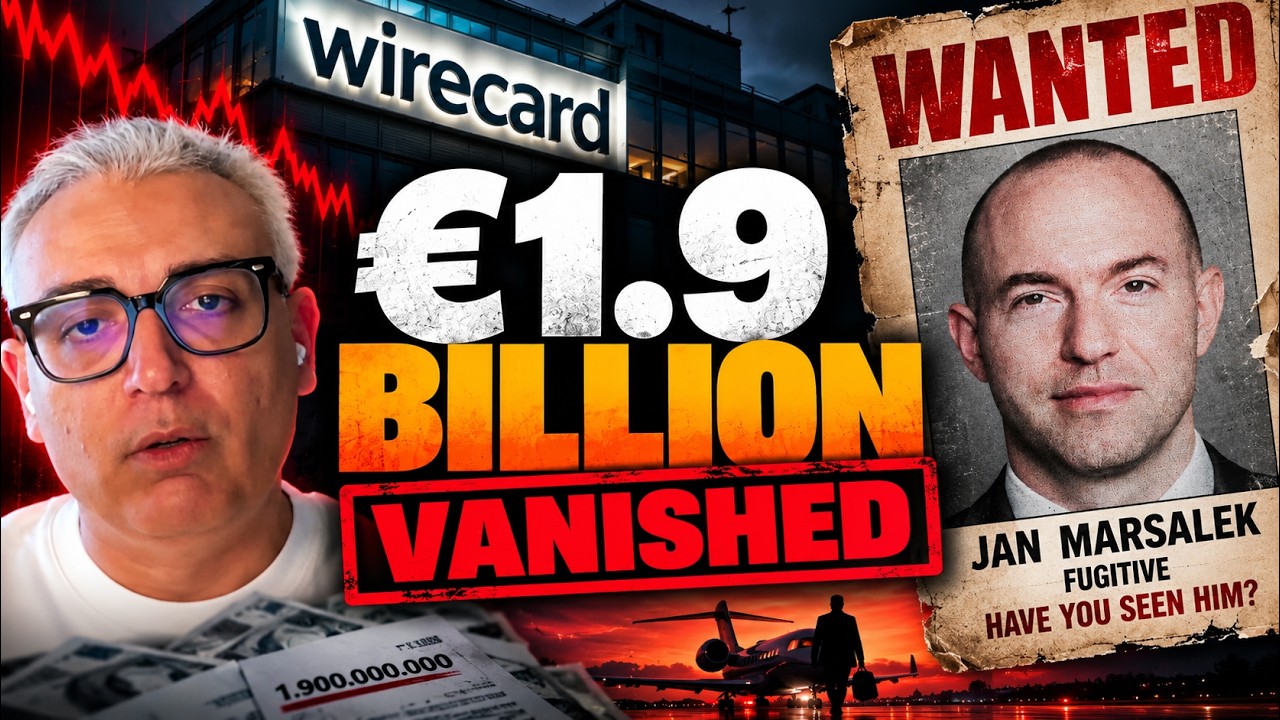
In June 2020 the auditors of Wirecard, one of the thirty largest companies on the German stock market, told the company they could not sign off its accounts. Wirecard said €1.9 billion was being held for it in two banks in the Philippines. The auditors had asked the banks to confirm it, and both replied that they had never held the money and that the documents carrying their names were not theirs.
That money was roughly a quarter of everything Wirecard said it owned. Within a week the company had filed for insolvency, its chief executive had been arrested, and its chief operating officer had boarded a private jet at a small airfield outside Vienna, flown to Belarus, and disappeared. For years its auditor, its regulator and its government had all stood behind it, and the people who first exposed it, two newspaper reporters, had been reported to prosecutors by Germany's financial regulator.
Our 27-minute documentary for The Signal goes through how Wirecard really made its money, why the people who tried to warn Germany were the ones investigated, and what happened after the collapse, as far as a London courtroom where a jury heard that the executive who vanished had gone on to direct a network of spies working for Russia. The film is at the top of this page; this piece follows it chapter by chapter, with the sources for each step.
The film in 8 chapters
Pick a chapter and the film starts there. 27:24 in all.
- 010:00The €1.9 billion that was never there
- 021:41Where Wirecard sat in the flow of money
- 034:50The partners nobody could visit
- 048:54The people who tried to warn Germany
- 0513:46June 2020: one week, one collapse
- 0617:32Where Jan Marsalek went
- 0721:45The trial in Munich
- 0824:54How Wirecard really made its money
What happened to Wirecard's €1.9 billion?
Watch from 0:00The €1.9 billion that was never there
The money never existed. In June 2020 Wirecard's auditor asked the two Philippine banks said to be holding the €1.9 billion to confirm the balances, and both said they had never held the money. On 22 June 2020 Wirecard itself said the sum most likely did not exist, and on 25 June it filed for insolvency.
The fraud only makes sense once you can see where the company sat in the flow of money, so the film starts there.
What did Wirecard actually do?
Watch from 1:41Where Wirecard sat in the flow of money
Wirecard processed card payments. Founded in 1999 in a suburb of Munich, it sat between shoppers and sellers, checking cards, passing requests through Visa or Mastercard and paying sellers, keeping a small fee on every transaction. In its early years much of that business came from online gambling and pornography, industries the big banks preferred to avoid.
Two people sit at the centre of the story. Markus Braun, an Austrian with a doctorate in business computing, became chief executive in 2002 and told investors Wirecard was a technology company that happened to handle money. Jan Marsalek, also Austrian, joined in 2000 at the age of twenty, without a university degree, and became chief operating officer in 2010; as investigators would later find, he was responsible for the parts of the business nobody else could see.
By 2018 Wirecard was the success story German business had been waiting for: a world leader in cars, chemicals and engineering had at last produced a technology champion. The product it sold most successfully was not payments. It was the story of a German technology champion, and Germany wanted that story so badly that very few people looked underneath it. In September 2018 Wirecard joined the DAX, the index of the thirty largest listed German companies, replacing Commerzbank, a bank founded in 1870, and at its peak that year it was valued at around €24 billion. From that autumn, anyone with a pension in a fund that tracks the DAX owned part of it.
The product it sold most successfully was not payments. It was the story of a German technology champion.
Where did Wirecard's profits come from?
Watch from 4:50The partners nobody could visit
Almost all of them came through three small partner companies, according to the Financial Times in April 2019: Al Alam in Dubai, PayEasy in the Philippines and Senjo in Singapore. Wirecard's internal spreadsheets said Al Alam handled about $386 million of payments a month and produced half of Wirecard's worldwide profit in 2016, yet Visa and Mastercard both said they had no record of any relationship with it.
In countries where it had no licence, Wirecard worked through licensed partners and earned commission for sending customers their way. That arrangement, third-party acquiring, is not improper in itself. What was unusual was how much of Wirecard depended on it, and that the most profitable part of one of Europe's most celebrated technology companies was a business the two card networks it relied on had never heard of.
Then there was where the money was supposed to be. Wirecard said its share of the partner profits sat in escrow, accounts run by an independent trustee, in Asia, and every year the auditors received a letter confirming it was there. In January 2026 a court in Singapore put names to some of those letters. Rajaratnam Shanmugaratnam, whose small firm Citadelle acted as trustee, issued letters between 2016 and 2018 stating that Citadelle held more than €1 billion of Wirecard's money. The court found they were false and sentenced him to ten years in prison. A British man, James Henry O'Sullivan, a business partner of Marsalek's for years who had introduced him to the trustee, was sentenced to six and a half years for persuading him to falsify five of them. Both men have said they will appeal.
The profit lived on paper, and for years the paper was accepted as proof. An audit that accepts a letter about a bank account, instead of asking the bank, is not an audit. It is a ritual.
An audit that accepts a letter about a bank account, instead of asking the bank, is not an audit. It is a ritual.
Who tried to warn Germany about Wirecard?
Watch from 8:54The people who tried to warn Germany
First, Wirecard's own lawyer. Pav Gill joined the company in Singapore in 2017 as senior lawyer for the Asia-Pacific region and within months found money moving in circles and coming back as apparent profit, known as round-tripping. Then the Financial Times reporters Dan McCrum and Stefania Palma, who published the first story on 30 January 2019.
Wirecard hired the Singapore law firm Rajah and Tann to look into Gill's findings, and its preliminary findings pointed to possible forgery and falsification of accounts. The investigation stalled, and in September 2018 Gill was pushed out. By his own account he was followed after he left, and so was his mother, who found a journalist who put them in touch with the Financial Times. McCrum had been writing about gaps in Wirecard's accounts since 2015. The first story described forged and backdated contracts and a document showing €37 million moving through suspicious transactions. Wirecard said the reporting was false.
On 18 February 2019 BaFin, Germany's financial regulator, banned short-selling in Wirecard shares, the first time it had ever imposed that kind of ban on a single company. In April 2019 it filed a criminal complaint naming McCrum and Palma, and Munich prosecutors opened an investigation into the journalists. In Germany that year, the safest place to stand was next to the fraud, and the most dangerous place to stand was next to the people exposing it. That same April, SoftBank agreed to invest €900 million in Wirecard.
In Germany that year, the safest place to stand was next to the fraud, and the most dangerous place to stand was next to the people exposing it.
In October 2019 the FT published the internal spreadsheets, and Wirecard's supervisory board appointed KPMG to carry out a special investigation. While it was underway, Chancellor Angela Merkel made an official visit to China; a few days before, Karl-Theodor zu Guttenberg, a former defence minister advising Wirecard, raised the company's planned Chinese acquisition with her, and in Beijing she raised it with the Chinese government. She later told a parliamentary inquiry that there had been no reason at the time to assume serious irregularities. Everyone with authority in the story had to decide whom to believe, and every one of them chose the company.
How did Wirecard collapse in June 2020?
Watch from 13:46June 2020: one week, one collapse
In eight days. On 18 June EY refused to sign the accounts because it could not confirm the €1.9 billion, and the shares lost more than 60 percent that day. On 19 June Braun resigned and Marsalek flew to Belarus. On 22 June Wirecard admitted the money most likely did not exist, and on 25 June it became the first DAX member ever to go bust.
KPMG's report, on 28 April 2020, had said it could not verify the partner business, its 2016 to 2018 revenue or that its customers existed, and complained of obstruction; Wirecard said it had found no evidence of wrongdoing. By then, Wirecard said, the escrow money had moved to BDO and BPI, two of the largest banks in the Philippines. EY, its auditor for more than a decade, did what an auditor can do in any year it chooses and asked the banks directly. The money did not disappear in June 2020. It had never been there.
On 17 June an employee of BaFin sold financial products linked to Wirecard's share price; BaFin later reported that employee to prosecutors on suspicion of insider trading. On the evening of 19 June a private jet took off from Bad Vöslau, south of Vienna, with Marsalek on board, and landed in Minsk a little before eleven. Austrian prosecutors have since alleged the flight was arranged with the help of a former Austrian member of parliament and a former officer of Austria's domestic intelligence service. No warrant had been issued for him at the time. On 21 June the Philippine central bank governor, Benjamin Diokno, said none of the money had ever entered the Philippine financial system. On 22 June Braun handed himself in to police in Munich and was released the next day on €5 million bail, and BaFin's president, Felix Hufeld, called the affair a complete disaster.
Creditors' claims came to around €15 billion, against a small fraction of that left to pay them. In July 2020 Braun was arrested again with two other former executives, on suspicion that a criminal gang had faked the accounts for years to keep borrowing from banks. He has been held in custody ever since.
Where did Jan Marsalek go?
Watch from 17:32Where Jan Marsalek went
To Russia, according to a September 2025 investigation by Der Spiegel, Der Standard, ZDF, PBS Frontline and The Insider, which reported that he was living in Moscow as Alexander Nelidov, with Russian citizenship issued under that name in 2023. Britain's Crown Prosecution Service says he directed a spy ring for Russian intelligence. Marsalek has never been tried for anything.
There were signs before the collapse. In summer 2018, according to documents later reviewed by the Financial Times, he showed London traders papers about Novichok, the nerve agent used that spring in the attempt to kill Sergei Skripal in Salisbury, and boasted of intelligence connections and a plan involving a private militia in Libya. A month after he vanished, Bellingcat and Der Spiegel published travel records showing more than sixty trips to Russia in ten years.
In 2023 British police arrested a group of Bulgarian nationals in England. Their leader, Orlin Roussev, worked out of a former guesthouse in Great Yarmouth, where police found what prosecutors called an Aladdin's cave of espionage equipment: hundreds of phones and SIM cards, dozens of identity documents in other people's names, and cameras hidden in sunglasses, ties and children's toys. The group watched journalists, including Christo Grozev, the Bellingcat investigator who helped identify the Skripal poisoners, and Roman Dobrokhotov, founder of The Insider. In the CPS's words, Marsalek "acted as the intermediary for the Russian Intelligence Services and gave instructions to Roussev." The court heard encrypted messages between the two men discussing kidnapping Grozev. On 7 March 2025 an Old Bailey jury convicted the last three members, after three others had pleaded guilty, and in May the six were sentenced to more than fifty years between them.
The investigators also reported that leaked phone data placed his phone near the headquarters of the FSB, Russia's security service, hundreds of times during 2024. No court has established how much of Wirecard was a fraud for money and how much served some other purpose, and the one person who could answer that is in Moscow under another name, out of reach of every court that wants to hear from him.
Where does Markus Braun's trial stand?
Watch from 21:45The trial in Munich
The trial is still running. Braun has been on trial in Munich since 8 December 2022, in a courtroom attached to Stadelheim prison, where he is held. After more than 270 days of hearings, closing arguments are due to begin on 19 October 2026, and no verdict has been reached. Braun denies every charge against him.
Two men are on trial with him: Wirecard's former chief accountant, and Oliver Bellenhaus, who ran its operation in Dubai, the centre of the partner business, and who handed himself in and became the prosecution's key witness. Bellenhaus told the court the partner business did not exist in the form presented to investors, calling it "a swindle from the beginning", and said "Braun gave the marching orders and everyone followed." The prosecution says Braun was the principal figure in a scheme that invented billions of euros of revenue to keep a loss-making company alive on borrowed money, and puts the damage at more than €3 billion.
Braun's defence tells the opposite story. He says he was a victim: the partner business was real, real money flowed through it, and a group around Marsalek and Bellenhaus stole that money and hid it. His lawyers point to more than €1 billion of payments into Wirecard from the partners and describe Bellenhaus as a perpetrator trying to save himself. Braun has called the trial a farce.
Others have had their reckoning. In September 2020 Munich prosecutors closed their investigation into the two FT reporters, saying the reporting had been essentially correct and neither false nor misleading. In January 2021 BaFin's president and his deputy left the regulator. A Bundestag inquiry's special investigator went through EY's audit files, 90 gigabytes of working papers and 40,000 emails, and found EY had missed warning signs and relied on what Wirecard's executives told it. Germany's audit regulator later found EY had breached its professional duties for the 2016, 2017 and 2018 accounts, banned it from new listed clients in Germany for two years and fined it €500,000, less than the bail set for Braun.
So how did Wirecard really make its money?
Watch from 24:54How Wirecard really made its money
Wirecard earned real money on the business you could see, but the profits that made it a giant were written down rather than earned. They came from partners nobody could visit, were held in accounts nobody inspected, and were confirmed by letters a court in Singapore found in 2026 to be false.
Wirecard is proof that every safeguard an ordinary investor relies on can be switched off by one belief: that a company is too important to doubt. It had an audit signed every year by one of the world's largest accounting firms, a national regulator, a place in Germany's top index and so inside millions of pension funds, nearly a billion euros from one of the best-known investors on the planet, and the head of the German government speaking up for it abroad. None of those safeguards checked the one thing that mattered, which was whether the money was really in the bank. The people who did check were a company lawyer who says he was followed, two reporters put under criminal investigation, and investors banned from betting against the company.
None of those safeguards checked the one thing that mattered, which was whether the money was really in the bank.
The film leaves two lessons for any company you trust with your money. Look at whether its profits ever turn into cash it holds itself, because profit that always sits in someone else's account is profit you are asked to take on trust. And watch how it responds when questioned: a company with nothing to hide wants the question answered, and when it goes after the person who asked, through lawyers, regulators or investigators, that tells you more than its accounts do.
A court in Munich is about to decide whether Markus Braun is guilty. The trustee who signed the escrow letters has been sentenced to ten years and has said he will appeal. And the man who ran the part of Wirecard that nobody could see is living in Moscow under another name.
Key findings
On 22 June 2020 Wirecard said there was a prevailing likelihood that bank trust account balances of €1.9 billion did not exist, roughly a quarter of everything it said it owned. Three days later it became the first member of the DAX ever to file for insolvency.
Wirecard AG, ad hoc statement, 22 Jun 2020On 18 February 2019, BaFin banned short-selling in Wirecard shares, the first time Germany's financial regulator had imposed that kind of ban on a single company. In April 2019 it filed a criminal complaint naming the two Financial Times reporters.
BaFin, general decree, 18 Feb 2019On 21 June 2020 the governor of the Philippine central bank, Benjamin Diokno, said none of Wirecard's missing money had ever entered the Philippine financial system.
GMA News, 21 Jun 2020In January 2026 a Singapore court sentenced Rajaratnam Shanmugaratnam, whose firm Citadelle acted as escrow trustee, to 10 years in prison for false letters stating it held more than €1 billion of Wirecard's money. James Henry O'Sullivan was sentenced to six and a half years for abetting. Both have said they will appeal.
Singapore Police Force, 8 Jan 2026On 7 March 2025 an Old Bailey jury convicted the last three members of a Bulgarian spy ring run from Great Yarmouth, after three others had pleaded guilty. Britain's Crown Prosecution Service said Jan Marsalek gave its leader instructions as the intermediary for Russian intelligence. Marsalek has never been tried.
Al Jazeera, 7 Mar 2025; Crown Prosecution ServiceGermany's audit regulator found EY had breached its professional duties over Wirecard's 2016 to 2018 accounts, fined it €500,000 and banned it from taking on new listed clients in Germany for two years, against creditor claims of around €15 billion.
LTO, on the APAS sanctions against EYMarkus Braun's trial in Munich opened on 8 December 2022. After more than 270 days of hearings, closing arguments are due to begin on 19 October 2026, with no verdict reached. Braun denies every charge.
Al Jazeera, 8 Dec 2022; LTO and beck-aktuell, 2026Frequently asked questions about Wirecard
How did Wirecard make its money?
Wirecard earned real fees processing card payments, the business you could see. But the profits that made it a giant came through third-party partners in Dubai, the Philippines and Singapore that nobody could visit, were said to sit in escrow accounts nobody inspected, and were confirmed by trustee letters that a Singapore court has since found to be false.
What happened to Wirecard's €1.9 billion?
It was never there. In June 2020 Wirecard's auditor EY asked two Philippine banks, BDO and BPI, to confirm the balance, and both said they had never held it and that the documents bearing their names were not genuine. On 22 June 2020 Wirecard said the €1.9 billion most likely did not exist, and on 25 June it filed for insolvency.
Where is Jan Marsalek now?
A September 2025 investigation by Der Spiegel, Der Standard, ZDF, PBS Frontline and The Insider reported that he was living in Moscow under the name Alexander Nelidov, with Russian citizenship issued in 2023. He flew from Bad Vöslau, south of Vienna, to Minsk on 19 June 2020 and has never been tried for anything.
Who exposed the Wirecard fraud?
Wirecard's own Singapore lawyer, Pav Gill, found suspected round-tripping in 2018, and the Financial Times reporters Dan McCrum and Stefania Palma published from January 2019. Germany's regulator BaFin filed a criminal complaint naming the reporters in April 2019; Munich prosecutors closed that investigation in September 2020, saying the reporting had been essentially correct.
Has Markus Braun been convicted?
No. Braun's trial has been running in Munich since 8 December 2022, and he has been held in custody since July 2020. Closing arguments are due to begin on 19 October 2026 and no verdict has been reached. Braun denies every charge and says he was a victim of a group around Marsalek and Bellenhaus.
What was Wirecard's auditor punished for?
Germany's audit regulator found that EY breached its professional duties in auditing Wirecard's accounts for 2016, 2017 and 2018. It fined the firm €500,000 and banned it from taking on new listed clients in Germany for two years. A special investigator for the Bundestag found EY had relied on what Wirecard's executives told it on key questions.
What is third-party acquiring?
An arrangement in which a payments company that lacks a licence in a country works through a local partner that has one. The partner processes the payments and the company earns a commission for sending customers its way. There is nothing improper about it in itself; Wirecard's problem was that almost all its profit came through three such partners nobody could find.
Sources
- Wirecard AG, ad hoc statement of the management board, 22 Jun 2020wirecard.com
- BaFin, general decree on a short-selling measure in Wirecard AG shares, 18 Feb 2019bafin.de
- GMA News, BSP chief Diokno says none of Wirecard's missing funds entered local financial system, 21 Jun 2020gmanetwork.com
- Financial Times reporting by Dan McCrum and Stefania Palma, 2015 to 2020, including 30 Jan 2019, 24 Apr 2019, 15 Oct 2019 and 10 Jul 2020ft.com
- Singapore Police Force, sentencing of R. Shanmugaratnam and J. H. O'Sullivan, 8 Jan 2026police.gov.sg
- Deutscher Bundestag, Wirecard committee of inquiry: testimony of Angela Merkel and Karl-Theodor zu Guttenberg, and the special investigator's report on EYbundestag.de
- LTO, APAS sanctions against EY over Wirecard: two-year ban on new listed clients and finelto.de
- Al Jazeera, Germany opens Wirecard fraud trial over missing $2bn, 8 Dec 2022aljazeera.com
- Al Jazeera, Russian spy ring dubbed the Minions convicted in UK court, 7 Mar 2025aljazeera.com
- Crown Prosecution Service (UK), the Roussev spy-ring casecps.gov.uk
- Bellingcat, with Der Spiegel and The Insider, on Jan Marsalek's travel to Russia, July 2020bellingcat.com
- Der Spiegel, Der Standard, ZDF, PBS Frontline and The Insider, joint investigation into Jan Marsalek in Moscow, September 2025spiegel.de
- The Moscow Times, on the joint investigation into Jan Marsalek, 17 Sep 2025themoscowtimes.com
- Deutsche Börse, index announcement on Wirecard's inclusion in the DAX, 5 Sep 2018deutsche-boerse.com
The Munich trial of Markus Braun is ongoing. Closing arguments are due to begin on 19 October 2026, no verdict has been reached, and Mr Braun denies every charge against him. Jan Marsalek has never been tried; every claim about him in the film and in this article is attributed to the prosecutors, courts or journalists who made it. The sentences in Singapore are subject to the appeals both men have said they will bring.
Watch next












The finance words behind stories like this one are explained in plain English, with a printable sheet, in our free Finance Terms guide.