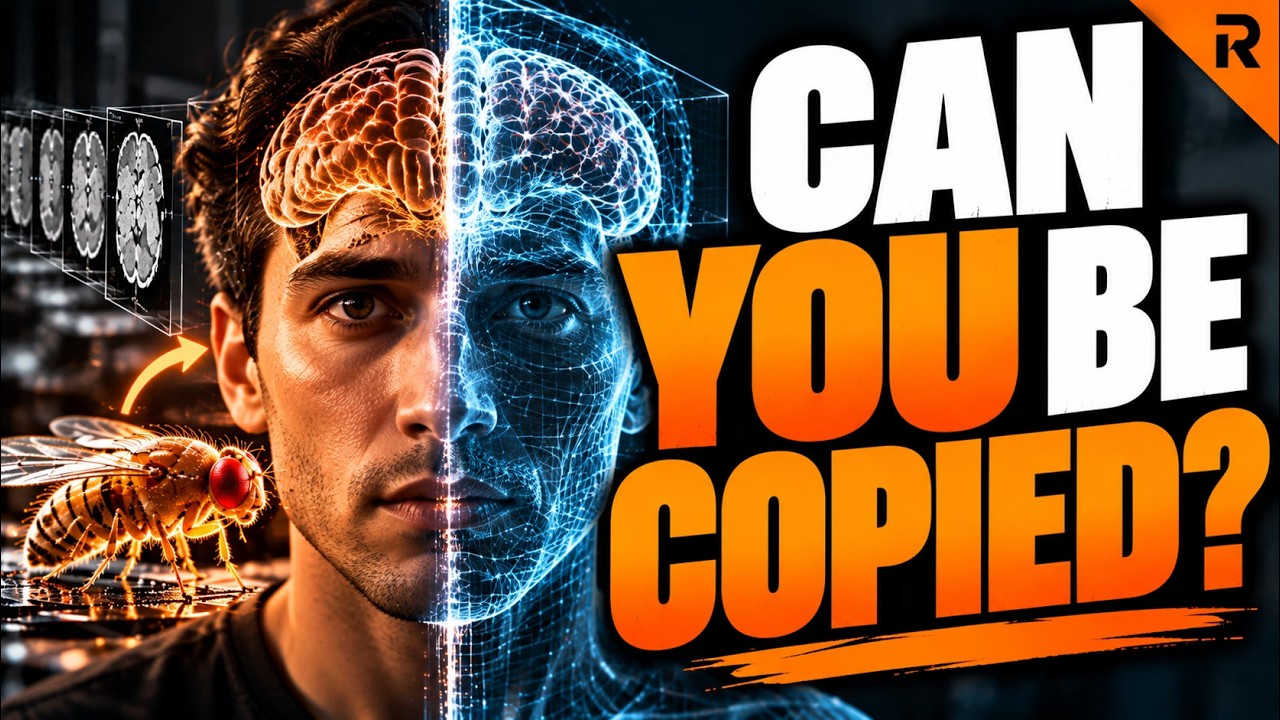
This fly died in a laboratory, and afterwards its brain was cut into seven thousand slices so that a computer could trace every wire inside it. That copy of its wiring was then connected to a body inside a computer, and the body moved. When dust settled on its antennae it cleaned them with its front legs, and when its feet touched sugar it reached out to feed, the way a living fly does.
For every animal that has ever lived, death has been the end, but for this fly it turned out to be the first step in being copied. So if this can be done to a fly, can it be done to you, and how far are we from that becoming real?
Our 26-minute documentary for The Signal answers both questions by following that fly from the laboratory where it died to the furthest point science has reached today, and then asks what it all means for death itself and for the people left behind. The film is at the top of this page; this piece follows it chapter by chapter, with the evidence for each step.
The film in 9 chapters
Pick a chapter and the film starts there. 26:10 in all.
- 010:00This fly died in a laboratory
- 021:00What was copied from the fly
- 034:34What the map left behind
- 046:54How far it is from a fly to a person
- 0510:14One grain of human brain
- 0611:33Keeping a brain until the future arrives
- 0715:32Would the copy be you?
- 0819:56The people left behind
- 0924:03Can it be done to you, and how far away is it?
Has a brain really been uploaded to a computer?
Watch from 0:00This fly died in a laboratory
A fruit fly's has, in one specific sense. In March 2026 a start-up called Eon Systems published a clip under the headline "We've uploaded a fruit fly": a virtual fly body, driven by a model built from the wiring of one real fly's brain, which cleaned its antennae and fed on sugar.
What was copied, and what was left behind, decides whether that headline is true, and the answer starts with where the brain came from.
How was the fruit fly brain copied?
Watch from 1:00What was copied from the fly
The brain was sliced, photographed and traced. In 2018 Zhihao Zheng and Davi Bock at the Janelia Research Campus in Virginia cut the preserved brain of one female fruit fly into about 7,000 slices, each more than a thousand times thinner than a human hair, and photographed every slice through an electron microscope, ending with around 21 million images.
Finding the brain inside those images was a problem nobody could solve by hand. A single neuron winds through thousands of slices, and if you lose track of it in one, the map is wrong from that point on. So Google built an artificial intelligence to do the tracing, and a project called FlyWire, based at Princeton University, brought together hundreds of researchers and volunteers from online gaming communities to correct it one connection at a time. When they published the finished map in Nature in October 2024, it held close to 140,000 neurons and tens of millions of synapses, the points where one neuron passes a signal to the next. It was the largest complete map of a brain anyone had made.
That same month a team at the University of California, Berkeley, led by Philip Shiu, showed what the map could do on its own. They gave every neuron one rule: if the signals pushing it to fire outweighed the signals holding it back, it fired. That was the entire model, small enough to run on a laptop. When they switched on the virtual neurons that sense sugar, the model lit up the neurons that make a real fly reach out its mouthparts to feed, and nine out of every ten of its predictions held when tested on real flies. Nobody had written an instruction telling the fly to eat; the behaviour came out of the wiring.
That model is the brain Eon used, connected to a detailed virtual body. The walking, though, did not come from the copied brain. Eon's own write-up says it came from movement software already built into the virtual body, so the copied brain was only steering. Eon also writes that internal state, plasticity, learning and hormonal changes are largely missing from the model.
What could the fly brain map not copy?
Watch from 4:34What the map left behind
Everything the fly had learned, and the chemistry that shaped how it behaved. Flies can learn: in 1974 three researchers at the California Institute of Technology trained them to avoid a smell paired with an electric shock. Learning is stored in how strong each connection is, and the map records only which neurons connect, not how strongly.
Then there is the chemistry. A living brain is soaked in chemicals that make an animal hungry, alert or calm. The neuroscientist Eve Marder, at Brandeis University, spent decades studying a circuit of about thirty neurons that controls a crab's stomach, and found that its wiring stays exactly the same while the rhythm it produces changes completely depending on which chemicals wash over it.
So what was copied was the wiring of a brain that was already dead, while the strength of every connection, the chemistry and everything the fly had ever learned died with it. What runs inside the computer is not that particular fly, but something closer to the general shape of a fly, running on one real fly's wiring. Even so, it is astonishing that a map plus one simple rule was enough to make a body feed and clean itself. In September 2026 the maps grew again, when Janelia, the University of Cambridge, the MRC Laboratory of Molecular Biology and Google published in Cell the complete nervous system of a male fly, brain and nerve cord, free for anyone to download.
What runs inside the computer is not that particular fly, but something closer to the general shape of a fly.
How far is it from a fly brain to a human brain?
Watch from 6:54How far it is from a fly to a person
A ladder of four rungs, and each is far steeper than the last. The worm C. elegans has 302 neurons and was mapped by hand in 1986. The fly has about 140,000. A mouse brain holds around 70 million neurons, several thousand times bigger than a fly's. You have around 86 billion.
The worm's map was published by John White and Sydney Brenner's team at the Medical Research Council's laboratory in Cambridge, traced from microscope photographs over years, and forty years later scientists are still working out how its behaviour comes out of its map. The wiring is necessary, but it is not the whole answer.
No one has mapped a whole mouse brain yet, but in April 2025 a group of laboratories including the Allen Institute, Baylor College of Medicine and Princeton published MICrONS in Nature, and it goes straight at the gap the fly left open. They recorded tens of thousands of neurons in a living mouse's visual cortex while it watched film clips, then mapped that same cubic millimetre, about the size of a grain of sand: more than 200,000 cells and around half a billion connections. For the first time at that scale, scientists had both the wiring and a record of what those neurons did while the animal was alive.
For a whole mouse, a non-profit called E11 Bio published a roadmap in December 2024. It points to an earlier report for the Wellcome Trust which found that, with existing methods, the human checking alone would cost billions of dollars for one mouse brain. E11 aims to cut the cost of the whole job by at least a hundred times, which would make a complete mouse brain possible in about five years. That is a forecast from the people building the tools, a budget rather than science fiction.
How much of a human brain has been mapped?
Watch from 10:14One grain of human brain
One cubic millimetre. A team from Harvard University and Google published it in Science in May 2024, and storing the images of that one piece took more than a million gigabytes. A whole human brain is more than a million of those grains, which multiplies out to over a zettabyte of images, and that would still be only the wiring.
That piece of brain came from a living woman, aged forty-five, having surgery for epilepsy; the surgeons had to remove a small piece of healthy tissue to reach the problem underneath. That shows where the real wall is. A piece of a living person's brain can be mapped, but a whole brain cannot, because every method that sees at this level of detail works by slicing. The fly died, the mouse in MICrONS died, and to read a whole brain this way you would have to end it.
Can a brain be preserved until the technology exists?
Watch from 11:33Keeping a brain until the future arrives
Its wiring can. In 2016 Robert McIntyre and the cryobiologist Greg Fahy, at 21st Century Medicine, preserved a whole rabbit brain, and in 2018 their method won the second stage of the Brain Preservation Foundation's prize with a pig brain. But the method's first step is an embalming fluid, so nothing can be revived after it, and the only future it leaves open is a copy.
The oldest answer is cryonics, cooling a body or brain after death in the hope that future medicine can repair it, and its problem has always been ice: water in tissue freezes into crystals that tear cells apart. In 2010 the neuroscientist Kenneth Hayworth helped set up the Brain Preservation Foundation, offering a prize to anyone who could preserve a whole mammal brain so well that every connection could still be seen under an electron microscope. The winning method, aldehyde-stabilised cryopreservation, pumps a chemical called glutaraldehyde through the blood vessels and locks every protein in place almost instantly.
McIntyre went on to co-found a start-up called Nectome to offer the procedure to people. In 2018 MIT Technology Review reported that the company planned to use it on terminally ill people at the end of their lives, that McIntyre described it as one hundred percent fatal, and that people had put down deposits totalling more than two hundred thousand dollars. Within weeks MIT, which had worked with the company on a federal grant, ended the relationship. The magazine quoted the Karolinska Institute neuroscientist Sten Linnarsson: "Fundamentally, the company is based on a proposition that is just false." A brain can now be preserved well enough for its wiring to survive, but nobody can yet show that the wiring is the person.
A brain can now be preserved well enough for its wiring to survive, but nobody can yet show that the wiring is the person.
One young woman made that bet anyway. Kim Suozzi, a neuroscience student, was diagnosed in 2011 with glioblastoma, and in 2012 she and her boyfriend asked strangers on Reddit to help pay for her brain to be preserved. When she died in January 2013, aged twenty-three, her brain was preserved by Alcor in Arizona. In 2015 the New York Times reported that a scan seemed to show the protective chemicals had reached only the brain's outer parts; Alcor later said the scan had been read with the wrong calibration and a corrected analysis showed far better protection. Her story is neither a promise nor a fraud, but a young woman who had studied the brain and decided a small chance was better than none.
Would a copy of your brain be you?
Watch from 15:32Would the copy be you?
Perhaps not in any deep sense, according to the Oxford philosopher Derek Parfit. In his 1984 book Reasons and Persons he argued that what matters is not whether the copy is really you, but whether your memories, intentions and character carry on, connected to what came before. He wrote that seeing it this way made him less afraid of his own death.
Parfit asked his readers to imagine a teleporter that records every cell of your body on Earth, destroys the original and builds a new you on Mars. Then he made it harder: the machine builds the copy but fails to destroy the original, so two of you exist, and the one on Earth learns the machine has damaged their heart and they will die within days. Many philosophers disagree with his conclusion, but either way the brain-copying ladder matches his first case, not the second. Every method we have reads a brain by ending it, so any copy would be made from a person who did not walk out of the booth.
The meaning of death has shifted before. When machines could keep a heart beating after the brain had permanently stopped, a Harvard Medical School committee led by the anaesthesiologist Henry Beecher defined death in 1968, in the Journal of the American Medical Association, as the permanent loss of all brain function, and that definition became law across the United States. In 1992 the computer scientist Ralph Merkle, one of the inventors of public-key cryptography, proposed information-theoretic death: you are dead only when the information that makes you who you are has been destroyed beyond recovery even in principle. No law uses it, but it shows where death could move. The question people ask would no longer be whether someone has died, but whether anyone deleted them.
The question people ask would no longer be whether someone has died, but whether anyone deleted them.
What are griefbots, and why do they matter?
Watch from 19:56The people left behind
Griefbots are chatbots built from the messages of the dead, and they arrived first. In 2020 a Canadian man, Joshua Barbeau, used Project December, a $5 chatbot site that the game designer Jason Rohrer had built on OpenAI's GPT-3, to talk through the night with a simulation of his fiancée Jessica Pereira, who had died eight years earlier.
He told his story to the San Francisco Chronicle, and Jason Fagone published it in July 2021 as "The Jessica Simulation". Later that year OpenAI told Rohrer to add monitoring to Project December or shut it down, and when he refused, his access to the model was cut off. A version of a dead woman had been living on a company's servers under that company's terms, and when the terms changed, she went with them.
In May 2024 two researchers at the University of Cambridge's Leverhulme Centre for the Future of Intelligence, Tomasz Hollanek and Katarzyna Nowaczyk-Basińska, published a study of deadbots in the journal Philosophy and Technology. They describe a dead parent's chatbot advertising products in that parent's voice, a child led to believe a dead parent is still there, and a grieving person who keeps receiving messages, which they call being digitally stalked by the dead. They call for a dignified way to switch a deadbot off, including a form of digital funeral, and suggest a question any family could ask today: have you talked with the person about how they would like to be remembered?
A griefbot is built from what a person said; a brain copy would be built from how they were wired. Both would run on somebody's computers, and both could be switched off by whoever pays for them. The film is explicit that what follows is speculation: who keeps a copy of your mother running, who pays and for how long, whether she can be inherited or sold, and whether grief can still happen when someone is never entirely gone. Those are questions for the people who loved them, and they are arriving before the technology that would make them hardest.
Can your brain be uploaded today?
Watch from 24:03Can it be done to you, and how far away is it?
No, not even in part. What exists is the wiring of a fly, the wiring and living activity of one cubic millimetre of mouse brain, and the wiring of one cubic millimetre of one woman's brain. The fly took 6 years from first images to finished map, the whole mouse is about 5 years away by its builders' forecast, and a whole human, with the chemistry included, has no credible date.
There is still no way to capture the strength of every connection or the chemistry across a whole brain, and no way to read one without ending it, while your brain has hundreds of thousands of times as many neurons as the fly's. When MIT Technology Review looked at this in 2018, its summary was that most neuroscientists think recreating a mind is at best decades away, and probably not possible at all.
What has changed is that copying a mind now has a ladder under it and a budget attached, and the worm and the fly are on the lower rungs. The ladder may never reach the top, but people are climbing it. Meanwhile the meaning of death is already shifting, in a preserved brain in Arizona, in a piece of mouse brain watched before it was mapped, and in the chatbots families build from the messages people leave behind.
The ladder may never reach the top, but people are climbing it.
Key findings
The finished FlyWire map of an adult fruit fly brain, published in Nature in October 2024, holds 139,255 neurons and 54.5 million synapses, traced by AI and checked by hand by hundreds of researchers and volunteer gamers.
Dorkenwald et al., Nature, 2 Oct 2024A model that gave every neuron in the fly map one simple firing rule, small enough to run on a laptop, matched 91% of 164 predictions tested against real flies.
Shiu et al., Nature, 2 Oct 2024One cubic millimetre of mouse visual cortex, about the size of a grain of sand, held more than 200,000 cells and around half a billion connections, mapped after the living mouse's neurons were recorded watching film clips.
MICrONS Consortium, Nature, April 2025The most detailed map of a human brain ever made covers one cubic millimetre, from a 45-year-old woman's epilepsy surgery, and its images take about 1.4 petabytes, more than a million gigabytes.
Shapson-Coe et al., Science, May 2024E11 Bio's roadmap aims to cut the cost of mapping a whole mouse brain by at least 100 times, which it says would make a complete mouse connectome possible in about five years.
E11 Bio roadmap, 3 Dec 2024In 2018 MIT Technology Review reported that Nectome described its brain-preservation procedure as 100 percent fatal, and that people had already put down deposits totalling more than $200,000.
MIT Technology Review, 13 Mar 2018Frequently asked questions about brain preservation and mind uploading
Has a brain ever been uploaded to a computer?
Only a fly's, and only its wiring. In March 2026 Eon Systems connected a model built on the 2024 FlyWire map of a fruit fly brain to a virtual body, which cleaned its antennae and reached out to feed on sugar. The walking came from movement software already in the virtual body, and Eon says internal state, plasticity, learning and hormonal changes are largely missing from the model.
What is brain preservation?
Keeping a brain after death well enough that its structure survives, in the hope that future technology can use it. The oldest method is cryonics, cooling a body or brain to very low temperatures. Aldehyde-stabilised cryopreservation, which won the Brain Preservation Foundation's prize in 2016 with a rabbit brain and in 2018 with a pig brain, preserves every connection but is fatal and cannot be reversed.
How far are we from uploading a human mind?
Nobody building these maps has put a credible date on it. The fly took six years from the first images to the finished map, a whole mouse brain is about five years away by its builders' forecast, and only one cubic millimetre of human brain has been mapped in this detail. A human brain has around 86 billion neurons, and every method that sees at this level of detail works by slicing.
What is a connectome?
A complete wiring diagram of a nervous system: every neuron and every connection between them. The first was the worm C. elegans, with 302 neurons, published in 1986. The fruit fly's adult brain followed in 2024 with about 139,000 neurons. A connectome records which neurons connect, not how strong each connection is, which is where learning is stored.
Who was Kim Suozzi?
A neuroscience student diagnosed in 2011 with glioblastoma, an aggressive brain cancer, who with her boyfriend raised money on Reddit to have her brain preserved. When she died in January 2013, aged 23, her brain was preserved by Alcor in Arizona. The New York Times reported in 2015 that a scan suggested poor protection; Alcor later said a corrected analysis showed far better protection.
Would an uploaded copy of my brain be me?
Philosophers disagree. Derek Parfit argued in his 1984 book Reasons and Persons that the question has no deep answer, and that what matters is whether your memories, intentions and character carry on. Every brain-copying method today reads a brain by ending it, so any copy would be made from a person who did not walk out of the booth.
What are griefbots?
Chatbots built from the messages and recordings a dead person leaves behind. A 2024 University of Cambridge study by Tomasz Hollanek and Katarzyna Nowaczyk-Basińska warned of deadbots advertising in a parent's voice and of people being digitally stalked by the dead, and called for a dignified way to switch one off, including a form of digital funeral.
Sources
- Eon Systems, company website and its March 2026 write-up, How the Eon Team Produced a Virtual Embodied Fly, as they read in October 2026eon.systems
- Zheng et al., A Complete Electron Microscopy Volume of the Brain of Adult Drosophila melanogaster, Cell 174(3), 2018cell.com
- Dorkenwald et al. (FlyWire), Neuronal wiring diagram of an adult brain, Nature, 2 Oct 2024nature.com
- Shiu et al., A Drosophila computational brain model reveals sensorimotor processing, Nature, 2 Oct 2024nature.com
- Quinn, Harris and Benzer, Conditioned behavior in Drosophila melanogaster, PNAS, 1974pnas.org
- Male CNS connectome, Janelia Research Campus, Cambridge, MRC LMB and Google, 2026male-cns.janelia.org
- White, Southgate, Thomson and Brenner, The structure of the nervous system of the nematode C. elegans, Phil. Trans. R. Soc. B, 1986royalsocietypublishing.org
- MICrONS Consortium, Functional connectomics spanning multiple areas of mouse visual cortex, Nature, April 2025nature.com
- E11 Bio, E11 Bio Roadmap, 3 Dec 2024e11.bio
- Shapson-Coe et al., A petavoxel fragment of human cerebral cortex reconstructed at nanoscale resolution, Science, May 2024science.org
- Brain Preservation Foundationbrainpreservation.org
- MIT Technology Review (Antonio Regalado), A startup is pitching a mind-uploading service that is 100 percent fatal, 13 Mar 2018technologyreview.com
- The New York Times (Amy Harmon), A Dying Young Woman's Hope in Cryonics and a Future, 12 Sep 2015nytimes.com
- Ralph Merkle, The Technical Feasibility of Cryonics, 1992merkle.com
- Ad Hoc Committee of the Harvard Medical School, A Definition of Irreversible Coma, JAMA, 5 Aug 1968jamanetwork.com
- San Francisco Chronicle (Jason Fagone), The Jessica Simulation, July 2021sfchronicle.com
- University of Cambridge, Call for safeguards to prevent unwanted 'hauntings' by AI chatbots of dead loved ones, 9 May 2024cam.ac.uk
- Hollanek and Nowaczyk-Basińska, Griefbots, Deadbots, Postmortem Avatars, Philosophy and Technology, May 2024link.springer.com
Every figure in the film and in this article comes from the papers, reports and articles listed above. Where the record is disputed, as with the scan of Kim Suozzi's preserved brain, the film gives both readings. The film marks illustrations as illustrations, and the questions about keeping, pausing and inheriting a copy of a mind as speculation: none of that exists yet. Its fly body animation is the film's own render, moved by a script, not by a brain model and not Eon's footage.
Watch next











The AI words behind stories like this one are explained in plain English, with a printable sheet, in our free AI Terms guide.