
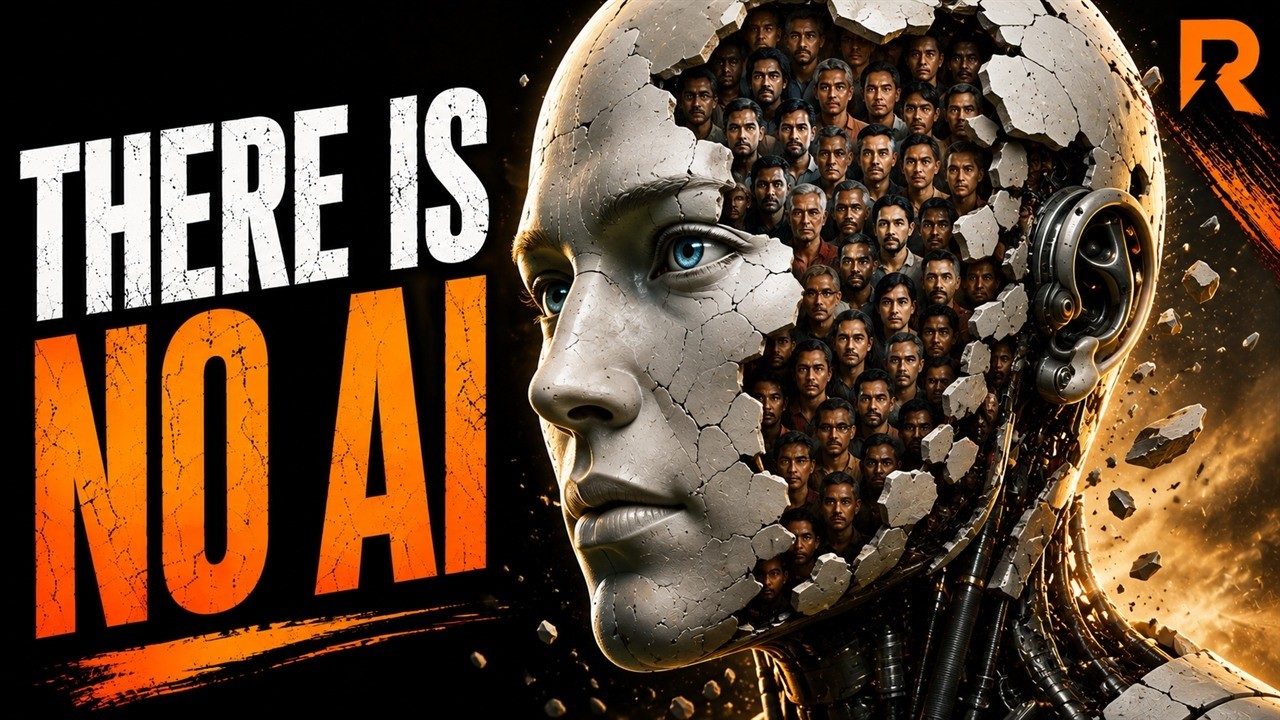
Humanoid robots walking through a crowd at a party on a Hollywood studio lot, waving, posing for photos and serving drinks. A drive-thru where an AI takes your order, whose maker told investors the AI handled ninety-five to ninety-nine percent of orders by itself. An app that could buy you anything from any shop on the internet with one tap, which raised more than forty million dollars. Three companies, three machines, and one thing in common: what was sold as AI was people.
None of this is new. In 1770 a chess-playing machine called the Turk beat the court of Vienna, and for decades nobody could say how. There was a man inside it.
Our 37-minute documentary for The Signal follows that trick from the Turk to the chatbot on your phone: the companies that hid the people, the companies that were open about them, the robotaxis with a person on the line, the workers who label the data, and the one question that tells you where the people are. Every claim comes from a named public source: court filings, regulators, published research and the companies' own statements. The film is at the top of this page; this piece follows it chapter by chapter.
The film in 11 chapters
Pick a chapter and the film starts there. 37:29 in all.
- 010:00The AI that was a person
- 022:26The Turk: a chess machine in Vienna, 1770
- 035:17Amazon Mechanical Turk: "artificial artificial intelligence"
- 046:42Nate, the shopping app, and the Presto drive-thru
- 0510:48Builder.ai: the story most people heard wrong
- 0613:49Amazon Go, Facebook M and the robotaxis
- 0718:30The safety net comes in sizes: Kiwibot and Tesla's robots
- 0822:07Who taught it: the strawberry, the puzzles and reCAPTCHA
- 0925:15The people inside the chatbot
- 1029:36When the hidden workers use AI themselves
- 1134:05Why hide them, and how to see them
Which AI products turned out to be people?
Watch from 0:00The AI that was a person
Three in the film's opening, each from the public record. Tesla's Optimus robots at its October 2024 party were being controlled, VentureBeat reported, by people in another room. The US government found the first version of Presto's own drive-thru system needed a person to type in every single order. And federal prosecutors say the share of purchases the shopping app Nate's AI actually made was "effectively zero percent".
Those people were in the Philippines and India. And the robotaxis with nobody at the wheel call a human when they get stuck: this year a US senator asked Waymo which countries those humans were in, and the answer was two words, "The Philippines."
None of it is new. Amazon built a business on it in 2005, and Jeff Bezos called it artificial artificial intelligence: not a machine pretending to be a person, but people pretending to be a machine. On 30 September 2026 Amazon switched that business off. The people inside it didn't go anywhere.
How did the Mechanical Turk chess machine work?
Watch from 2:26The Turk: a chess machine in Vienna, 1770
A strong chess player sat folded into the lower part of the cabinet, followed the game through magnets under the board, moved the figure's arm with a lever and saw by candlelight. Wolfgang von Kempelen, a civil servant at the Habsburg court, showed it to the Empress Maria Theresa at Schönbrunn Palace in 1770, and it fooled audiences for 84 years.
Before anyone played it, the showman opened it. Door by door and drawer by drawer, the cabinet was swung open so the audience could see wheels, levers and gears, with a lit candle held up so the light shone straight through. Edgar Allan Poe, who watched it in Richmond, Virginia, in 1836, called the opening "a routine from which he never deviates", and wrote that by the end the idea anyone could be hidden inside "is immediately dismissed as preposterous in the extreme". Then the Turk played, and won. It played Benjamin Franklin. It played Napoleon.
The gears were real; they just weren't doing anything. The doors weren't hiding the man. The doors were the trick. In July 1854 a fire in Philadelphia spread to the museum where the Turk was kept and destroyed it, and only once the machine was ash did the family publish how it had worked. You almost never find out while the machine is running. You find out afterwards.
The doors weren't hiding the man. The doors were the trick.
What was Amazon Mechanical Turk?
Watch from 5:17Amazon Mechanical Turk: "artificial artificial intelligence"
A website Amazon opened in 2005 for jobs computers still couldn't do, such as whether a photo shows a cat, answered by people anywhere in the world for a few cents a task, with the answer coming back through the computer as if the computer had worked it out. Amazon named it after Kempelen's machine.
That is the Turk turned inside out. In 1770 a machine pretended to think while a person did the work; in 2005 people did the thinking, and the website's whole job was to make them look like a machine. The company asking never had to know who answered, where they lived or what they were paid. On 25 August 2026 Amazon posted: "Following an assessment, we've made the decision to close AWS Mechanical Turk, effective September 30, 2026." Twenty-one years after it opened, the machine named after a fake machine was switched off.
What did Nate and Presto claim about their AI?
Watch from 6:42Nate, the shopping app, and the Presto drive-thru
Nate told investors its app was "able to transact online without human intervention", and Presto told investors its drive-thru AI's "automated order completion" rate was 95 to 99 percent. Prosecutors say Nate's real automation rate was effectively zero; the SEC found Presto's first system needed a person to enter every single order.
Inside Nate, prosecutors say, an automation rate dashboard measured how true the pitch was, and the founder, Albert Saniger, restricted access to it and told staff to keep the number secret. Every tap on the buy button went to contractors in the Philippines who bought your trainers by hand. In autumn 2021, with Christmas coming, prosecutors say Saniger told his engineers to build bots to help, despite insisting Nate didn't use bots. Saniger was charged in April 2025 with securities fraud and wire fraud. Charged is not convicted, so all of that is what prosecutors allege.
Presto, listed on the Nasdaq, sold restaurant chains a voice that took your order. In January 2025 the Securities and Exchange Commission published what had been happening; Presto settled without admitting or denying it. Your voice was turned into text, the text appeared in front of a worker in the Philippines or India, that worker typed your order into the till, and a newer version tried from summer 2023 still needed a person about 70 percent of the time. The 95 to 99 percent counted orders completed without help from restaurant staff. Presto's orders were completed without human intervention, as long as you only counted the humans in the building. One executive's message, quoted in the SEC order, says that with humans in the loop the system "can even get to 95% or more with humans."
What really happened at Builder.ai?
Watch from 10:48Builder.ai: the story most people heard wrong
The people didn't bring it down; the accounts did. Builder.ai, a London company that said its AI would build you an app, raised $250 million in 2023 and was valued at about $1.5 billion. In 2025 Bloomberg reported its sales had been inflated, a lender seized most of its cash, and by June it had filed for bankruptcy.
Its founder, Sachin Dev Duggal, called himself the company's "chief wizard". In August 2019 the Wall Street Journal reported that current and former employees said the company, then Engineer.ai, was exaggerating its AI and that most of the coding was done by people; the company said its AI had always been described as human-assisted. Former employees later told Rest of World that the bulk of the building was done by developers in countries including India and Ukraine. Its last chief executive insisted: "It wasn't a gimmick. It wasn't smoke and mirrors."
The chief wizard title is funnier than it sounds, because there is a real method with that name. In the Wizard of Oz method, credited to the psychologist John F. Kelley in the early 1980s, a researcher plays a machine that doesn't exist yet, out of sight, to find out whether anyone wants it before spending years building it. A person behind the curtain isn't a con. The difference between a prototype and a fraud is whether anybody was told. The person isn't the scandal. The hiding is.
The person isn't the scandal. The hiding is.
Are there people behind Amazon Go and driverless cars?
Watch from 13:49Amazon Go, Facebook M and the robotaxis
Yes, as a safety net. In April 2024 The Information reported that about 1,000 people in India reviewed Amazon Go purchases and that in 2022 roughly 700 of every 1,000 sales needed checking. Amazon called the reports "erroneous" and said the people were mainly labelling footage to improve the system, though it said they may validate "a small minority of shopping visits".
Both sides agree there were people in India and that some trips were checked; they disagree about how many. In January 2026 Amazon said it was closing its Amazon Go shops. Facebook's assistant M, launched in August 2015, was openly backed by contractors it called M trainers, but inside a conversation you couldn't tell which you were talking to. MIT Technology Review put it in one sentence in 2017: "M is so smart because it cheats." Facebook switched the human side off in January 2018.
Robotaxis are the clearest case. In November 2023 Cruise's chief executive, Kyle Vogt, wrote that "Cruise AVs are being remotely assisted 2-4% of the time on average, in complex urban environments." On 4 February 2026, at a US Senate hearing, Senator Ed Markey said a confused Waymo "phones a human friend for help". Waymo's chief safety officer, Mauricio Peña, said: "They provide guidance. They do not remotely drive the vehicles." Asked whether they were all in the United States, he said "we have some in the US and some abroad", and asked which countries: "The Philippines." A car that can phone a friend may well be safer than one that can't. The problem is the word painted on the side. Driverless turns out to mean there's nobody in the driver's seat. It doesn't mean there's nobody on the line.
Driverless turns out to mean there's nobody in the driver's seat. It doesn't mean there's nobody on the line.
How much of Tesla's robot demo was human?
Watch from 18:30The safety net comes in sizes: Kiwibot and Tesla's robots
Much of what the guests saw. At Tesla's "We, Robot" evening in October 2024, Optimus robots walked among the guests, and within a day VentureBeat reported they had been teleoperated by people in another room. The venture capitalist Josh Wolfe wrote that it was "totally dishonest to demo these as autonomous robots".
The safety net comes in sizes. When the New York Times visited the Berkeley start-up Kiwi in 2019, it found its cartoon-eyed delivery robots had at first been steered entirely by remote control by employees 3,800 miles away in Medellín, Colombia, who by then set each robot's route as a string of points.
The most honest company in the story is 1X, which opened orders in October 2025 for NEO, a home humanoid at $20,000 or $499 a month. Its own website describes Expert Mode: for a chore NEO doesn't know, "you can schedule a 1X Expert to guide it", a person who operates your robot remotely and sees your home through its cameras. The Wall Street Journal's Joanna Stern headlined her review "It's Still Part Human." The chief executive, Bernt Børnich, told her: "If we don't have your data, we can't make the product better." The anthropologist Mary Gray and the computer scientist Siddharth Suri named this ghost work in 2019, and its home automation's last mile. But Børnich wasn't describing a backup. The person is the teacher.
Who labelled the data that taught AI?
Watch from 22:07Who taught it: the strawberry, the puzzles and reCAPTCHA
Crowds of people paid by the task, and you. Between 2007 and 2010, 49,000 people in 167 countries labelled the pictures in Fei-Fei Li's ImageNet, found through Amazon Mechanical Turk, and AlexNet's 2012 win on ImageNet is still treated as the starting gun for today's AI boom. A 2018 study of 2,676 Mechanical Turk workers found median pay of about $2 an hour.
Li, then at Princeton, had planned to pay students, which would have taken years, until a graduate student showed her Mechanical Turk. "I can tell you literally that day I knew the ImageNet project was going to happen," she said later. The 2018 study, led from Carnegie Mellon, covered 3.8 million tasks and counted the unpaid time, and only 4 percent earned more than the $7.25 US federal minimum wage.
You have done the work too. reCAPTCHA, launched in 2007 by a Carnegie Mellon team led by Luis von Ahn, showed you two words: one the site knew, and one from an old scanned book or newspaper a computer couldn't read. Google bought it in 2009, it helped digitise the New York Times archive and Google Books, by 2010 it was showing more than 100 million puzzles a day, and from 2012 the words were joined by Street View photographs. If you've ever clicked every square with a traffic light, for about four seconds you were the artificial artificial intelligence.
Who taught ChatGPT to answer politely?
Watch from 25:15The people inside the chatbot
About forty contractors, hired through Upwork and Scale AI, according to OpenAI's own 2022 paper on reinforcement learning from human feedback. They wrote examples of good answers and picked the better of pairs of the model's answers, and they agreed with each other only about 73 percent of the time.
When OpenAI launched ChatGPT later that year, it said human trainers had "played both sides" of the first example conversations, the user and the AI assistant. Before ChatGPT spoke to the public, people were sitting at keyboards pretending to be it.
Scale AI, founded in San Francisco in 2016, turned this into an industry, running a worker platform called Remotasks through a company set up in the Philippines. In 2023 the Washington Post reported late pay and some tasks paying below one cent. In June 2025 Meta's investment valued Scale at more than $29 billion, in an announcement describing it as "the humanity-first AI company". The two numbers don't prove anyone was cheated; they show where the value went. And in February 2026 two Swedish newspapers, with the Kenyan journalist Naipanoi Lepapa, published interviews with more than thirty workers at Sama in Nairobi, hired to label data for Meta, several of whom said they had been shown footage from Meta's smart glasses that included people in bathrooms. The reporters had not seen the footage. Meta said humans review AI content "for which we get clear user consent", and that it was ending its work with Sama; Sama said its teams were paid living wages.
Do the hidden workers behind AI use AI themselves?
Watch from 29:36When the hidden workers use AI themselves
Some do. In a 2023 test by three EPFL researchers, Veniamin Veselovsky, Manoel Horta Ribeiro and Robert West, an estimated 33 to 46 percent of Mechanical Turk workers paid $1 to summarise a medical abstract used an AI chatbot. It was 44 people and one task, a glimpse rather than a census, and they titled the paper "Artificial Artificial Artificial Intelligence."
Count the layers: in 1770 a machine pretended to think while a person thought; in 2005 people thought while a website made them look like a machine; and in 2023 some of those people were quietly handing the work back to a machine. OpenAI's ChatGPT trainers had been given "model-written suggestions" too.
That matters because it is sold as human data, used to teach the next machine. In July 2024 an Oxford-led team under Ilia Shumailov showed in Nature that models trained on earlier models' text collapse, the rare and surprising things going first, until the "tails of the original content distribution disappear". The paper ends by saying genuine human data "will be increasingly valuable". If the person quietly isn't there any more, the label still says human, and what's inside it isn't. People who worked on Mechanical Turk say that is where its work went: to companies recruiting people to train AI, now including experts with advanced degrees on Scale's Outlier platform. The person in the box always had to be brilliant at the very thing the machine was famous for.
Why do companies hide the humans behind AI?
Watch from 34:05Why hide them, and how to see them
Because of the price tag. A business that is software is valued like software, because one more customer costs almost nothing, while a business that is people needs more of them for every new customer. In March 2024 the SEC fined two investment firms for claiming AI they didn't have, and its chairman, Gary Gensler, called the practice AI washing.
The film gives the mechanism, not a figure, because nobody can measure it across companies. One former Builder.ai product manager put it bluntly to Rest of World: "Builder said it's an AI company, so obviously when you have AI you cannot have so many developers on your company payroll." So the person isn't hidden because they're embarrassing. They're hidden because they're expensive.
So the person isn't hidden because they're embarrassing. They're hidden because they're expensive.
You don't need a regulator to see it, just Poe's trick. He didn't argue with the Turk's doors. He looked at the people around the machine, and noticed that Maelzel travelled with a man called Schlumberger who had "no ostensible occupation" and was "never to be seen during the exhibition of the Chess-Player, although frequently visible just before and just after". Schlumberger was the man in the box. That's how you see it: not by looking inside the machine, but by noticing who disappears whenever the show starts.
In 2017, marking ImageNet's first ten years, Fei-Fei Li thanked her collaborators by name on a slide, and one line had no names at all: "49k Amazon Mechanical Turk Workers". There has never been a machine that seemed to think on its own with nobody inside. There have only been machines whose people you haven't met yet.
There have only been machines whose people you haven't met yet.
Key findings
Federal prosecutors allege that the shopping app Nate, which raised more than $40 million on the claim that its AI bought for you, had an automation rate of 'effectively zero percent', with purchases made by hand by contractors in the Philippines. Its founder was charged in April 2025; the charges are allegations.
US Attorney's Office, Southern District of New York, April 2025Presto Automation told investors its drive-thru AI completed 95 to 99% of orders without human intervention. The SEC found the first version of its own system needed a worker in the Philippines or India to enter every order, and a newer version still needed one about 70% of the time. Presto settled without admitting or denying the findings.
US Securities and Exchange Commission, order against Presto Automation, January 2025Cruise's chief executive said in November 2023 that its driverless cars were remotely assisted 2-4% of the time on average in complex urban environments, and the company told CNBC it had roughly one remote assistant for every 15 to 20 cars.
CNBC, 6 Nov 2023Between 2007 and 2010, 49,000 people in 167 countries labelled the pictures in ImageNet, the dataset on which AlexNet's 2012 win set off the current AI boom.
ImageNet project, as described by Fei-Fei LiLogs of 2,676 Mechanical Turk workers covering 3.8 million tasks showed a median wage of about $2 an hour once unpaid time is counted, and only 4% earned more than the US federal minimum wage of $7.25.
Hara et al., A Data-Driven Analysis of Workers' Earnings on Amazon Mechanical Turk, CHI 2018OpenAI's 2022 paper on teaching a language model to follow instructions says it hired about 40 contractors through Upwork and Scale AI to write and rank answers, and that they agreed with each other about 73% of the time.
Ouyang et al. (OpenAI), Training language models to follow instructions with human feedback, 2022In a 2023 EPFL experiment, an estimated 33 to 46% of Mechanical Turk workers asked to summarise medical abstracts used an AI chatbot to do it. The paper was titled Artificial Artificial Artificial Intelligence.
Veselovsky, Horta Ribeiro and West, EPFL, 2023Frequently asked questions about the hidden humans behind AI
What was the Mechanical Turk?
A chess-playing machine built by Wolfgang von Kempelen and shown to the Empress Maria Theresa in Vienna in 1770: a wooden cabinet with a carved figure that played and beat human opponents, including, the story goes, Benjamin Franklin and Napoleon. A strong chess player sat folded inside the cabinet. It fooled audiences for 84 years until it burned in a fire in Philadelphia in July 1854.
Why is Amazon Mechanical Turk shutting down?
Amazon announced on 25 August 2026 that it would close AWS Mechanical Turk, effective 30 September 2026, saying only that the decision followed an assessment. According to people who worked on it, the work had moved to newer companies, Scale AI among them, that recruit people specifically to train AI. Jeff Bezos once described what the site sold as artificial artificial intelligence.
Which AI products secretly used humans?
In the public record: Nate, a shopping app whose AI purchases prosecutors say were effectively zero percent automated (allegations, not a conviction); Presto's drive-thru AI, which the SEC found needed a human for every order in its first version; and Tesla's Optimus robots at the October 2024 We, Robot event, which VentureBeat reported were teleoperated. Amazon disputes reports about how many Just Walk Out sales were checked by people.
Do driverless cars use remote human operators?
They use remote human helpers. Cruise said its cars were remotely assisted 2-4% of the time in complex city driving. At a US Senate hearing on 4 February 2026, Waymo's chief safety officer said its remote staff provide guidance and do not remotely drive the vehicles, that some are abroad, and, asked which countries, answered: "The Philippines."
What is AI washing?
Claiming artificial intelligence a product or company does not really have. The term was given currency by the SEC chairman Gary Gensler in March 2024, when the SEC fined two investment firms for claiming AI they did not use. The film's explanation for why companies hide the people is valuation: a business that is software is valued like software, and a business that is people is not.
What is ghost work?
A name given in 2019 by the anthropologist Mary Gray and the computer scientist Siddharth Suri to work done by a person that the customer believes is done by a machine. They called the place it lives automation's last mile: the final, hardest stretch of a job that the machine cannot quite do.
How do you tell if there is a human behind an AI?
Use the trick Edgar Allan Poe used on the Turk in 1836. He did not look inside the machine; he looked at the people around it, and noticed a man who was never seen during the show but often just before and after. Ask who disappears whenever the AI starts working, and whether the company says where its people are.
Sources
- US Attorney's Office, Southern District of New York, Tech CEO charged in artificial intelligence investment fraud scheme (Albert Saniger, Nate), April 2025justice.gov
- US Securities and Exchange Commission, order in the matter of Presto Automation Inc., January 2025sec.gov
- US Securities and Exchange Commission, SEC charges two investment advisers with making false and misleading statements about their use of artificial intelligence, March 2024sec.gov
- Edgar Allan Poe, Maelzel's Chess-Player, Southern Literary Messenger, 1836eapoe.org
- CNBC, Amazon service that Jeff Bezos called artificial artificial intelligence is shutting down, 25 Aug 2026cnbc.com
- The Wall Street Journal, AI startup boom raises questions of exaggerated tech savvy (Engineer.ai), Aug 2019wsj.com
- Rest of World, on the downfall of Builder.ai, 2025restofworld.org
- Business Insider, Amazon's Just Walk Out reports and Amazon's response, April 2024businessinsider.com
- Amazon (Dilip Kumar), An update on Amazon's plans for Just Walk Out and checkout-free technology, 2024aboutamazon.com
- MIT Technology Review, Facebook's perfect, impossible chatbot, 14 Apr 2017technologyreview.com
- CNBC, Cruise confirms robotaxis rely on human assistance every four to five miles, 6 Nov 2023cnbc.com
- San Francisco Chronicle, on Waymo's remote workers and the Senate hearing of 4 Feb 2026sfchronicle.com
- The New York Times, Kiwibot delivery robots and their remote pilots in Colombia, 7 Nov 2019nytimes.com
- VentureBeat, Tesla's big We, Robot event criticized for parlor tricks and vague timelines, Oct 2024venturebeat.com
- Josh Wolfe on X, on the We, Robot demonstration, Oct 2024x.com
- 1X, NEO product page, as it read in October 20261x.tech
- The Wall Street Journal (Joanna Stern), I Tried the Robot That's Coming to Live With You. It's Still Part Human, Oct 2025wsj.com
- Hara et al., A Data-Driven Analysis of Workers' Earnings on Amazon Mechanical Turk, CHI 2018arxiv.org
- Ouyang et al. (OpenAI), Training language models to follow instructions with human feedback, 2022arxiv.org
- OpenAI, Introducing ChatGPT, 30 Nov 2022openai.com
- Scale AI, announcement of Meta's investment, June 2025scale.com
- Ars Technica, Workers report watching Ray-Ban Meta-shot footage of people using the bathroom, March 2026arstechnica.com
- Veselovsky, Horta Ribeiro and West, Artificial Artificial Artificial Intelligence: Crowd Workers Widely Use Large Language Models for Text Production Tasks, 2023arxiv.org
- Shumailov et al., AI models collapse when trained on recursively generated data, Nature, July 2024nature.com
- ImageNetimage-net.org
Every claim in the film and in this article comes from a named public source: court filings, regulators, published research, reporting and the companies' own statements. The case against Albert Saniger is a criminal charge, not a conviction, and Presto settled with the SEC without admitting or denying its findings. Where a company disputes reporting, as Amazon does over Just Walk Out and Meta over its contractors, its answer is given beside the report.
Watch next
















The AI words behind stories like this one are explained in plain English, with a printable sheet, in our free AI Terms guide.